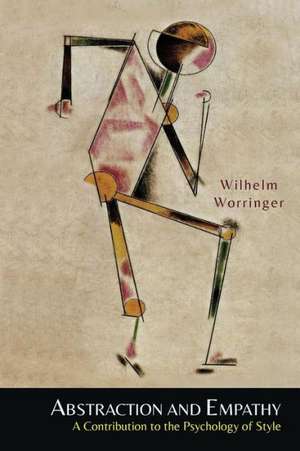
Abstraction and Empathy
Autor Wilhelm Worringeren Limba Engleză Paperback – 26 feb 2014
Preț: 86.94 lei
Puncte Express: 130
Carte indisponibilă temporar
Livrare prin curier în România Termenul estimat este afișat lângă disponibilitate.
Transport gratuit de la 400.00 lei Plată online sau ramburs, în funcție de opțiunile comenzii.
Retur gratuit în 14 zile Comandă securizată și suport în română.
Specificații
ISBN-13: 9781614275879
ISBN-10: 1614275874
Pagini: 162
Dimensiuni: 152 x 229 x 10 mm
Greutate: 0.25 kg
Editura: Martino Fine Books
ISBN-10: 1614275874
Pagini: 162
Dimensiuni: 152 x 229 x 10 mm
Greutate: 0.25 kg
Editura: Martino Fine Books
V-ar putea interesa
-
 When China Rules the WorldMartin Jacques-18%Preț: 112.90 lei137.35 lei
 -
 After TamerlaneJohn Darwin-27%Preț: 89.37 lei122.97 lei
 -
 The Enemy WithinJohn DemosPreț: 150.03 lei
 -
 War in Human CivilizationAzar Gat-10%Preț: 321.80 lei356.89 lei
 -
 A Little History of the WorldE. H. GombrichPreț: 91.10 lei
 -
 Preț: 61.23 lei
 -
 Preț: 269.70 lei
 -
 A Splendid ExchangeWilliam J BernsteinPreț: 128.98 lei
 -
 World History: 50 Events You Really Need to KnowIan Crofton-23%Preț: 73.50 lei95.54 lei
 -
 Asia-Pacific: A History of Empire and ConflictDr Thomas Crump-41%Preț: 182.74 lei311.83 lei
Descriere
Descriere de la o altă ediție sau format:
Wilhelm Worringer's landmark study in the interpretation of modern art, first published in 1908, has seldom been out of print. Its profound impact not only on art historians and theorists but also for generations of creative writers and intellectuals is almost unprecedented. Starting from the notion that beauty derives from our sense of being able to identify with an object, Worringer argues that representational art produces satisfaction from our "objectified delight in the self," reflecting a confidence in the world as it is-as in Renaissance art. By contrast, the urge to abstraction, as exemplified by Egyptian, Byzantine, primitive, or modern expressionist art, articulates a totally different response to the world: it expresses man's insecurity. Thus in historical periods of anxiety and uncertainty, man seeks to abstract objects from their unpredictable state and transform them into absolute, transcendental forms. Abstraction and Empathy also has a sociological dimension, in that the urge to create fixed, abstract, and geometric forms is a response to the modern experience of industrialization and the sense that individual identity is threatened by a hostile mass society. Hilton Kramer's introduction considers the influence of Worringer's thesis and places his book in historical context.
Wilhelm Worringer's landmark study in the interpretation of modern art, first published in 1908, has seldom been out of print. Its profound impact not only on art historians and theorists but also for generations of creative writers and intellectuals is almost unprecedented. Starting from the notion that beauty derives from our sense of being able to identify with an object, Worringer argues that representational art produces satisfaction from our "objectified delight in the self," reflecting a confidence in the world as it is-as in Renaissance art. By contrast, the urge to abstraction, as exemplified by Egyptian, Byzantine, primitive, or modern expressionist art, articulates a totally different response to the world: it expresses man's insecurity. Thus in historical periods of anxiety and uncertainty, man seeks to abstract objects from their unpredictable state and transform them into absolute, transcendental forms. Abstraction and Empathy also has a sociological dimension, in that the urge to create fixed, abstract, and geometric forms is a response to the modern experience of industrialization and the sense that individual identity is threatened by a hostile mass society. Hilton Kramer's introduction considers the influence of Worringer's thesis and places his book in historical context.
Recenzii
Worringer's little book is an enduring classic.