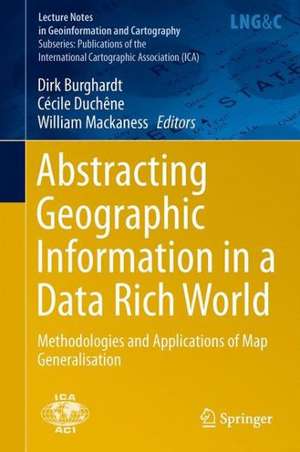
Abstracting Geographic Information in a Data Rich World: Lecture Notes in Geoinformation and Cartography
Editat de Dirk Burghardt, Cécile Duchêne, William Mackanessen Limba Engleză Hardback – 12 mar 2014
Din seria Lecture Notes in Geoinformation and Cartography
- 18%
 Preț: 927.11 lei
 - 18%
 Preț: 1642.58 lei
 - 20%
 Preț: 635.03 lei
 - 18%
 Preț: 995.02 lei
 - 18%
 Preț: 1278.48 lei
 - 18%
 Preț: 1279.56 lei
 - 18%
 Preț: 979.85 lei
 - 18%
 Preț: 987.20 lei
 - 18%
 Preț: 1281.73 lei
 - 18%
 Preț: 984.66 lei
 - 18%
 Preț: 1280.26 lei
 - 18%
 Preț: 988.19 lei
 - 18%
 Preț: 1908.23 lei
 - 18%
 Preț: 982.91 lei
 - 18%
 Preț: 978.23 lei
 - 18%
 Preț: 1232.41 lei
 - 18%
 Preț: 1285.90 lei
 - 18%
 Preț: 1230.57 lei
 - 18%
 Preț: 993.74 lei
 - 15%
 Preț: 663.72 lei
 - 18%
 Preț: 979.66 lei
 - 18%
 Preț: 993.84 lei
 - 5%
 Preț: 1142.98 lei
 - 18%
 Preț: 1269.85 lei
 - 18%
 Preț: 1457.76 lei
 - 18%
 Preț: 957.33 lei
 - 18%
 Preț: 984.17 lei
 - 18%
 Preț: 989.29 lei
 - 18%
 Preț: 983.79 lei
 - 18%
 Preț: 987.83 lei
 - 15%
 Preț: 669.16 lei
 - 18%
 Preț: 913.62 lei
 - 18%
 Preț: 983.90 lei
 - 18%
 Preț: 980.13 lei
 - 18%
 Preț: 988.90 lei
 - 18%
 Preț: 952.24 lei
 - 18%
 Preț: 1276.16 lei
 - 18%
 Preț: 1285.68 lei
 - 18%
 Preț: 1266.91 lei
 - 18%
 Preț: 1279.32 lei
 - 38%
 Preț: 1143.52 lei
 - 18%
 Preț: 1719.95 lei
 - 18%
 Preț: 1286.47 lei
 - 18%
 Preț: 986.75 lei
Preț: 991.61 lei
Preț vechi: 1209.28 lei
-18%
Puncte Express: 1487
Carte tipărită la comandă
Livrare economică 09-23 decembrie
Livrare prin curier în România Termenul estimat este afișat lângă disponibilitate.
Transport gratuit pentru acest produs Plată online sau ramburs, în funcție de opțiunile comenzii.
Retur gratuit în 14 zile Comandă securizată și suport în română.
Specificații
ISBN-13: 9783319002026
ISBN-10: 3319002023
Pagini: 424
Ilustrații: XV, 407 p. 180 illus., 128 illus. in color.
Dimensiuni: 160 x 241 x 29 mm
Greutate: 0.75 kg
Ediția:2014
Editura: Springer
Colecția Lecture Notes in Geoinformation and Cartography
Seria Lecture Notes in Geoinformation and Cartography
Locul publicării:Cham, Switzerland
ISBN-10: 3319002023
Pagini: 424
Ilustrații: XV, 407 p. 180 illus., 128 illus. in color.
Dimensiuni: 160 x 241 x 29 mm
Greutate: 0.75 kg
Ediția:2014
Editura: Springer
Colecția Lecture Notes in Geoinformation and Cartography
Seria Lecture Notes in Geoinformation and Cartography
Locul publicării:Cham, Switzerland
V-ar putea interesa
-
 Introduction to Microwave Remote SensingIain H. Woodhouse-18%Preț: 964.95 lei1176.77 lei
 -
 Environment Conscious ManufacturingSurendra M. Gupta-18%Preț: 1702.00 lei2075.60 lei
 -
 -18%Preț: 1703.52 lei2077.46 lei
 -
 -18%Preț: 875.62 lei1067.83 lei
 -
 Remote Sensing Tools for ExplorationPamela Elizabeth Clark-18%Preț: 921.50 lei1123.79 lei
 -
 Collaborative Geographic Information SystemsShivanand Balram-15%Preț: 574.50 lei675.89 lei
 -
 Mathematical Foundation of GeodesyKai Borre-24%Preț: 1235.12 lei1625.16 lei
 -
 A Hierarchical Coordinate System for Geoprocessing and CartographyGeoffrey H. DuttonPreț: 370.84 lei
 -
 Cartography from Pole to PoleManfred Buchroithner-18%Preț: 996.49 lei1215.24 lei
 -
 Terrigenous Mass MovementsBiswajeet Pradhan-15%Preț: 649.57 lei764.20 lei
 -
 Maps for the FutureLászló Zentai-18%Preț: 982.45 lei1198.11 lei
 -
 -18%Preț: 911.54 lei1111.63 lei
 -
 Online Maps with APIs and WebServicesMichael P Peterson-18%Preț: 950.22 lei1158.80 lei
 -
 Remote Sensing of the Environment and Radiation TransferAnatoly KuznetsovPreț: 370.55 lei
 -
 Computer-Animation in der KartographieDoris DranschPreț: 315.94 lei
 -
 -15%Preț: 475.86 lei559.83 lei
 -
 Progress in Geospatial AnalysisYuji Murayama-15%Preț: 619.69 lei729.05 lei
Public țintă
ResearchCuprins
Changing contexts and new challenges.- Modelling user requirements.- Modelling geographic relationships in automated environments.- Data structures and continuous generalisation.- Integrating Multi source data and user generated content.- Generalisation operators.- Process modelling, web services and geoprocessing.- Object and field generalisation.- Evaluation and usability of map generalisation outputs.- Generalisation in the context of schematic maps / maps on mobile devices.- Generalisation in practice.
Recenzii
“This book provides a really critical contribution to summarizing, conceptualizing, and discussing the main problems and solutions in map generalization to date. … I recommend this book to everyone who works with map generalization and wants to be productive in solving his or her tasks, as well as those who are interested in understanding short- and mid-term perspectives in map generalization developments.” (Timofey Samsonov, Cartographic Perspectives, Issues 80, 2015)
Textul de pe ultima copertă
Research in the field of automated generalisation has faced new challenges in recent years as a result of technological developments in web-based processing, new visualisation paradigms and access to very large volumes of multi-source data generated by sensors and humans. In these contexts, map generalisation needs to underpin ‘on-demand mapping’, a form of mapping that responds to individual user requirements in the thematic selection and visualisation of geographic information. It is this new impetus that drives the research of the ICA Commission on Generalisation and Multiple Representation (for example through its annual workshops, biannual tutorials and publications in international journals). This book has a coherent structure, each chapter focusing on core concepts and tasks in the map generalisation towards on-demand mapping. Each chapter presents a state-of-the-art review, together with case studies that illustrate the application of pertinent generalisation methodologies. Thebook addresses issues from data gathering to multi scaled outputs. Thus there are chapters devoted to defining user requirements in handling specifications, and in the application and evaluation of map generalisation algorithms. It explores the application of generalisation methodologies in the context of growing volumes of data and the increasing popularity of user generated content.
Caracteristici
Delivers an extensive compendium of current research and development work in the field of automated generalisation Employs a sequence of core chapters to match the different phases of the teneralisation process Offers a chapter on the practical usage of automated generalisation with commercial production systems and open-source systems Includes supplementary material: sn.pub/extras