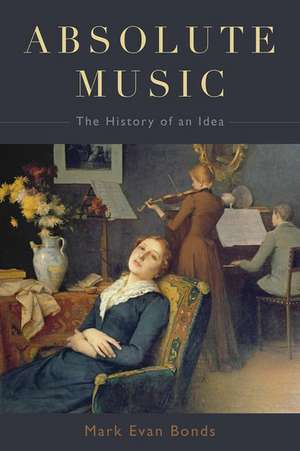
Absolute Music: The History of an Idea
Autor Mark Evan Bondsen Limba Engleză Hardback – 26 iun 2014
Preț: 372.79 lei
Preț vechi: 457.70 lei
-19%
Puncte Express: 559
Carte tipărită la comandă
Livrare economică 27 noiembrie-02 decembrie
Livrare prin curier în România Termenul estimat este afișat lângă disponibilitate.
Transport gratuit de la 400.00 lei Plată online sau ramburs, în funcție de opțiunile comenzii.
Retur gratuit în 14 zile Comandă securizată și suport în română.
Specificații
ISBN-13: 9780199343638
ISBN-10: 0199343632
Pagini: 400
Ilustrații: 3 BW line, 9 BW halftones
Dimensiuni: 165 x 236 x 36 mm
Greutate: 0.66 kg
Editura: Oxford University Press
Colecția OUP USA
Locul publicării:New York, United States
ISBN-10: 0199343632
Pagini: 400
Ilustrații: 3 BW line, 9 BW halftones
Dimensiuni: 165 x 236 x 36 mm
Greutate: 0.66 kg
Editura: Oxford University Press
Colecția OUP USA
Locul publicării:New York, United States
V-ar putea interesa
-
 Robert Schumann: Herald of a 'New Poetic Age'John Daverio-27%Preț: 404.32 lei554.51 lei
 -
 Conducting BrahmsNorman Del Mar-31%Preț: 630.09 lei916.94 lei
 -
 Conducting BerliozNorman Del Mar-19%Preț: 470.74 lei581.16 lei
 -
 Tchaikovsky's Last Days: A Documentary StudyAlexander Poznansky-30%Preț: 540.29 lei776.00 lei
 -
 -29%Preț: 534.15 lei750.09 lei
 -
 Redefining Hungarian Music from Liszt to BartókLynn M. Hooker-31%Preț: 534.71 lei772.16 lei
 -
 Why Mahler?Norman LebrechtPreț: 94.17 lei
 -
 Rimsky-Korsakov: Letters to His Family and FriendsNikolay Rimsky-Korsakov-20%Preț: 267.79 lei334.04 lei
 -
 New Illustrated Lives of Great Composers: MahlerEdward Seckerson-23%Preț: 77.21 lei100.44 lei
 -
 Illustrated Lives of the Great Composers: Franz LisztBryce MorrisonPreț: 77.11 lei
 -
 Introducing WagnerKevin ScottPreț: 63.40 lei
 -
 The Schubert Song CompanionJohn Reed-25%Preț: 268.96 lei358.62 lei
 -
 The Wagner ExperiencePaul Dawson-BowlingPreț: 289.61 lei
Recenzii
Bonds rises brilliantly to his own challenge, writing an epic narrative with a masterly command of 2,500 years of music history from the mysteries of Pythagoras to the mysteries of the CIA ... Bonds's concept is immaculately conceived, wonderfully lucid, beautifully organized, and elegantly written.
This is an immensely informed, thoroughly documented, and detailed book, offering much to chew on during a delicious and intellectually nourishing journey through millennia of theoretical discussions about the nature of music. Readers with an interest in these matters should find Bonds' account profoundly satisfying, and his book should also provide the basis for graduate seminars on musical aesthetics. Highly recommended.
Bond seeks authority and originality by way of conceptual comprehensiveness and documentary depth ... [the reader will] dervice considerable enlightenment from his trenchant and pertinent perspectives.
This is an immensely informed, thoroughly documented, and detailed book, offering much to chew on during a delicious and intellectually nourishing journey through millennia of theoretical discussions about the nature of music. Readers with an interest in these matters should find Bonds' account profoundly satisfying, and his book should also provide the basis for graduate seminars on musical aesthetics. Highly recommended.
Bond seeks authority and originality by way of conceptual comprehensiveness and documentary depth ... [the reader will] dervice considerable enlightenment from his trenchant and pertinent perspectives.
Notă biografică
Mark Evan Bonds is the Cary C. Boshamer Distinguished Professor of Music at the University of North Carolina at Chapel Hill, where he has taught since 1992. He has served as editor-in-chief of Beethoven Forum and has published widely on music, aesthetics, and the philosophy of music.
Cuprins
- Introduction 7
- Part One
- Essence as Effect: To 1550 23
- 1. Orpheus and Pythagoras 23
- 2. Isomorphic Resonance 30
- Part Two
- Essence and Effect: 1550-1850 39
- 3. Expression 41
- The Separation of Powers 41
- Music and Language 48
- Music as Language 58
- Mimesis 69
- 4. Beauty 79
- 5. Form 90
- Form as Number 91
- Form as Content 98
- 6. Autonomy 103
- Material Autonomy 103
- Ethical Autonomy 108
- 7. Disclosure 112
- The Composer as Oracle 112
- Beautiful Insights 117
- Cosmic Insights 121
- Part Three
- Essence or Effect: 1850-1945 127
- 8. Wagner's "Absolute" Music 129
- 9. Hanslick's "Pure" Music 140
- Hanslick the Conventional 156
- Hanslick the Radical 171
- Hanslick the Ambivalent 181
- 10. Liszt's "Program" Music 205
- 11. Polemics 214
- 12. Reconciliation 231
- 13. Qualities Recast 244
- Expression 246
- Beauty 263
- Form 264
- Autonomy 278
- Disclosure 284
- Epilogue: Since 1945 292
- Appendix: Hanslick's Vom Musikalischen-Schönen:
- Early and Selected Later Reviews and Commentary 294
- Works Cited ] 304