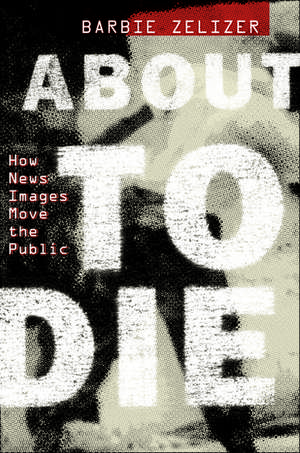
About to Die: How News Images Move the Public
Autor Barbie Zelizeren Limba Engleză Paperback – 23 dec 2010
Preț: 307.59 lei
Preț vechi: 349.48 lei
-12%
Puncte Express: 461
Carte tipărită la comandă
Livrare economică 04-09 decembrie
Livrare prin curier în România Termenul estimat este afișat lângă disponibilitate.
Transport gratuit de la 400.00 lei Plată online sau ramburs, în funcție de opțiunile comenzii.
Retur gratuit în 14 zile Comandă securizată și suport în română.
Specificații
ISBN-13: 9780199752140
ISBN-10: 0199752141
Pagini: 432
Ilustrații: 55 illus.
Dimensiuni: 231 x 152 x 31 mm
Greutate: 0.62 kg
Editura: Oxford University Press
Colecția OUP USA
Locul publicării:New York, United States
ISBN-10: 0199752141
Pagini: 432
Ilustrații: 55 illus.
Dimensiuni: 231 x 152 x 31 mm
Greutate: 0.62 kg
Editura: Oxford University Press
Colecția OUP USA
Locul publicării:New York, United States
V-ar putea interesa
-
 Preț: 230.04 lei
 -
 Keywords in News and Journalism StudiesBarbie Zelizer-29%Preț: 152.30 lei214.93 lei
 -
 Reporting War: Journalism in WartimeStuart AllanPreț: 408.61 lei
 -
 The Politics of Reality Television: Global PerspectivesMarwan M. Kraidy-18%Preț: 1117.60 lei1362.94 lei
 -
 Explorations in Communication and HistoryBarbie ZelizerPreț: 393.81 lei
 -
 -18%Preț: 1114.82 lei1359.54 lei
 -
 Making the University MatterBarbie Zelizer-18%Preț: 1119.70 lei1365.49 lei
 -
 -27%Preț: 355.11 lei485.15 lei
 -
 -19%Preț: 670.18 lei827.38 lei
 -
 Reality TVMisha Kavka-17%Preț: 175.07 lei210.48 lei
 -
 American Idolatry: Celebrity, Commodity and Reality TelevisionChristopher E. BellPreț: 225.29 lei
 -
 Taking Journalism SeriouslyBarbie Zelizer-18%Preț: 798.00 lei973.17 lei
 -
 Thinking Outside the BoxGary R EdgertonPreț: 235.55 lei
 -
 Preț: 456.91 lei
 -
 -15%Preț: 421.37 lei495.73 lei
 -
 The Televiewing AudienceRobert AbelmanPreț: 306.35 lei
 -
 Time on TVPaul Booth-9%Preț: 900.50 lei989.55 lei
 -
 Preț: 395.67 lei
 -
 -23%Preț: 540.71 lei702.22 lei
 -
 -15%Preț: 579.11 lei681.31 lei
Recenzii
Zelizer bolsters her arguments with extensive primary research, including readers' reactions from letters to the editor and blog postings regarding daring and shocking images. Her seventy-nine pages of notes are a treasure trove to readers and researchers because they are so detailed and thorough.
Why are some deaths fit spectacles for the camera and others off-limits? What philosophical and social purposes do news images serve? Barbie Zelizer answers such questions in this ambitious new book, a stunning examination of a little-explored aspect of modern journalism.
In Barbie Zelizer's most powerful, profound, and disturbing work, she shows that news photos do not document reality but are suspended precariously between the 'as is' and the 'as if,' touching feelings, touching off imaginations. With an astonishing cascade of evidence about iconic news images and the stories behind them, Zelizer offers little comfort, no certainty, but much illumination.
[About to Die] is an audacious and often chilling examination of how visual media handle the moment of death, from engravings of the Great Chicago Fire of 1871 to the Pacific tsunami of 2004. With an obvious and admitted debt to the academy's favorite photography buff Susan Sontag, Zelizer treats these images as both rare and powerful.
[An] enlightening new book"
[Zelizer] produced an engaging history, with accounts of the best-known about-to-die images and their post-publication trajectories."
If, like me, you think that Big Money exerts ever more influence on the way politics gets covered in this country; and if, like me, you think that Citizens United, the recent Supreme Court decision that lifts the lid on corporate campaign spending, will speed up, reinforce and otherwise extend this unfortunate trend; and if, like me, you believe that for the past fifty years the main way corporate money has worked its electoral will is by manipulating news images via television commercials (watch Mad Men if you don't believe me), then you will want to read Barbie Zelizer's new book, About to Die . . . a refutation of this 'words matter and images don't' perspective . . . [a] densely packed, closely reasoned book."
An extraordinary contribution to the literature...Aside from value of the theoretical construct within which Zelizer contextualizes specific images (and types of images), there is value in her fair, reasoned, and engaging investigation of the authenticity and authority of certain of the most controversial photographs of the past century.
Why are some deaths fit spectacles for the camera and others off-limits? What philosophical and social purposes do news images serve? Barbie Zelizer answers such questions in this ambitious new book, a stunning examination of a little-explored aspect of modern journalism.
In Barbie Zelizer's most powerful, profound, and disturbing work, she shows that news photos do not document reality but are suspended precariously between the 'as is' and the 'as if,' touching feelings, touching off imaginations. With an astonishing cascade of evidence about iconic news images and the stories behind them, Zelizer offers little comfort, no certainty, but much illumination.
[About to Die] is an audacious and often chilling examination of how visual media handle the moment of death, from engravings of the Great Chicago Fire of 1871 to the Pacific tsunami of 2004. With an obvious and admitted debt to the academy's favorite photography buff Susan Sontag, Zelizer treats these images as both rare and powerful.
[An] enlightening new book"
[Zelizer] produced an engaging history, with accounts of the best-known about-to-die images and their post-publication trajectories."
If, like me, you think that Big Money exerts ever more influence on the way politics gets covered in this country; and if, like me, you think that Citizens United, the recent Supreme Court decision that lifts the lid on corporate campaign spending, will speed up, reinforce and otherwise extend this unfortunate trend; and if, like me, you believe that for the past fifty years the main way corporate money has worked its electoral will is by manipulating news images via television commercials (watch Mad Men if you don't believe me), then you will want to read Barbie Zelizer's new book, About to Die . . . a refutation of this 'words matter and images don't' perspective . . . [a] densely packed, closely reasoned book."
An extraordinary contribution to the literature...Aside from value of the theoretical construct within which Zelizer contextualizes specific images (and types of images), there is value in her fair, reasoned, and engaging investigation of the authenticity and authority of certain of the most controversial photographs of the past century.
Notă biografică
Barbie Zelizer is the Raymond Williams Chair of Communication and the Director of the Scholars Program in Culture and Communication at the Annenberg School for Communication at the University of Pennsylvania.