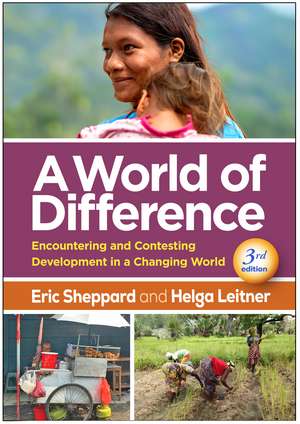
A World of Difference, Third Edition: Encountering and Contesting Development in a Changing World
Autor Eric Sheppard, Helga Leitneren Limba Engleză Paperback – 5 apr 2027
New to This Edition
- Restructured to clarify how colonialism and slavery have shaped the postcolonial South’s development challenges.
- New and expanded topics: transnational migration, global population dynamics, global agriculture, mineral extraction, financialization, southern megacities, global heating, rising ethnonationalism, logistics, new development agents, the China model, and more.
- New chapter on alternative Southern development imaginaries and practices.
- Numerous new and updated sidebars, maps, and graphics, including 14 full-color plates depicting the book's major themes.
Preț: 518.09 lei
Preț vechi: 649.51 lei
-20% Precomandă
Puncte Express: 777
Carte nepublicată încă
Livrare prin curier în România Precomanda se expediază când titlul devine disponibil.
Transport gratuit pentru acest produs Plată online sau ramburs, în funcție de opțiunile comenzii.
Retur gratuit în 14 zile Comandă securizată și suport în română.
Doresc să fiu notificat când acest titlu va fi disponibil:
Se trimite...
Specificații
ISBN-13: 9781462565443
ISBN-10: 1462565441
Pagini: 480
Dimensiuni: 178 x 254 mm
Ediția:3
Editura: Guilford Publications
Colecția Guilford Press
ISBN-10: 1462565441
Pagini: 480
Dimensiuni: 178 x 254 mm
Ediția:3
Editura: Guilford Publications
Colecția Guilford Press
Notă biografică
Eric Sheppard, PhD, is Distinguished Research Professor of Geography Emeritus at the University of California, Los Angeles (UCLA), and a member of its Institute of the Environment and Sustainability and Institute on Inequality and Democracy. He previously held the Alexander von Humboldt Chair at UCLA and a Regents Professorship at the University of Minnesota. Dr. Sheppard has traveled and conducted research throughout the global South, with a particular focus recently on southeast Asia. He has published numerous books and articles on topics that range across geographical political economy, urban politics and dynamics, geographical thought and methods, critical geospatial technologies, social movements, and socio-spatial theory. Dr. Sheppard is the recipient of awards including Distinguished Scholarship Honors from the American Association of Geographers, the Distinguished Teaching Award from UCLA, Honorary Doctor of Laws from Bristol University, and a fellowship from the Center for Advanced Study in the Behavioral Sciences at Stanford University.
Helga Leitner, PhD, is Research Professor of Geography Emeritus at the University of California, Los Angeles, and a member of its Institute of the Environment and Sustainability and Institute on Inequality and Democracy. She was previously Professor of Geography and Global Studies at the University of Minnesota, and is a corresponding member of the Austrian Academy of Sciences. One of the highlights of her career has been sojourns spent living, working, and traveling in many parts of the world. Dr. Leitner has published numerous books, articles, and book chapters on the politics of immigration and citizenship, immigrant incorporation, globalization, urban transformations and sustainability, grassroots movements, and socio-spatial theory. Dr. Leitner's research and teaching have been recognized with awards including Distinguished Scholarship Honors from the American Association of Geographers, the Award for Outstanding Contributions to Graduate and Professional Education from the University of Minnesota, and the Austrian Decoration for Science and Art.
Helga Leitner, PhD, is Research Professor of Geography Emeritus at the University of California, Los Angeles, and a member of its Institute of the Environment and Sustainability and Institute on Inequality and Democracy. She was previously Professor of Geography and Global Studies at the University of Minnesota, and is a corresponding member of the Austrian Academy of Sciences. One of the highlights of her career has been sojourns spent living, working, and traveling in many parts of the world. Dr. Leitner has published numerous books, articles, and book chapters on the politics of immigration and citizenship, immigrant incorporation, globalization, urban transformations and sustainability, grassroots movements, and socio-spatial theory. Dr. Leitner's research and teaching have been recognized with awards including Distinguished Scholarship Honors from the American Association of Geographers, the Award for Outstanding Contributions to Graduate and Professional Education from the University of Minnesota, and the Austrian Decoration for Science and Art.
Recenzii
“A World of Difference is unusual for several reasons. It covers a huge array of problems and disciplinary fields, from political economy to physical science and social theory. The analysis is genuinely multiscalar, with abundant global analysis complemented by rich regional studies. While this text provides a solid foundation to teach the economic geography of development, its scope also includes geopolitics of development, political economy of development policies, environment and development, and the critique of development--no mean feat! I know of no other textbook in economic geography or development studies that is as capacious, with such beautifully written prose.â€--Joel Wainwright, PhD, Department of Geography, The Ohio State University
“When I recommend this book to colleagues, I explain that it has allowed me to work with students in a North American setting to begin to critically explore international development and inequality. The text invites students to explore their own subjective relationship to international development and to think critically about their assumptions regarding people and places around the world and their relationship to them. This is truly a valuable and accessible resource for courses on geography and development.â€--Jonathan Otto, PhD, School of Journalism, Writing, and Media, University of British Columbia, Canada
- A valuable work that historically traces how the unequal development of the world has been produced and accelerated by Western powers since the colonial era.…A World of Difference allows us a means to teach critical insights about neoliberal globalization and developmentalism to our students, some of whom may dream of going to work for international organizations. (on the second edition)--Human Geography, 01/01/2011ƒƒ This accessible and valuable book will inspire students to get firsthand experiences on development and the consequences of globalization in cities and villages of Asia, Africa, and Latin America and critically reflect on the consequences of development and globalization. (on the second edition)--European Planning Studies, 08/01/2010ƒƒ This massive volume is a cultural geography textbook to be used in college-level courses dealing with world economic development. It covers an enormous range of topics using geographical and historical analyses....This is an excellent book that does not shy away from controversial issues or from taking a moral stand in the face of overwhelming suffering among so much of the world's population....It is a first-rate introduction for students and anyone else seeking a better understanding of the most important challenges facing the world today. (on the second edition)--Diaspora, Indigenous, and Minority Education, 01/01/2010ƒƒ A 600-plus-page epic tour-de-force of geographical and historical analysis of development discourse and data….Takes the reader on a historical world tour of development ideas and concepts and keeps her questioning fundamental disciplinary assumptions right across the social sciences throughout. (on the second edition)--The Canadian Geographer, 10/01/2011
Cuprins
1. Introduction
I. Ways of Knowing Development
2. Conceptualizing and Representing the “Majority Worldâ€
3. The Colonized World: Colonial Encounters
4. The Third World: The Development Decades
5. The Global South: Globalization and Its Discontents
II. Political-Economic Relations
6. Colonialism and the Slave Trade
7. Colonialism as Spatial and Labor Control System
8. The End of Colonialism and the Free Trade Doctrine
9. Trading Primary Commodities: Unequal Exchange
10. Peripheral Industrialization: Paths and Strategies
11. Postcolonial Population Flows: Barriers and Migrant Acts
III. Nature-Society Relations
12. Populating the Planet: Too Many or Too Few?
13. A Differentiated Urban World
14. The Biosphere: Food, Fibers, and Genes
15. Earth’s Crust: Extracting Minerals and Energy
16. Contested Environments: Entanglements of Nature and Development
IV. Agents of Development
17. The Development Complex
18. Transnational Corporations
19. Financing Development
20. Toward Different Worlds
Index