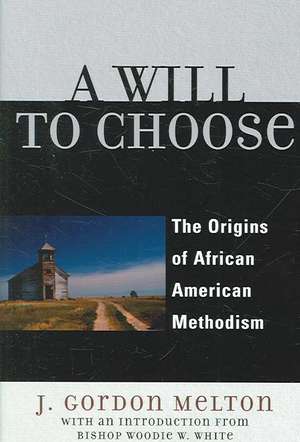
A Will to Choose: The Origins of African American Methodism
Autor Gordon J. Meltonen Limba Engleză Paperback – 23 feb 2007
Preț: 347.04 lei
Preț vechi: 463.05 lei
-25%
Puncte Express: 521
Carte tipărită la comandă
Livrare economică 30 noiembrie-14 decembrie
Livrare prin curier în România Termenul estimat este afișat lângă disponibilitate.
Transport gratuit de la 400.00 lei Plată online sau ramburs, în funcție de opțiunile comenzii.
Retur gratuit în 14 zile Comandă securizată și suport în română.
Specificații
ISBN-13: 9780742552654
ISBN-10: 0742552659
Pagini: 317
Dimensiuni: 153 x 228 x 24 mm
Greutate: 0.49 kg
Editura: Bloomsbury Publishing
Colecția Rowman & Littlefield
Locul publicării:New York, United States
ISBN-10: 0742552659
Pagini: 317
Dimensiuni: 153 x 228 x 24 mm
Greutate: 0.49 kg
Editura: Bloomsbury Publishing
Colecția Rowman & Littlefield
Locul publicării:New York, United States
V-ar putea interesa
-
 Women, Dissent, and Anti-Slavery in Britain and America, 1790-1865Elizabeth J. Clapp-18%Preț: 332.52 lei404.04 lei
 -
 -33%Preț: 1950.63 lei2906.01 lei
 -
 -19%Preț: 509.56 lei629.08 lei
 -
 Places of Redemption: Theology for a Worldly ChurchMary McClintock Fulkerson-13%Preț: 317.53 lei363.72 lei
 -
 The Oxford Handbook of Methodist StudiesWilliam J. Abraham-19%Preț: 323.22 lei399.71 lei
 -
 -27%Preț: 78.22 lei106.49 lei
 -
 The Mormon Jesus – A BiographyJohn G. TurnerPreț: 323.93 lei
 -
 The Salvation ArmySusan Cohen-32%Preț: 46.32 lei68.10 lei
 -
 Assist Me to ProclaimJohn R. TysonPreț: 228.80 lei
 -
 Faith the Yes of the HeartGrace A BramePreț: 141.25 lei
 -
 Freedomas ProphetRichard S. NewmanPreț: 296.94 lei
 -
 The Sermons of John WesleyKenneth J. CollinsPreț: 362.93 lei
 -
 RevivalAdam HamiltonPreț: 102.55 lei
 -
 The Vampire BookJ Gordon Melton-8%Preț: 433.34 lei471.03 lei
 -
 The Boys on the PorchJune Nilssen EastvoldPreț: 83.56 lei
 -
 A Christian's Pocket Guide to the PapacyLeonardo De ChiricoPreț: 35.48 lei
 -
 Preț: 116.61 lei
Cuprins
Chapter 1 Introduction
Chapter 2 Anthony's Legacy
Chapter 3 African American Methodism's Beginnings
Chapter 4 Emerging Centers of Black Methodism: Baltimore, Washington, D.C., and Wilmington
Chapter 5 Emerging Centers of Black Methodism: Philadelphia, New York City, and Brooklyn
Chapter 6 African Methodism Away from the Cities
Chapter 7 The Push into the South
Chapter 8 Women-the New Force in Church Life
Chapter 9 Toward Emancipation
Chapter 10 Emancipation and Its Transitions
Chapter 2 Anthony's Legacy
Chapter 3 African American Methodism's Beginnings
Chapter 4 Emerging Centers of Black Methodism: Baltimore, Washington, D.C., and Wilmington
Chapter 5 Emerging Centers of Black Methodism: Philadelphia, New York City, and Brooklyn
Chapter 6 African Methodism Away from the Cities
Chapter 7 The Push into the South
Chapter 8 Women-the New Force in Church Life
Chapter 9 Toward Emancipation
Chapter 10 Emancipation and Its Transitions
Recenzii
Melton has given us an excellent history of a heretofore scarcely-documented theme. It is light enough that it is hard to put down and deep enough to refer to again and again. This work will be a classic of American church history.
J. Gordon Melton has performed a thoroughgoing research effort in probing the records and publications to present an integrative and inclusive picture of Methodism with African American Methodism seen in its realistic roles and functions at the center of the founding and development of this major denomination in American church and social history. He is to be lauded for his persistence in pursuing over several decades the rigorous goal of bringing together the separate strands of Methodists within their true interactive historical perspective.
A Will to Choose is the most original and extensive treatment of early African Methodism produced up to this point. Remarkable for its rich information and the breadth and balance of its interpretations, this book is not likely to be surpassed or superseded. Essential reading for historians of religion and the African American experience.
A Will to Choose gives those who have been unknown to history, prominence; those who have been voiceless, voice; those who have been neglected, attention. In this richly textured narrative, J. Gordon Melton has mined never-used and under-used sources to ensure that the story of African Americans in the first century of American Methodism is fully told and never overlooked again. The inclusion of all the historic African American denominations makes this a critical and welcomed addition to Methodist historiography.
In A Will to Choose, Gordon Melton presents a deeply insightful and well researched chronicle of African American Methodism which he traces from its mid 18th century Moravian roots through the Civil War. He does a masterful job of weaving together the divergent but sometimes intersecting histories of several strands of the Methodist movements as it spread from the North East throughout the South. This book makes a very significant contribution to our understanding of African American religion and spirituality.
Of the writing of books on African American Methodism there will be no end, but this book is well worth paying attention to. This book has been a labor of love, the culmination of a forty-two year project by J. Gordon Melton in searching out and making sense of many scattered and not easily accessible sources....What he [Melton] aims to trace in all of its glory and struggles is a tradition of African American leadership....He succeeds remarkably well....There is much to recommend this work....This book is an important advance in black Methodist historiography.
From one of the most productive scholars of American religions, Gordon Melton in A Will to Choose reclaims the lost stories of enslaved and free black men and women who embraced and advanced variant expressions of African-American Methodism from 1770-1870. His narrative sparkles as a moving chronicle of the active and creative presence of these amazing black Christians in the Wesleyan tradition from its very beginnings in North America and functions as a sharp corrective to a scholarship that has more often than not made these African-American Methodists invisible within the largest Protestant movement throughout the 19th century in the US. This book culminates a generation of Melton's devoted research and joins the ever-growing and engaging literature of African-American religious history.
This work will be of value to all interested in African American life, American religious history, and American social and cultural studies. . . . Highly recommended. All levels.
Thoughtful and meticulous.
J. Gordon Melton has produced a very useful and readable examination of African American Methodism....This will be an indispensable book for those with an interest in African American history and the history of religion.
Long after the promise of Reconstruction gave way to the closed society of the Jim Crow South, the church remained a crucial site of black self-determination and self-definition. A Will to Choose demonstrates that this was always a characteristic of African American Methodism.
J. Gordon Melton has performed a thoroughgoing research effort in probing the records and publications to present an integrative and inclusive picture of Methodism with African American Methodism seen in its realistic roles and functions at the center of the founding and development of this major denomination in American church and social history. He is to be lauded for his persistence in pursuing over several decades the rigorous goal of bringing together the separate strands of Methodists within their true interactive historical perspective.
A Will to Choose is the most original and extensive treatment of early African Methodism produced up to this point. Remarkable for its rich information and the breadth and balance of its interpretations, this book is not likely to be surpassed or superseded. Essential reading for historians of religion and the African American experience.
A Will to Choose gives those who have been unknown to history, prominence; those who have been voiceless, voice; those who have been neglected, attention. In this richly textured narrative, J. Gordon Melton has mined never-used and under-used sources to ensure that the story of African Americans in the first century of American Methodism is fully told and never overlooked again. The inclusion of all the historic African American denominations makes this a critical and welcomed addition to Methodist historiography.
In A Will to Choose, Gordon Melton presents a deeply insightful and well researched chronicle of African American Methodism which he traces from its mid 18th century Moravian roots through the Civil War. He does a masterful job of weaving together the divergent but sometimes intersecting histories of several strands of the Methodist movements as it spread from the North East throughout the South. This book makes a very significant contribution to our understanding of African American religion and spirituality.
Of the writing of books on African American Methodism there will be no end, but this book is well worth paying attention to. This book has been a labor of love, the culmination of a forty-two year project by J. Gordon Melton in searching out and making sense of many scattered and not easily accessible sources....What he [Melton] aims to trace in all of its glory and struggles is a tradition of African American leadership....He succeeds remarkably well....There is much to recommend this work....This book is an important advance in black Methodist historiography.
From one of the most productive scholars of American religions, Gordon Melton in A Will to Choose reclaims the lost stories of enslaved and free black men and women who embraced and advanced variant expressions of African-American Methodism from 1770-1870. His narrative sparkles as a moving chronicle of the active and creative presence of these amazing black Christians in the Wesleyan tradition from its very beginnings in North America and functions as a sharp corrective to a scholarship that has more often than not made these African-American Methodists invisible within the largest Protestant movement throughout the 19th century in the US. This book culminates a generation of Melton's devoted research and joins the ever-growing and engaging literature of African-American religious history.
This work will be of value to all interested in African American life, American religious history, and American social and cultural studies. . . . Highly recommended. All levels.
Thoughtful and meticulous.
J. Gordon Melton has produced a very useful and readable examination of African American Methodism....This will be an indispensable book for those with an interest in African American history and the history of religion.
Long after the promise of Reconstruction gave way to the closed society of the Jim Crow South, the church remained a crucial site of black self-determination and self-definition. A Will to Choose demonstrates that this was always a characteristic of African American Methodism.