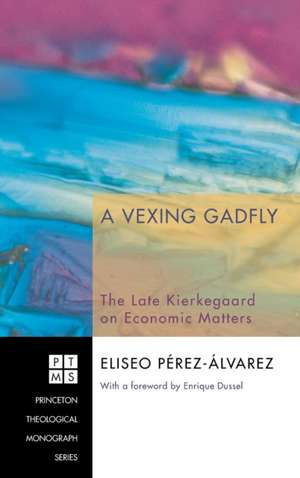
A Vexing Gadfly
Autor Eliseo Pérez-Álvarezen Limba Engleză Hardback – 30 apr 2009
Preț: 308.88 lei
Puncte Express: 463
Carte tipărită la comandă
Livrare economică 10-24 decembrie
Livrare prin curier în România Termenul estimat este afișat lângă disponibilitate.
Transport gratuit de la 400.00 lei Plată online sau ramburs, în funcție de opțiunile comenzii.
Retur gratuit în 14 zile Comandă securizată și suport în română.
Specificații
ISBN-13: 9781498251525
ISBN-10: 1498251528
Pagini: 236
Dimensiuni: 152 x 229 x 14 mm
Greutate: 0.49 kg
Editura: Pickwick Publications
ISBN-10: 1498251528
Pagini: 236
Dimensiuni: 152 x 229 x 14 mm
Greutate: 0.49 kg
Editura: Pickwick Publications
V-ar putea interesa
-
 The Ecumenical Movement & the Making of the European CommunityLucian Leustean-31%Preț: 790.33 lei1147.20 lei
-
 Preț: 152.99 lei
-
 Their Rock Is Not Like Our Rock: A Theology of ReligionsDaniel StrangePreț: 164.87 lei
-
 Preț: 93.70 lei
-
 The Gospel According to HereticsDavid E. WilhitePreț: 244.26 lei
-
 Exploring Catholic TheologyRobert BarronPreț: 157.63 lei
-
 Dignity and DestinyJohn F KilnerPreț: 264.46 lei
-
 On the Path of the ImmortalsThomas HornPreț: 172.98 lei
-
 Kantian Reason and Hegelian SpGary DorrienPreț: 406.43 lei
-
 The Edge of Words: God and the Habits of LanguageThe Rt Hon Rowan Williams-31%Preț: 131.11 lei190.88 lei
-
 Accidental Theologians: Four Women Who Shaped ChristianityElizabeth A. DreyerPreț: 117.77 lei
-
 Passionate PursuitJames W. GollPreț: 102.84 lei
-
 Are Non-Christians Saved?Ambrose MongPreț: 171.21 lei
-
 The Man Christ JesusCardinal Giacomo BiffiPreț: 73.07 lei
Recenzii
"Perez-Alvarez has made a significant contribution to Kierkegaardian scholarship, if for no other reason to spur us on to read the other 'hand' of Kierkegaard's incisive writings." Eric Austin Lee, University of Nottingham in: The Heythrop Journal, Vol. 53 (1), January 2012. 'Against the image of Kierkegaard as a bourgeois intellectual of independent means and idiosyncratic tastes, Perez-Alvarez portrays a man passionate about the poor, allying himself with the "ordinary man", and scathing in his attack on wealth and privilege. (...) Perez-Alvarez argues that Kierkegaard moved from a position of conventional conservatism, through a transitional period of increasing interest in economic affairs, and on to a final, thoroughgoing radicalisation of his socio-economic rhetoric. (...) it is an important contribution to Kierkegaardian scholarship, and will challenge many students of "the melancholy Dane" to think again.' The Rt Revd Dr Saxbee in Church Times, 28th September 2012. 'With this work, Eliseo-Perez-Alvarez has occupied an empty nook in Kierkegaard studies.' Bruce P. Baugus, Journal of Markets & Morality, Volume 15, Number 2 "This book would be of great value to those studying Kierkegaard's critique of Christendom, from social, political, economic, and philosophical or theological perspectives. [ - ] It offers an accessible, interesting, and thought-provoking account of one of the most famous thinkers of the nineteenth century, contextualized and yet still relevant today. [ - ] This refreshing and liberational reading of Kierkegaard rewards the reader." Victoria Davies, Reviews in Religion and Theology Vol.20 Issue 3. July 2013
"Perez-Alvarez has made a significant contribution to Kierkegaardian scholarship, if for no other reason to spur us on to read the other 'hand' of Kierkegaard's incisive writings." Eric Austin Lee, University of Nottingham in: The Heythrop Journal, Vol. 53 (1), January 2012. 'Against the image of Kierkegaard as a bourgeois intellectual of independent means and idiosyncratic tastes, Perez-Alvarez portrays a man passionate about the poor, allying himself with the "ordinary man", and scathing in his attack on wealth and privilege. (...) Perez-Alvarez argues that Kierkegaard moved from a position of conventional conservatism, through a transitional period of increasing interest in economic affairs, and on to a final, thoroughgoing radicalisation of his socio-economic rhetoric. (...) it is an important contribution to Kierkegaardian scholarship, and will challenge many students of "the melancholy Dane" to think again.' The Rt Revd Dr Saxbee in Church Times, 28th September 2012.
"Perez-Alvarez has made a significant contribution to Kierkegaardian scholarship, if for no other reason to spur us on to read the other 'hand' of Kierkegaard's incisive writings." Eric Austin Lee, University of Nottingham in: The Heythrop Journal, Vol. 53 (1), January 2012. 'Against the image of Kierkegaard as a bourgeois intellectual of independent means and idiosyncratic tastes, Perez-Alvarez portrays a man passionate about the poor, allying himself with the "ordinary man", and scathing in his attack on wealth and privilege. (...) Perez-Alvarez argues that Kierkegaard moved from a position of conventional conservatism, through a transitional period of increasing interest in economic affairs, and on to a final, thoroughgoing radicalisation of his socio-economic rhetoric. (...) it is an important contribution to Kierkegaardian scholarship, and will challenge many students of "the melancholy Dane" to think again.' The Rt Revd Dr Saxbee in Church Times, 28th September 2012.
Cuprins
Foreword Acknowledgments List of Abbreviations Introduction 1. Golden Age Denmark 2. Kierkegaard on Economic Issues: Years of Transition, 1846 - 1852 3. Kierkegaard on Economic Issues: The Radical Final Years, 1852 - 1855 Conclusion Appendix A: Denmark's Geopolitics Appendix B: Journals and Papers: Some Untranslated Kierkegaardian Material Appendix C: Papirer X 3 A 135 n.d., 1850 Bibliography