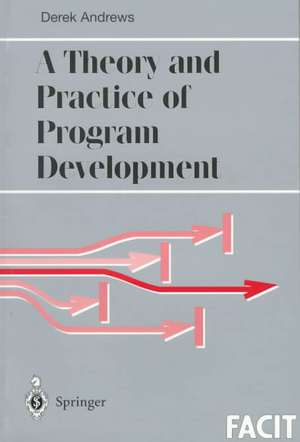
A Theory and Practice of Program Development: Formal Approaches to Computing and Information Technology (FACIT)
Autor Derek J. Andrewsen Limba Engleză Paperback – 4 iul 1997

Preț: 328.76 lei
Preț vechi: 410.96 lei
-20%
Puncte Express: 493
Carte tipărită la comandă
Livrare economică 08-22 decembrie
Livrare prin curier în România Termenul estimat este afișat lângă disponibilitate.
Transport gratuit de la 400.00 lei Plată online sau ramburs, în funcție de opțiunile comenzii.
Retur gratuit în 14 zile Comandă securizată și suport în română.
Specificații
ISBN-13: 9783540761624
ISBN-10: 3540761624
Pagini: 424
Ilustrații: XVII, 405 p. 2 illus.
Dimensiuni: 155 x 235 x 23 mm
Greutate: 0.64 kg
Ediția:1st Edition.
Editura: Springer
Colecția Formal Approaches to Computing and Information Technology (FACIT)
Seria Formal Approaches to Computing and Information Technology (FACIT)
Locul publicării:London, United Kingdom
ISBN-10: 3540761624
Pagini: 424
Ilustrații: XVII, 405 p. 2 illus.
Dimensiuni: 155 x 235 x 23 mm
Greutate: 0.64 kg
Ediția:1st Edition.
Editura: Springer
Colecția Formal Approaches to Computing and Information Technology (FACIT)
Seria Formal Approaches to Computing and Information Technology (FACIT)
Locul publicării:London, United Kingdom
V-ar putea interesa
-
 Not Exactly: In Praise of VaguenessKees van Deemter-16%Preț: 123.57 lei147.89 lei
 -
 Notes on Set TheoryYiannis MoschovakisPreț: 472.08 lei
 -
 A Course in Model TheoryBruno Poizat-15%Preț: 612.43 lei720.50 lei
 -
 Inductive LogicDov M. Gabbay-25%Preț: 1275.59 lei1701.10 lei
 -
 -27%Preț: 683.97 lei936.94 lei
 -
 Theory of Computational ComplexityDing-Zhu Du-9%Preț: 850.00 lei934.08 lei
 -
 Preț: 556.88 lei
 -
 Preț: 183.57 lei
 -
 Mathematical Logic for Computer ScienceMordechai Ben-Ari-20%Preț: 395.53 lei494.41 lei
 -
 Introducing InfinityBrian CleggPreț: 63.40 lei
 -
 Sets, Logic and CategoriesPeter J. CameronPreț: 280.57 lei
 -
 Duality Theories for Boolean Algebras with OperatorsSteven GivantPreț: 405.84 lei
 -
 The Life and Work of Leon HenkinMaría ManzanoPreț: 398.56 lei
 -
 -15%Preț: 735.59 lei865.39 lei
 -
 Preț: 419.31 lei
Public țintă
ResearchCuprins
1. Writing Correct Programs.- 1.1 Satisfying Specifications.- 1.2 An Alternative Approach.- 1.3 Summary.- 2. A Small Programming Language.- 2.1 Satisfying Specifications.- 2.2 Specifications and Programs.- 2.3 The Semantics of Commands.- 2.4 Non-determinism and Partial Commands.- 2.5 The Concepts of Predicate Transformers.- 2.6 Substitution.- 2.7 The Formal Semantics of the Kernel Language.- 2.8 The Weakest Liberal Pre-conditions, Termination, and Relations.- 2.9 Executable Programs.- 2.10 Summary.- 3. Concepts and Properties.- 3.1 More Commands.- 3.2 The Domain of a Command.- 3.3 Some Properties of Commands.- 3.4 A Normal Form.- 3.5 Some Further Properties.- 3.6 The Primitive Commands Revisited.- 3.7 Initial Values.- 3.8 A Compiler for the Small Language.- 3.9 Summary.- 4. Building New Commands from Old.- 4.1 Defining Commands.- 4.2 An Approach to Recursion.- 4.3 Sequences of Predicates and their Limit.- 4.4 Limits of Predicate Transformers.- 4.5 Limits of Commands.- 4.6 Tidying the Loose Ends.- 4.7 Epilogue.- 5. Program Refinement.- 5.1 Stepwise Refinement.- 5.2 Replacing Specifications.- 5.3 Conventions.- 5.4 Refinement Classes.- 5.5 Alternative Views of Refinement.- 5.6 Other Refinement Relations.- 5.7 Summary.- 6. The Basic Commands.- 6.1 The Constant Commands.- 6.2 Assertions.- 6.3 Assignment.- 6.4 Summary.- 7. Declarations and Blocks.- 7.1 The Declaration Command.- 7.2 Some Interactions Between Commands.- 7.3 The Definitional Commands.- 7.4 Refining Definitional Commands.- 7.5 Defining Constant Values.- 7.6 Logical Constants.- 7.7 Summary.- 8. Command Sequences.- 8.1 Solve a Part and then the Whole.- 8.2 Summary.- 9. The Alternative Command.- 9.1 Divide and Conquer.- 9.2 The Partition.- 9.3 Reassembly.- 9.4 Alternatives — The If Command.- 9.5 RefiningSpecifications.- 9.6 Summary.- 10. The Iterative Command.- 10.1 Another Approach.- 10.2 The Generalized Loop and Refinement.- 10.3 The General Variant Theorem.- 10.4 An Application.- 10.5 Loops.- 10.6 Iteration — The Do Command.- 10.7 Practical Do Commands.- 10.8 The Refinement of Loop Bodies.- 10.9 Summary.- 11. Functions and Procedures.- 11.1 Proper Procedures and their Calls.- 11.2 Function Procedures and their Calls.- 11.3 Function Calls in Expressions.- 11.4 An Alternative Approach to Parameters and Arguments.- 11.5 Postscript.- 11.6 Summary.- 12. An Example of Refinement at Work.- 12.1 The Problem — Integer Multiplication.- 12.2 Logical Constants Revisited.- 12.3 Summary.- 13. On Refinement and Loops.- 13.1 The Factorial Problem.- 13.2 Finding Guards and Invariants.- 13.3 Identifying the Loop Type Incorrectly.- 14. Functions and Procedures in Refinement.- 14.1 Factorial.- 14.2 Multiply.- 14.3 Summary.- 15. Refinement and Performance.- 15.1 A Second Approach to Multiplication.- 15.2 Fast Division.- 15.3 Summary.- 16. Searching and Sorting.- 16.1 A Diversion — the Array Data Type.- 16.2 Linear Search.- 16.3 Binary Search.- 16.4 A Simple Sort Algorithm.- 16.5 Summary.- 17. Data refinement.- 17.1 The Refinement Strategy.- 17.2 The Refinement to Executable Code.- 17.3 The Next Step.- 17.4 The Refinement of the Operations.- 17.5 The First Refinement Step.- 17.6 The Next Refinement Step.- 17.7 A Summary of the Approach.- 17.8 Summary.- 18. A Theory of Data Refinement.- 18.1 An Approach to Data Refinement.- 18.2 Data Refinement in Practice.- 18.3 Another View of Data Refinement.- 18.4 Functional Refinement.- 18.5 An Alternative Data Refinement of Assignments.- 18.6 Summary.- 19. An Alternative Refinement of the Security System.- 19.1 A Data Refinement.- 19.2Another Approach to the Refinement.- 19.3 Summary.- 20. Stacks and Queues.- 20.1 A Finite Stack.- 20.2 A stack of Boolean Values.- 20.3 A Finite Queue.- 20.4 An Efficient Queue.- 21. Dynamic Data Structures.- 21.1 Simulating a Linked List.- 21.2 Explicit Pointers.- 21.3 The Stack Using Explicit Pointers.- 21.4 Summary.- 22. Binary Trees.- 22.1 The Specification.- 22.2 The Refinement.- 22.3 The Refinement of the in Operation.- 22.4 The Refinement of the insert Operation.- 22.5 The Refinement of the delete Operation.- 22.6 An In-order Traversal.- 22.7 Summary.- 23. Epilogue.- 23.1 An Approach to Loose Patterns and Functions.- A. Program Refinement Rules.- A.1 Replace Specification.- A.2 Assume Pre-condition in Post-condition.- A.3 Introduce Assignment.- A.4 Introduce Command-semicolon.- A.5 Introduce Semicolon-command.- A.6 Introduce Leading Assignment.- A.7 Introduce Following Assignment.- A.8 Introduce Alternatives.- A.9 Introduce Iteration.- A.10 Introduce Proper Procedure Body.- A.11 Introduce Proper Procedure Call.- A.12 Introduce Function Procedure Body.- A.13 Introduce Function Procedure Call.- A.14 Add Variable.- A.15 Realize Quantifier.- A.16 Remove Scope.- A.17 Expand Frame.- A.18 Contract Frame.- A.19 Introduce Logical Constant.- A.20 Remove Logical Constant.- A.21 Refine Block.- A.22 Introduce Skip.