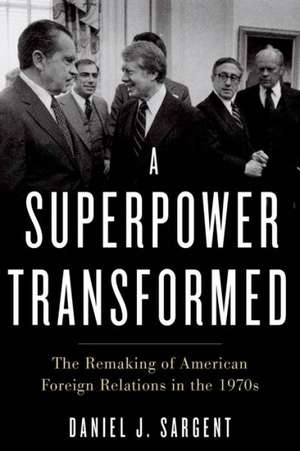
A Superpower Transformed: The Remaking of American Foreign Relations in the 1970s
Autor Daniel J. Sargenten Limba Engleză Hardback – 8 ian 2015
Preț: 309.42 lei
Preț vechi: 384.48 lei
-20%
Puncte Express: 464
Carte tipărită la comandă
Livrare economică 03-09 decembrie
Livrare prin curier în România Termenul estimat este afișat lângă disponibilitate.
Transport gratuit de la 400.00 lei Plată online sau ramburs, în funcție de opțiunile comenzii.
Retur gratuit în 14 zile Comandă securizată și suport în română.
Specificații
ISBN-13: 9780195395471
ISBN-10: 0195395476
Pagini: 452
Dimensiuni: 157 x 236 x 38 mm
Greutate: 0.7 kg
Editura: Oxford University Press
Colecția OUP USA
Locul publicării:New York, United States
ISBN-10: 0195395476
Pagini: 452
Dimensiuni: 157 x 236 x 38 mm
Greutate: 0.7 kg
Editura: Oxford University Press
Colecția OUP USA
Locul publicării:New York, United States
V-ar putea interesa
-
 Hippies, Indians, and the Fight for Red PowerSherry L. Smith-20%Preț: 302.85 lei380.66 lei
 -
 Heart of Europe: The Past in Poland's PresentNorman Davies-19%Preț: 128.36 lei158.03 lei
 -
 Modern Spain, 1875-1980Raymond Carr-20%Preț: 95.85 lei120.12 lei
 -
 France Since 1945Robert GildeaPreț: 79.37 lei
 -
 Restless Giant: The United States from Watergate to Bush vs. GoreJames T. Patterson-17%Preț: 144.44 lei175.01 lei
 -
 Europe Since 1945Mary Fulbrook-11%Preț: 359.75 lei405.90 lei
 -
 Mandela: A Critical LifeTom Lodge-20%Preț: 121.83 lei153.21 lei
 -
 -21%Preț: 400.78 lei508.22 lei
 -
 Westmoreland's War: Reassessing American Strategy in VietnamGregory Daddis-28%Preț: 367.88 lei511.43 lei
 -
 Preț: 153.61 lei
 -
 Buried Glory: Portraits of Soviet ScientistsIstvan Hargittai-18%Preț: 383.70 lei468.83 lei
 -
 ParklandVincent BugliosiPreț: 108.67 lei
 -
 Preț: 145.70 lei
 -
 Mountain of the DeadKeith MccloskeyPreț: 71.50 lei
 -
 -24%Preț: 77.93 lei102.85 lei
 -
 From the Imjin to the HookJames JacobsPreț: 145.79 lei
 -
 Cairo in the War: 1939-45Artemis Cooper-26%Preț: 79.65 lei107.90 lei
Recenzii
Daniel Sargent's comprehensive assessment of Nixon, Ford, and Carter foreign policies integrates geopolitical, economic, and human rights issues with such skill that it now must be the starting point for all future scholarship on that era. A major accomplishment by a talented young historian.
Daniel Sargent's new book goes a long way toward illuminating the course of the Cold War and the U.S. engagement with globalization. Deeply researched and wonderfully well written, A Superpower Transformed blends world politics and international economics to explain the momentous changes in 1970s U.S. foreign relations. This is a brilliant contribution to our understanding of America's place in the world today.
Daniel Sargent's book shows how the 'Cold War order' imploded during the 1970s, as rapid globalization shaped a new era of unpredictability, fragmentation, and improvised policies. With its deep research, fresh interpretations, beautiful writing, and tight focus on questions of how power is exercised, A Superpower Transformed is a work of major importance.
Ambitious in its design, capacious in its coverage, this eloquent and nuanced analysis will be essential reading for anyone who wants to understand the origins of the contemporary era.
will likely have a long-lasting impact on our understanding of the role of the United States in the 1970s. Daniel J. Sargent writes vividly and makes many of the complicated issues he discusses clearer with helpful charts, tables, and graphs. Sargent's book is also highly relevant today, as it demonstrates the challenges of policy making in turbulent and changing times.
Daniel Sargent's new book goes a long way toward illuminating the course of the Cold War and the U.S. engagement with globalization. Deeply researched and wonderfully well written, A Superpower Transformed blends world politics and international economics to explain the momentous changes in 1970s U.S. foreign relations. This is a brilliant contribution to our understanding of America's place in the world today.
Daniel Sargent's book shows how the 'Cold War order' imploded during the 1970s, as rapid globalization shaped a new era of unpredictability, fragmentation, and improvised policies. With its deep research, fresh interpretations, beautiful writing, and tight focus on questions of how power is exercised, A Superpower Transformed is a work of major importance.
Ambitious in its design, capacious in its coverage, this eloquent and nuanced analysis will be essential reading for anyone who wants to understand the origins of the contemporary era.
will likely have a long-lasting impact on our understanding of the role of the United States in the 1970s. Daniel J. Sargent writes vividly and makes many of the complicated issues he discusses clearer with helpful charts, tables, and graphs. Sargent's book is also highly relevant today, as it demonstrates the challenges of policy making in turbulent and changing times.
Notă biografică
Assistant Professor of History, University of California, Berkeley. Co-editor of The Shock of the Global: The International History of the 1970s (Harvard University Press, forthcoming, 2009).
Cuprins
- Acknowledgments
- Intro
- Ch 1 Pax Americana
- Part I Reaching Backward
- Ch 2 In Pursuit of Primacy
- Ch 3 Geopolitics and Humanitarianism
- Ch 4 The Dollar in Decline
- Ch 5 Oil Shocked
- Part II Stumbling Forward
- Ch 6 Managing Interdependence
- Ch 7 Human Rights and Detente
- Ch 8 World Olrder Politics
- Ch 9 The Revenge of Geopolitics
- Conclusion
- Notes
- Bibliography
- Index