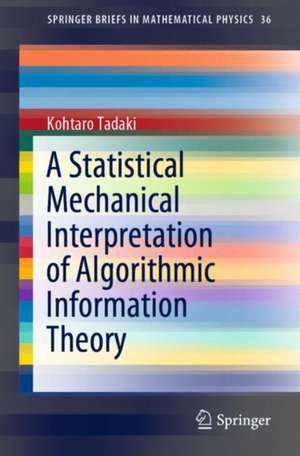
A Statistical Mechanical Interpretation of Algorithmic Information Theory: SpringerBriefs in Mathematical Physics, cartea 36
Autor Kohtaro Tadakien Limba Engleză Paperback – 21 noi 2019
Notăm cu interes apariția volumului A Statistical Mechanical Interpretation of Algorithmic Information Theory, o lucrare ce ocupă o nișă interdisciplinară rară la intersecția dintre fizica matematică și informatica teoretică. În cadrul programelor de studii avansate, această monografie se situează ca un text de specializare pentru cursurile de termodinamică statistică și teoria complexității Kolmogorov, oferind prima punte formală între dimensiunea programelor de calcul și legile fizicii sistemelor macroscopice.
Suntem de părere că abordarea lui Kohtaro Tadaki este fundamental inovatoare prin modul în care „traduce” mărimile termodinamice clasice în limbajul algoritmilor. Cartea debutează pedagogic prin reinterpretarea codării sursei fără zgomot (noiseless source coding), unde conceptele de entropie și temperatură sunt mapate natural pe eficiența compresiei datelor. Progresia narativă este una riguroasă: după stabilirea fundamentelor AIT, autorul introduce noțiunea de „aleatoriu parțial”, demonstrând matematic că temperatura unui sistem informațional este echivalentă cu rata de compresie măsurată prin complexitatea mărginirii programelor.
Acoperă aceeași arie tematică precum Information and Randomness de Cristian S. Calude sau lucrările lui Gregory J. Chaitin, dar cu o abordare mult mai orientată spre fizica matematică decât spre informatica pură. Spre deosebire de An Introduction to Kolmogorov Complexity and Its Applications, care rămâne un tratat generalist, volumul de față se concentrează pe demonstrarea faptului că valorile termodinamice sunt puncte fixe ale aleatoriului parțial. Structura este tehnică, atingând punctul culminant în capitolul dedicat tranziției de fază la T=1, oferind o clarificare teoretică a modului în care computabilitatea limitează sau permite manifestarea fenomenelor fizice.
Din seria SpringerBriefs in Mathematical Physics
-
 Preț: 382.64 lei
 -
 Preț: 346.74 lei
 -
 Preț: 414.37 lei
 - 15%
 Preț: 634.86 lei
 - 15%
 Preț: 476.59 lei
 -
 Preț: 481.16 lei
 - 20%
 Preț: 433.83 lei
 -
 Preț: 448.64 lei
 -
 Preț: 390.51 lei
 -
 Preț: 363.61 lei
 -
 Preț: 365.45 lei
 -
 Preț: 428.15 lei
 -
 Preț: 482.44 lei
 -
 Preț: 427.99 lei
 -
 Preț: 471.75 lei
 -
 Preț: 445.65 lei
 -
 Preț: 429.09 lei
 - 20%
 Preț: 435.99 lei
 -
 Preț: 396.09 lei
 - 15%
 Preț: 473.48 lei
 -
 Preț: 363.41 lei
 - 15%
 Preț: 506.68 lei
 -
 Preț: 428.92 lei
 -
 Preț: 364.19 lei
 - 33%
 Preț: 299.71 lei
 -
 Preț: 381.07 lei
 -
 Preț: 414.32 lei
 - 15%
 Preț: 475.64 lei
 -
 Preț: 447.65 lei
 -
 Preț: 447.98 lei
 -
 Preț: 481.67 lei
 - 15%
 Preț: 465.81 lei
 - 15%
 Preț: 463.28 lei
 - 15%
 Preț: 400.84 lei
 -
 Preț: 478.69 lei
 - 15%
 Preț: 400.29 lei
 -
 Preț: 359.94 lei
 -
 Preț: 414.11 lei
 -
 Preț: 381.27 lei
 -
 Preț: 348.75 lei
 -
 Preț: 348.24 lei
 - 15%
 Preț: 524.50 lei
 -
 Preț: 380.63 lei
 -
 Preț: 433.08 lei
 - 20%
 Preț: 466.44 lei
 -
 Preț: 430.54 lei
 -
 Preț: 390.23 lei
 -
 Preț: 399.46 lei
Preț: 388.71 lei
Preț vechi: 457.31 lei
-15%
Carte disponibilă
Livrare economică 28 octombrie-11 noiembrie
Livrare express 14-20 octombrie pentru 24.25 lei
Specificații
ISBN-10: 9811507384
Pagini: 148
Ilustrații: XI, 136 p. 1 illus.
Dimensiuni: 155 x 235 x 9 mm
Greutate: 0.24 kg
Ediția:1st ed. 2019
Editura: Springer
Colecția SpringerBriefs in Mathematical Physics
Seria SpringerBriefs in Mathematical Physics
Locul publicării:Singapore, Singapore
De ce să citești această carte
Recomandăm această carte cercetătorilor care doresc să înțeleagă fundamentul fizic al informației. Cititorul câștigă o perspectivă matematică precisă asupra modului în care principiile termodinamicii, precum energia liberă sau principiul lui Landauer, guvernează de fapt complexitatea algoritmică. Este o lectură esențială pentru a înțelege de ce temperatura nu este doar o variabilă fizică, ci o măsură a impredictibilității informaționale.