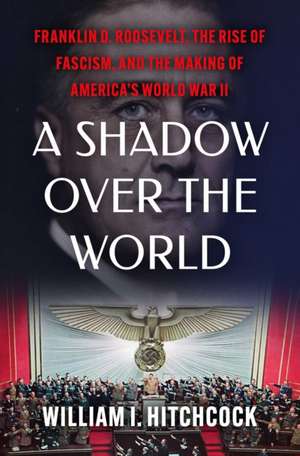
A Shadow Over the World: Franklin D. Roosevelt, the Rise of Fascism, and the Making of America's World War II
Autor William I Hitchcocken Limba Engleză Hardback – 22 oct 2026
How did FDR and the American public respond to the rise of dictators across Europe and Asia on the eve of World War II? The familiar narrative is that they reacted with indifference and embraced isolationism. Only with the Japanese attack on Pearl Harbor were Americans reluctantly drawn into the global conflict. But distinguished historian William I. Hitchcock reveals a far more complex and surprising story.
From the time Mussolini came to power in 1922 to America’s entry into the war in 1941, Americans engaged in a fraught national debate over the rising threat—and for some, the lure—of fascism. At the center of this debate was Roosevelt himself. When he took office in 1933, Roosevelt was determined to avoid foreign entanglements that would harm his ambitious domestic agenda of the New Deal. But over the course of his first two terms, a network of journalists, activists, advisers, and diplomats gradually awakened him to the global dangers of fascism.
Roosevelt’s transformation was part of a larger national reckoning with authoritarianism around the world. A Shadow Over the World shines a light on a time when a coalition of courageous humanists gathered around a visionary leader to forge a new purpose for America: to protect democracy, oppose imperialism, support human rights, and lead a global fight for freedom. Their successful struggle against the dark forces of fascism holds powerful lessons for our own perilous times.
Preț: 155.32 lei
Preț vechi: 197.56 lei
-21% Nou
Puncte Express: 233
Carte disponibilă
Livrare economică 13-25 noiembrie
Livrare prin curier în România Termenul estimat este afișat lângă disponibilitate.
Transport gratuit de la 400.00 lei Plată online sau ramburs, în funcție de opțiunile comenzii.
Retur gratuit în 14 zile Comandă securizată și suport în română.
Specificații
ISBN-13: 9781982157722
ISBN-10: 1982157720
Pagini: 736
Ilustrații: 52 b-w images throughout and 5 maps
Dimensiuni: 152 x 229 x 43 mm
Greutate: 0.91 kg
Editura: Simon&Schuster
Colecția Simon & Schuster
ISBN-10: 1982157720
Pagini: 736
Ilustrații: 52 b-w images throughout and 5 maps
Dimensiuni: 152 x 229 x 43 mm
Greutate: 0.91 kg
Editura: Simon&Schuster
Colecția Simon & Schuster
Notă biografică
William I. Hitchcock is a New York Times bestselling author and award-winning teacher who has published numerous books relating to World War II and the Cold War, including The Bitter Road to Freedom: A New History of the Liberation of Europe, which was a finalist for the Pulitzer Prize and a winner of the George Louis Beer Prize from the American Historical Association. He is also the author of The Age of Eisenhower: America and the World in the 1950s. He received his BA degree from Kenyon College and his PhD from Yale University. He has been a Fulbright scholar, a fellow of the Nobel Institute in Oslo, the holder of the Henry Kissinger Chair at the Library of Congress, and a Berlin Prize fellow at the American Academy in Berlin. He is now the James Madison Professor of History at the University of Virginia.
Extras
Prologue PROLOGUE NO LONE ISLAND
“The future of the nation and of the American people is at stake.”
—FRANKLIN D. ROOSEVELT
I
The Memorial Gymnasium at the University of Virginia—a large Beaux-Arts building of brick, white plaster pillars, and tall, vaulted windows—opened in 1924 as a tribute to the graduates of the school who had died in the Great War. The largest gym in the South at the time, it could comfortably hold 2,500 spectators for boxing matches, basketball games, swimming competitions, and track meets. On the afternoon of Monday, June 10, 1940, as a light rain fell outside, three times that number had crammed into the large stuffy central hall to observe the commencement ceremonies of the class of 1940—and to hear remarks from the day’s distinguished speaker, Franklin D. Roosevelt.
The president and Mrs. Roosevelt had a particular reason to attend this ceremony: their son Franklin D. Roosevelt Jr. would receive his law degree that day. Knowing this, the university’s president, John Lloyd Newcomb, had invited FDR to address the graduating class. The Roosevelts rode down to Charlottesville by train and then motored the short distance from the train station to the packed gymnasium. Although the legions of journalists there did not mention it, FDR was helped from his car and into his steel leg braces by his senior military aide, General Edwin “Pa” Watson; his naval aide, Captain Daniel J. Callaghan; and his physician, Admiral Ross T. McIntire. They supported him as he entered the hall and lurched toward the rostrum. There he stood, cloaked in the traditional gown and crimson academic hood of a Harvard man, while the university band struck up “Hail to the Chief.” The crowd gave the president a thundering ovation, punctuated with shouts and rebel yells. Under normal circumstances, President Roosevelt might have amused his audience with a few lighthearted anecdotes about his own college days. But he had arrived in Charlottesville at a moment of extreme tension and anxiety in world affairs. He came not to entertain his listeners, but to awaken them.1
The war in Europe, which began in September 1939 with Germany’s invasion of Poland, reached new intensity on May 10, 1940, when the German army launched a swift and devastating invasion of France and the Low Countries. In World War I, France and Germany struggled for four terrible years over every inch of this same landscape, with the battle lines rarely moving. Not this time. In a few weeks of fighting, Hitler’s forces penetrated the defensive positions of the British, French, Dutch, and Belgian armies. German divisions cleverly maneuvered through the hilly wooded terrain of the Ardennes Forest in Belgium, totally surprising and surrounding the outmatched Anglo-French troops. In the first days of June, 330,000 British and French soldiers undertook a daring but humiliating retreat from the shrapnel-strewn beaches of Dunkirk, boarding a flotilla of ships that ferried them toward safety across the foaming English Channel. By the time FDR began his journey to Charlottesville, the Netherlands and Belgium had surrendered, the French government had fled Paris, and the Germans were just three days away from entering France’s capital.
As his train rolled southward through the rolling green countryside of central Virginia on the morning of June 10, President Roosevelt received more disheartening news: Fascist Italy declared war on France and sent troops across the Alps, eager to scoop up territory from its mortally wounded neighbor. Italy’s decision to join Germany as an allied combatant seemed inevitable, given the close affinity of Mussolini and Hitler and the “pact of steel” the two had concluded in May 1939. But for months in the spring of 1940, Roosevelt had been in touch with the Italians, trying to keep them out of the war. He hoped his diplomacy might avoid a widening of the European conflict. The news from Europe shattered those illusions.
Suddenly the world seemed headed toward a terrible, almost inconceivable fate. Mussolini’s decision to attack France officially aligned Fascist Italy with Nazi Germany and completed the formation of an imposing bloc of the world’s dictatorships. The August 1939 Hitler-Stalin Pact had already linked Germany and the Soviet Union into a tacit alliance, while Japan, aligned with Germany’s ambitions, was rapidly subduing China and seemed poised to strike at Southeast Asia. The American press often lumped these aggressive states together under the term “totalitarian.” They combined military, technological, and industrial power with fanatical ideologies that welcomed war as the means to bring about the destruction of a world order that had stymied their ambitions. The aggressive militarist states stood shoulder to shoulder, determined to build a New Order on the ashes of the old. By the time Roosevelt reached Charlottesville, Hitler was on the cusp of absolute victory, and America looked ever more cut off and alone.
When Roosevelt began to speak to the university graduates in the packed hall, with his rhythmic cadences and his familiar patrician accent, it became clear this would not be an ordinary commencement address. The president knew that the moment called for a sobering message of forceful determination. After years of drift and uncertainty, he wished to strike a new note. The young men arrayed before him in gowns and mortarboards had a right to know “what the future holds for all peoples and all nations that have been living under democratic forms of Government—under the free institutions of a free people.” Should America be drawn into this war, the president knew, the lives of these students would be unalterably changed. These young men might soon find themselves in uniform, and in harm’s way.
Roosevelt did not try to assuage the anxieties of the students and their families. Instead, he drew an alarming picture. Democracy was dying before their very eyes. “The ideal of individual liberty,” the president said, “the ideal of free franchise, the ideal of peace through justice,” these had been called “decadent” by Europe’s dictators. The fascists, determined to rule with an iron fist, had “abandoned with deliberate contempt all the moral values to which even this young country for more than three hundred years has been accustomed and dedicated.” Italy’s attack on France that very day only illustrated the treachery of Europe’s thuggish leaders. In a much-quoted phrase, borrowed from the French prime minister Paul Reynaud, FDR rebuked Italy’s aggression: “The hand that held the dagger has struck it into the back of its neighbor.” He laid out the hard facts: The fascists were on the march and democracy was losing the war.
What, Roosevelt asked, will America do? With a confidence and determination all too often lacking during his first two terms, he firmly and clearly rejected a policy of isolation or appeasement. He expressed his contempt for those who “still hold to the now somewhat obvious delusion that we of the United States can safely permit the United States to become a lone island, a lone island in a world dominated by the philosophy of force.” In chilling imagery, he depicted America alone, chained up, and forgotten. “Such an island may be the dream of those who still talk and vote as isolationists. Such an island represents to me and to the overwhelming majority of Americans today a helpless nightmare of a people without freedom—the nightmare of a people lodged in prison, handcuffed, hungry, and fed through the bars from day to day by the contemptuous, unpitying masters of other continents.”
Instead of isolation, Roosevelt promised action on behalf of the democracies. “In our American unity, we will pursue two obvious and simultaneous courses. We will extend to the opponents of force the material resources of this nation; and, at the same time, we will harness and speed up the use of those resources in order that we ourselves in the Americas may have equipment and training equal to the task of any emergency and every defense.” FDR was promising military aid to the anti-fascist forces overseas, and a rapid rearmament program at home. It wasn’t war yet, but it was perilously close. The president acknowledged that the country had been divided over how to respond to the rise of the dictators. “But in recent months,” he said, “the principal question has been somewhat simplified.” The dictators threatened democracy not just in Europe and Asia but at home. A world war had begun, one that might soon engulf the United States. Concluding with an ominous send-off, he said, “The future of the nation and of the American people is at stake.”
The speech at Charlottesville marked Roosevelt’s boldest, most powerful statement yet about how the United States would respond to the fascist onslaught. In fact, the policies that flowed from this address marked a turning point in the history of the Second World War and of the subsequent “American Century.” Robert Sherwood, the celebrated playwright who joined the administration as a speechwriter and later wrote a sympathetic biography of Roosevelt, called the commitment made at the University of Virginia to arm the European democracies “the most important and most courageous decision of his entire career.” From this point on, the United States engaged its economic resources, and soon its military might, in a struggle for the survival of democracy in the world. As German, Italian, Soviet, and Japanese armies rolled across the world map with ever more force and confidence, the isolationism that had appealed to so many Americans in the 1930s lost its allure. Well before the Japanese attack on Pearl Harbor on December 7, 1941, that would bring the United States into World War II, Franklin Roosevelt positioned America as the world’s guarantor of democracy against authoritarian rule.2
II
But this declaration of June 10, 1940, which was met with an outpouring of praise by the press and the public, had been a long time coming. Though some historians like to portray Roosevelt as a secret internationalist who long expected war with the fascist powers but was constrained by public opinion from doing anything to prepare for it, this book presents a more complex portrait of the president than we have seen before. It is a picture of a man who remained unsure for many years just what kind of threat fascism posed to the United States. Though he instinctively hated fascism, he did not have a strategy for confronting it, nor did he fully grasp its potential dangers. He came only slowly and quite grudgingly to the realization that fascism and American democracy could not coexist in the world.3
From the start of his presidency in 1933 and through his first two terms, Franklin Roosevelt sought to avoid war, urged world disarmament, and even signed legislation banning U.S. arms sales to any nation at war. His administration faced the collapse of democratic capitalism at home, and the immense effort to restore basic economic security to the American people dominated his first years in office. Pushing international affairs to the back burner, he proposed the policy of nonintervention and the “good neighbor” in 1933 and reaffirmed it in 1936. Even as Hitler repudiated the Versailles peace agreements that had ended World War I; even as he launched a vast, illegal rearmament program; even as Italy invaded Ethiopia and both the Nazis and Italians poured soldiers and weapons into Spain to support the fascists in the civil war there; even as the German concentration camps began to fill up—Roosevelt insisted on neutrality, not conflict. He signed the Neutrality Acts of 1935, 1936, and 1937, refusing to fight Congress over them because he largely supported the measures. “We shun political commitments which might entangle us in foreign wars,” he said in August 1936. “We seek to isolate ourselves completely from war.” The “conflicting economic and political fanaticisms” of Europe would not, he said, stir America from its neutrality. “I have seen war,” he said darkly. “I hate war.” There is no reason to doubt that he spoke from the heart.
By 1937, as Japan intensified its brutal conquest of China and committed unspeakable atrocities across that war-scarred country, FDR began to speak out about what America’s responsibilities in the world should be. Yet his calls for negotiation, moral leadership, peace, and collective security were cautious, even passive. “The epidemic of world lawlessness is spreading,” he said in Chicago in October 1937, and “when an epidemic of physical disease starts to spread, the community approves and joins in a quarantine of the patients in order to protect the health of the community against the spread of the disease.” Despite a surprisingly welcome reception for this speech, and its implied “quarantine” of lawless militarists, little action followed. Vague schemes for using naval power to hem in the Japanese Empire evaporated quickly. Roosevelt certainly expressed anxiety about trends in world affairs; but as of 1937, he saw no role for the United States in altering them.
Following Hitler’s bellicose demands for a revision of the map of Europe, Roosevelt fell in line with British and French appeasement policy. Hitler swallowed Austria; FDR did nothing. To be sure, in 1938 he made a worthy effort to ease the plight of Europe’s Jews by convening a conference about sheltering refugees right after Hitler’s troops marched into Vienna, but it brought no solutions. Roosevelt knew Hitler would take aim at Czechoslovakia next, but remained passive. When British prime minister Neville Chamberlain flew across the English Channel not once but three separate times to beg Hitler to negotiate the peaceful dismembering of Czechoslovakia and avoid war, FDR encouraged him with a one-line telegram: “Good man.” He also wrote numerous public letters to the dictators, urging them to pursue peace and negotiation. He spoke and acted like a pacifist, and in fact he described himself as a pacifist. Though he certainly loathed fascism, he did not commit American power to contain it or fight it. Even his effort to cultivate the Soviet Union as a bid to keep pressure on Germany crumbled into ashes when Stalin and Hitler agreed to a nonaggression pact and a trade deal in August 1939. When war came the following month, Roosevelt insisted that America would remain neutral. He wanted to keep America out of war, and that meant staying free from foreign entanglements of any kind.4
III
What happened to change Roosevelt’s mind so completely that by the time of his speech in Charlottesville he seemed ready to commit America to aid Britain in its desperate struggle with Nazi Germany, even at the risk of war? This is the most fundamental question that scholars of the Roosevelt years must ask. Because FDR is often elusive, and because he left so little in writing about his own thoughts and intentions, the answer is not immediately apparent. Without access to a Roosevelt presidential memoir or a detailed diary, scholars must knit together fragments from his presidency, drawing from government papers, the writings of those around him, as well as the letters and press conferences in which Roosevelt revealed pieces of himself to friends and to reporters (usually off the record). Placing these materials alongside the roiling, turbulent events of the 1930s, we can begin to make sense of Roosevelt’s evolution from an anti-war pacifist, a nationalist, and an American exceptionalist to a man who embraced a stunningly ambitious global task: the safeguarding of democracy in a world that had fallen under the shadow of fascism.5
At least three major forces propelled Roosevelt’s transformation and brought him to that speech in Charlottesville. The first was the immediate problem: In June 1940 Hitler was winning the war. Roosevelt’s policies of neutrality and mediation had failed to have any impact whatsoever on the course of world affairs. If he did not act quickly and use American power to assist the anti-fascist states in stemming the Nazi tide, the war would end with Hitler triumphant. Once France and Britain had been subdued by the Nazis, all of Eurasia, from Japan to the Irish Sea, would be entirely dominated by dictatorships. The oceans would be closed to American trade and commerce and organized around new militarist empires bent on war and conquest. In such a dystopian scenario, America would have to transform itself into a garrison state, always on alert, always fearful of a possible attack. Democracy itself might be snuffed out forever. No president likes to admit failure; to his great credit, FDR understood that he needed to change course quickly. With his words in Charlottesville, he announced a new direction.
The second reason for Roosevelt’s move from neutrality to confrontation lies in American domestic politics. Like most presidents, Roosevelt initially saw foreign policy as a distraction from his domestic priorities. He feared that his New Deal coalition would be rent apart by any adventures overseas, and he remained neutral and passive on the world stage because he was so active at home. During his second term in office, however, from 1936 to 1940, Roosevelt faced a major backlash against the New Deal. Most Republicans disliked it from the start and some members of Roosevelt’s own Democratic Party turned against it, especially conservative Southerners, who feared the New Deal’s support for labor unions and its promise of greater economic and political opportunity for African Americans. And some American demagogues and charlatans—the Detroit priest Father Charles Coughlin being the most effective—claimed that Roosevelt and his New Deal policies were un-American, and part of a Jewish-Communist conspiracy to undermine America from within.
In defending his transformational domestic achievements, Roosevelt embraced a rhetorical strategy that emphasized the New Deal as a triumph of American democracy—a practice of government that gave power back to the people. FDR talked about democracy often. It became the keyword of his presidency. And from late 1937 on, as part of his defense of the New Deal, he used the threat of fascism in the world to raise the stakes of his program for strengthening democracy at home. Opponents of the New Deal in America, he implied, were part of a global reaction against democracy. Brownshirts and Blackshirts in Europe were in league with American fascist sympathizers as well as oligarchs and “economic royalists” who feared the great democratic experiment of the New Deal. Since the danger to democracy was a global one, the defense of democracy must also become global in its scope. Roosevelt developed his most powerful argument by linking democracy at home with anti-fascism in the world.
In 1940, as he sought an unprecedented third term in office, FDR accelerated this strategy and painted his domestic opponents as lackeys of the world’s dictators. He hinted that Republican standard-bearer Wendell Willkie was a type of American fascist, seeking to impose Mussolini’s model of a “corporate state” on America. His Democratic surrogates in the campaign regularly asserted that Willkie was the man the dictators wanted as president. If Americans wished to save their democracy, Roosevelt argued, they would have to beat back fascism wherever it reared its menacing head. In this way, FDR domesticated the global fascist threat and used it to explain why Americans could not remain isolated from the wars of the dictators.6
The third explanation for Roosevelt’s remarkable shift from neutrality to intervention in the world can be found in the changing patterns of American public opinion, a process that started much earlier than the emergencies of 1940. Although historians have devoted extensive attention to the “isolationists” of this era, they have tended to overlook the simultaneous growth—and ultimate victory—of internationalism.7 This book shows that, for all the importance of neutrality, pacifism, and the widespread reluctance to intervene in the world’s troubles, Americans during the 1930s became increasingly hostile to the world’s dictators. The crises of this era—from the early assaults on Jews in Germany to the Italian invasion of Ethiopia, the fascist war on democracy in Spain, Japan’s brutal invasion of China, and the Nazi assault on Austria, Czechoslovakia, Poland, and Western Europe—engaged and enraged the American public. In the pages of countless publications, on radio airwaves, and in public meetings of every kind, Americans argued about how to stem the rising tide of fascism and how to halt the drift of the world toward the abyss of war and tyranny.8
Of course, Americans did not want to enter another war, so soon after the Great War ended. But they did not wish to remain passive accomplices in the death of democracy, either. Was there a path for them between these two alternatives, between doing nothing and entering another world war? Roosevelt strove to find it. He, too, wished to keep American soldiers out of European trenches and Asian jungles. In 1940, he developed a robust and ambitious program of “methods short of war” that he hoped would play a decisive role in helping Britain and China stave off their attackers. These policies carried the risk that America might be drawn into war, and by the start of 1941, both he and the country were willing to run that risk. This was a sea change in America’s world outlook, and it emerged not from Roosevelt alone but from a prolonged national debate about the proper role for America in the world. This book will show that the daring ambition Roosevelt revealed in the Charlottesville speech was largely a product, not a catalyst, of American hostility toward the ideology of fascism. While Roosevelt is central to this story of an American awakening, he was by no means its only author. His gradual embrace of an active world role for the country reflected the transformation of American values and ideas that took place in these years.
Taken together, these three developments—Roosevelt’s immediate fear of a Nazi victory; his political defense of the New Deal during his second term; and the decade-long growth of anti-fascist sentiment in the country—set America on a new course, toward a tragic but necessary and just war for the survival of democracy in the world. How Americans chose that path and accepted that heavy responsibility is the subject of this book.
IV
To mobilize a people for war, leaders must first mobilize ideas. Ideas mattered to Roosevelt, and he regularly framed his major policy plans, foreign and domestic, in a distinctive language of progress, economic justice, and democracy—principles that he believed comprised the American tradition. To follow Roosevelt as he grew from a cautious pacifist and nationalist focused strictly on domestic economic problems into a militant defender of democracy in the world, we need to understand the network of people and ideas that animated him and spurred his transformation.
Roosevelt sat at the center of at least three large concentric circles between which ideas, information, and policy flowed. Though the people inside these circles differed in their political beliefs and policy prescriptions, they helped to prompt in Roosevelt’s mind the conclusion that American democracy could not thrive or even survive in a world dominated by barbarism, mass murder, fascism, and war. Democracy was worth saving, even if that meant fighting for it.
In the inner ring, closest to the president, we find those who worked with FDR almost daily—the cabinet officers, “brain trust” policy advisers, family members, and trusted friends of the president. Among the most important was First Lady Eleanor Roosevelt. A champion of liberal causes and especially African American civil and economic rights, her influence on FDR’s domestic policy is well-known. Yet by 1938, particularly in response to the death struggle of democracy in the Spanish Civil War, she developed a language of her own to justify a bolder world role for America—a language of humanitarian concern, Christian charity, and defiance in the face of evil. She used “My Day,” her enormously popular syndicated daily newspaper column, to inject these ideas into public discourse and to undercut the central claim of isolationism: that the world’s problems were not America’s to solve. Though Roosevelt did not often credit Eleanor’s influence, he valued her instincts and respected the immense prestige she had accumulated in the country.
Alongside the First Lady, Roosevelt relied on a chorus of intimate advisers who helped him build a case for confronting fascism in the world. Treasury Secretary Henry Morgenthau Jr., Interior Secretary Harold Ickes, Commerce Secretary (and later FDR’s closest counselor on national security matters) Harry Hopkins, associate justice of the Supreme Court Felix Frankfurter, the lawyer Samuel Rosenman, the playwright Robert Sherwood, the librarian of Congress Archibald MacLeish, among others formed a phalanx of trusted counselors that became crucial in helping Roosevelt to articulate a new American resolve to meet the fascist threat.9
In a second ring around the president, there gathered the diplomatic officials and envoys who provided FDR with a perspective on the wider world as it descended into chaos and disorder. From this group, Roosevelt received wildly mixed messages, which may explain in part his long delay in awakening to the foreign danger. Secretary of State Cordell Hull shared Roosevelt’s internationalist instincts, yet his innately cautious and territorial nature undermined his influence in the White House. Sumner Welles, Hull’s deputy, knew Roosevelt well and relied on his personal connection to encourage Roosevelt to break away from the restraints of isolationism. William C. Bullitt, the ambassador to the Soviet Union and later to France, was tricky and manipulative, but he, like FDR, shifted from advocating appeasement to urging a muscular confrontation with Hitler by 1940. In London, Ambassador Joseph P. Kennedy, appeasement-prone, ambitious, and self-centered, was a disastrous appointment whose defeatism became a major obstacle to Roosevelt at the height of the world crisis; after replacing this difficult envoy at the end of 1940, however, Roosevelt took more personal control of American relations with Britain.
From Berlin, William Dodd—a history professor turned diplomat who was much maligned for his lack of ambassadorial flair and his provincial ways—sent Roosevelt ever-more alarming memos about the true nature of the Third Reich. Though FDR did not welcome Dodd’s foreboding letters, he drew from them undeniable evidence of the malevolent intent of the Nazis. George Messersmith, consul in Berlin and ambassador in Vienna from 1934 until 1937, sent reams of long, detailed, and portentous missives to the State Department and the president about Nazi outrages. Claude Bowers, a Democratic Party strategist awarded with the embassy in Madrid, became an ardent anti-fascist and, like Dodd, sent Roosevelt thousands of pages of anxious cables warning about the spread of aggressive fascism in Spain and Europe.
And two formidable Republican leaders, Henry Stimson, a former secretary of both state and war, and Frank Knox, a newspaper publisher, former army officer, and 1936 vice presidential candidate, were outspoken advocates of confrontation with fascist powers. Stimson in particular penned numerous open public letters and speeches from 1937 onward calling for robust action by the democracies against the dictatorships in Europe and Asia. FDR brought both men into his cabinet in June 1940. Cumulatively, these and many other presidential envoys persuaded FDR that only the United States had the power, and the moral standing, to rally the world in an anti-fascist coalition. Failing this, Hitler and the other dictators would determine the fate of the world.10
In the outer ring of influence around the president, there circulated what we might call the witnesses of the world’s descent to war: the enormously influential journalists, writers, editors, lobbyists, religious leaders, and public figures who sounded the alarm about fascism from its earliest days. Roosevelt, it is well-known, paid close attention to newspaper editorials and foreign reporting; he read about a dozen papers every day. In the morning, in bed with his breakfast, he riffled through the New York Times, the New York Herald Tribune, the Baltimore Sun, the Chicago Tribune, the Washington Post, and the Washington Times-Herald. In the evening, he looked at the Washington Evening Star, the Washington Daily News, the New York World-Telegram, the New York Journal American (published by arch-isolationist and Hitler admirer William Randolph Hearst), and the New York Sun. He also paid attention to a tabloid, the New York Daily News, which was one of the nation’s most-read papers. And he spent a great deal of time with reporters, holding press conferences twice a week, usually Tuesday afternoons and Friday mornings. He made every effort to shape press coverage of his presidency, and to stay abreast of the editorial pages. Newspapers conveyed to him the temper of the nation.11
Foreign correspondents were especially valuable because Roosevelt’s ambassadors were unreliable, while the State Department was excessively legalistic and procedure-bound. And unlike presidents today, FDR had only a limited intelligence service, located in the armed services, to give him timely information about the intentions of potential adversaries. The overseas reporters whose work he read painted a portrait of a darkening world. They sought to alert their readers to the grave danger of fascism to human liberty and to American security. Many of these writers went to Europe in search of sophistication and liberation, and perhaps to leave behind a dull, provincial, and rapidly commercializing America—the land Sinclair Lewis brutally satirized in his 1922 novel Babbitt. Instead, they found in Europe a political culture in profound crisis, unable to defend itself from internal enemies. Observing the sinister methods of fascism up close, they advocated American engagement in the world because they believed America must become a bulwark against this dangerous ideology. In pushing Roosevelt to embrace this global vision of America’s responsibilities, they helped him develop the language and the intellectual arguments he would use to mobilize the nation for the coming clash.12
No one made the case for confrontation more forcefully than Dorothy Thompson, a woman of extraordinary gifts who acted as a powerful counterweight to the neutralism and disengagement of the 1930s. Thompson appears often in the pages that follow, almost Roosevelt’s alter ego. Brash, uncompromising, often self-righteous, a Republican, and an acute critic of the New Deal, Thompson was also an anti-fascist of the first hour. An active suffragist in her youth, she became the Central European correspondent of a Philadelphia newspaper in the 1920s and knew European politics better than anyone in the insular State Department. In 1931, she interviewed Hitler and chronicled the alarming rise of the Nazis to power. Through her syndicated, thrice-weekly column in the New York Herald Tribune, which she wrote from 1936 to 1941, Thompson became a national sensation, putting hundreds of thousands of words of warning into circulation.
She was regularly referred to as the “First Lady of American Journalism” and the most influential woman in America after Eleanor Roosevelt. Her friend John Gunther called her “a blue-eyed tornado,” though others were less charitable and considered her an alarmist and warmonger. Her fellow columnist and rival at the Herald Tribune, Walter Lippmann, uncharitably likened her to the Statue of Liberty: “made of brass; visible at all times to all the world; holding the light aloft but always the same light.” But Lippmann could only have dreamed of possessing the power and influence Thompson enjoyed in these years. Her consistent hatred of fascism and dictatorship, her clear-eyed understanding of the nature of the threat they posed, and her enormous public reach through her columns, radio broadcasts, books, and lectures (as well the notoriety of her marriage to novelist Sinclair Lewis) made her the most compelling and consequential analyst of world affairs in this dark decade.13
Of course, these years formed the high-water mark of the foreign correspondent. “Ours is the age of the reporter,” Thompson believed. Events were moving too fast for historians or academics to study them carefully. Snap judgments were needed, and America’s newspapers and airwaves were full of sharp, well-informed, and ever-more ominous reports from dozens of brilliant journalists who watched with dread as fascism took hold and metastasized across Europe. Many of them appear here, including the brainy, uncompromising Edgar Mowrer of the Chicago Daily News, who ran afoul of both Mussolini and Hitler; the sparkling, fiery Martha Gellhorn, who covered the civil war in Spain and passed on heartbreaking reports to Eleanor Roosevelt; and the dogged, skillful chief of the Chicago Tribune’s Berlin bureau, Sigrid Schultz, who despite the deeply anti-Roosevelt and isolationist views of her boss, the Tribune’s owner, Robert McCormick, pulled no punches in her careful reporting on the rise of the Nazis.14
The New York Times, though not yet the national newspaper it later became, carried particular influence in the White House. That made the work of its most well-respected foreign correspondent, Anne O’Hare McCormick, especially important. A rather aloof, independent-minded woman who did not join the boys at the local watering holes, but traveled in the company of her devoted husband, McCormick won a Pulitzer Prize in 1937 in the category of “correspondence.” Across the entire two decades of the 1920s and 1930s, she demonstrated her gifts as a portraitist of foreign leaders—and became an occasional apologist for dictators, who she tried to humanize in her essays.15
It was an age of words, millions of them, on pages and airwaves, too. Radio correspondents like William Shirer and Edward R. Murrow joined print journalists in informing Americans about world affairs as Europe slipped into fascism. Influential editors on the home front did their part to promote the anti-fascist cause. Freda Kirchwey of The Nation; Henry Luce, publisher of Time, Life, and Fortune; and Hamilton Fish Armstrong of Foreign Affairs were wholly different in their politics, but fully committed to stopping the advance of fascism. A lively and popular Black press, owned by African Americans and written chiefly for Black readers in cities like Pittsburgh, Baltimore, Chicago, New York, and Atlanta, kept a watchful eye on world events. In these pages could be found the reflections of travelers like W. E. B. Du Bois and Langston Hughes or policy advice from activists like A. Philip Randolph and Adam Clayton Powell Jr. And Jewish weekly papers carried a stream of worried editorials about the rise of Nazism and fascism in the world. These were years when journalists, publishers, and intellectuals formed a powerful advocacy bloc that valiantly fought back against what they perceived as an irresponsible, reflexive neutralism and passivity in America.16
Lobbying committees also popped up with almost weekly regularity in the 1930s, dedicated to countless causes and beleaguered peoples around the globe. These groups were visible, well funded, and capable of enrolling leading public figures from the churches, universities, law firms, the military, industry, and the entertainment world. The most influential included interventionist organizations like the Committee to Defend America by Aiding the Allies, led by the Kansas Republican newspaper editor William Allen White; the Fight for Freedom organization that in 1941 made the explicit case for war against Nazi Germany and Fascist Italy; and the small, discreet Century Group, composed of powerful, well-connected, civic-minded elites who helped design both the first peacetime conscription law and the framework for getting military aid to Britain in 1940 and 1941. These public voices mattered. In fact, they helped Roosevelt capture the public arena from the advocates of American neutrality. In the fall of 1939, with the help of these able publicists and activists, Roosevelt broke the choke hold of the Neutrality Act on his freedom of action; from that point on, he moved with greater confidence and certainty to guide the country toward the confrontation with fascism he now expected.17
To help him slip free of the neutrality strictures, FDR drew upon ideas that had been hammered out in the public sphere during the previous decade to explain to an apprehensive public what was at stake. No longer, Roosevelt said at Charlottesville, could America think of itself as a “lone island” of democracy in a world of tyranny. Should fascism and dictatorship triumph in Europe and Asia, Americans would find themselves not safely shielded from the world’s troubles, but imprisoned and isolated by ruthless tyrants. Such vivid images sprang from a vocabulary honed over the years by advocates for aid to the European democracies, who led a relentless and highly effective campaign against appeasement and neutrality. In fact, by late 1940, Dorothy Thompson herself was involved in writing some of Roosevelt’s most powerful speeches.
In placing Roosevelt onto a broad canvas populated with many dynamic, compelling characters, this book moves beyond earlier works on Roosevelt and American foreign policy. Although FDR has attracted excellent biographers, their concern, naturally enough, is on the daily doings of the president in the White House or at presidential retreats in Hyde Park, New York, and Warm Springs, Georgia. Such accounts typically do not reach out into the public arena to capture the tumult in America at this time.18 Similarly, studies of FDR’s foreign policy often give too little attention to nonofficial actors and analysts, the very people whose voices shaped American public opinion; while others race past the great arguments that unfolded in the years before 1939.19 Some popular works about America and the world in the 1930s compress the era into a verbal duel between Roosevelt and the young aviator and outspoken isolationist Charles Lindbergh, as if the arm’s-length sparring of those two in 1940 and 1941 could adequately summarize the full and prolonged national debate about the fascist threat that gripped the country from 1922 until Pearl Harbor.20
When we widen the lens to capture a fuller picture of society, we can see that Americans were never “isolated” from global events in the 1930s. The combined shocks of a worldwide depression and the rise of fascism prompted one of the greatest periods of introspection and self-diagnosis that Americans had ever experienced. In newspapers and journals, on nationwide radio broadcasts, in town halls, mass meetings, rallies, auditoriums, college classrooms, street corners and, of course, during election time, Americans anxiously asked complex, unsettling questions: What kind of society did they want to build? Could they revive and defend their own distinctly American way of life in the shadow of war? Was capitalism even worth saving? Was democracy still viable in the modern world, and did it possess the strength and endurance to meet the ideological challenge of fascism? Could a world of law and justice supplant a world built on war, empire, and force—and did America have a responsibility to bring that world into being? These questions animated millions of Americans across the interwar years, shaping domestic politics as much as foreign policy.21
Roosevelt, too, wrestled with these questions, but only in late 1938 at the earliest did he begin to develop the idea—so crucial to later U.S. and world history—that to save democratic capitalism at home, he would have to ensure the survival of democracy in the world. And that could mean war. In coming to that conclusion, Roosevelt listened to, and learned from, a remarkable assortment of people who saw, much sooner than he did, that the forces of fascism, race war, and autarkic imperialism presented a mortal danger to America’s security and prosperity. They would help Roosevelt, and indeed an entire generation, find the words to legitimate the coming struggle between democracy and fascism in the world.22
By adopting this method, by seeing him within the colorful, angry, tumultuous years of the 1930s, a time when chaos, fear, and profound human insecurity ruled, we will see FDR in a new light. We will observe that, as the dictators tightened their grip, Roosevelt initially temporized, equivocated, and deferred decisions. The renowned “juggler,” he dropped more than a few balls. Like many Americans, he expressed a certain admiration for fascism of the kind Mussolini imposed on Italy, while feeling quiet revulsion at Hitler and Nazism. In due course, however, he grew into the century’s most fervent champion of democracy at home and in the world. This is a story of a great leader becoming great over time, searching in the darkness until finally lighting the way forward with his own sense of certainty and courage. Even the great presidents are not born so; they must test themselves in the heat of battle, as Franklin Roosevelt certainly did.23
But that battle was not fought alone, nor did it begin only in 1940. The effort to define America’s response to the crisis of democracy started immediately in 1922, when Mussolini’s Blackshirts bullied their way to power in Rome; it carried on until the Japanese attack on December 7, 1941. In these two decades, Americans ceaselessly debated how to respond to democracy’s alarming collapse, and fascism’s alarming success. Over time, the public view of the fascist challenge shifted from smug indifference to a grim determination to face the dictators. FDR’s leadership had something to do with this, of course, but so, too, did the innate sense of indignation the American public felt toward the naked brutality of the dictators and their open, aggravated assault on the foundations of modern civilization. Well before the Japanese torpedo bombers took to the air for the fateful attack on Pearl Harbor, Americans had come to accept what many commentators often called their “destiny” to fight fascism, to sustain the ideas of political liberty and self-determination, and to establish what they saw as the liberating power of democratic capitalism. As Roosevelt put it in his “Four Freedoms” address in January 1941, almost a year before taking the country to war, Americans would use their strength not only to defend their shores and to protect their form of government, but so that freedom of speech and religion, and freedom from want and fear, might flourish “everywhere in the world.”
V
This inspiring story of America gathering itself to take on the dictators comes with a sting in the tail: As we will discover throughout this book, in preparing to wage a war for democracy, the United States frequently betrayed the values it claimed to embody. The country throughout these years remained committed to racial segregation not just in society generally, but specifically in the U.S. armed forces—the very instrument through which the nation would seek to roll back fascism. The racial apartheid of Jim Crow deprived millions of African Americans of their rights. Roosevelt himself led a political party composed of some of the most virulent racists in American history, and because he needed their political support in Congress to pass his ambitious domestic priorities, he rarely tangled with his Southern supporters on issues of race. Furthermore, from the late 1930s on through the war, Roosevelt and many of his closest policy advisers all too willingly trampled on civil liberties at home. Long before the United States entered the war, FDR ordered wiretapping and surveillance of suspected spies, aliens, and political rivals. On the eve of war, he spoke frequently of a dangerous “fifth column” in America and urged the public to be alert to any un-American activities in their neighborhoods. The decision to incarcerate Japanese Americans almost immediately after the war began sprang from this long public effort to demonize German and Japanese Americans as subversive and threatening.
Throughout the late 1930s, FDR also joined with many other politicians to stigmatize Communists, and he lumped them together with Nazis and fascists as America’s “totalitarian” enemies. The Smith Act, or Alien Registration Act of 1940, made it possible for the government to prosecute anyone—chiefly Communists—who might “advocate, abet, advise, or teach” the violent destruction of the U.S. government. And perhaps most consequential in the long run, the language that FDR deployed to awaken the country to the fascist threat legitimated the unprecedented expansion of what scholars would later call “the warfare state”—a massive and permanent structure of military power at the heart of American life.24
This bitter paradox compels us to confront what we might call “the progressive origins of the American empire.” In the name of saving democracy, Roosevelt made tactical alliances with segregationists as well as J. Edgar Hoover’s FBI. He deployed Christian rhetoric of human rights while demonizing his and the nation’s enemies as less than human. In 1940 and 1941, he characterized the European and Asian conflicts as wars between the free and the enslaved, between democracy and tyranny, between God-fearing individualists and the unchristian monolith of Nazism. In waging a war to protect democracy, he projected U.S. military power across the globe, supplanting the old order of European empires with a new form of hegemony.25
After FDR’s death in April 1945, a new generation of leaders turned to Roosevelt’s storehouse of arresting phrases and images; they borrowed freely from it as they moved toward a new ideological contest with the Soviet Union in the emerging Cold War. FDR served as an example to later leaders: When they chose to attack Communists, left-wing radicals, labor activists, agrarian rebels, anti-colonial freedom fighters, Black nationalists, and eventually Islamist extremists, they used many of the concepts Roosevelt developed in the early 1940s. Like a genie let out of its glowing lantern, the idea of an American war for democracy, so luminous and hopeful when the enemy was Nazism, took on malevolent force when it was repurposed against new foes long after the Second World War had ended. After 1945, across Asia, Latin America, and the Middle East, the United States justified wars using many of the tropes Roosevelt had articulated.26
Does such misuse of power by FDR and many later U.S. leaders compel us to repudiate the larger purpose—the defeat of fascism in the world—for which Roosevelt strived? Surely not, and for two reasons. First, America’s cause in the Second World War was undoubtedly a just one, and the innumerable half-truths and hypocrisies that Roosevelt accepted ought not to obscure the larger purpose of this anti-fascist war. Second, Roosevelt came to believe that the war would genuinely help secure and advance democracy at home. The New Deal, he felt, was his chief legacy and for much of the 1930s, he feared that war would be its undoing, allowing conservatives to mount a counterattack against its signature measures. But by 1939, he came to see that the only way to ensure the future of democracy at home was to confront, and defeat, fascism in the world. Progress and reform, so hard-won against the vested interests of American capitalism, required Roosevelt to turn back the forces of reaction and tyranny abroad.
In these pages, then, we will see an imperfect nation and an imperfect leader strive to do good after a long stretch of doing nothing in the face of fascist persecution. In the 1930s, in the shadow of the greatest economic and ideological upheaval the country had ever known, American citizens from across the social and political spectrum—men and women, Republicans and Democrats, Southerners and Northerners, Catholics and Protestants, African Americans and Jews—wove their voices together with the cries of millions of anguished people around the world—Ethiopians, Spaniards, Austrians, Czechs, Poles, British, French, Chinese, Finns, among many others—and shaped a call to fight for freedom from fascist tyranny. The crusading internationalists we will encounter may have promised a future they could not deliver. They sometimes fell short in living up to the idealism they regularly deployed in public debate.
Knowing this, however, we must still take heart from this story, when a president, in tandem with an extraordinary cast of talented counselors and advocates, brought the country to accept that America had a moral and national interest in fighting for democracy against the inhuman, monstrous wrong of the fascist New Order. After all, no one now would look back at those crisis-filled days at the start of history’s most terrible war—as German, Italian, Soviet, and Japanese forces moved from triumph to triumph, as more and more people filled up the concentration camps, as ever-greater swaths of the globe fell to jackbooted columns—and wish that Americans had turned away, and closed their ears and their hearts to the torment of others. Fortunately, rather than stay silent, they stood up and threw themselves into a great battle for a better world. We are fighting for it still.
“The future of the nation and of the American people is at stake.”
—FRANKLIN D. ROOSEVELT
I
The Memorial Gymnasium at the University of Virginia—a large Beaux-Arts building of brick, white plaster pillars, and tall, vaulted windows—opened in 1924 as a tribute to the graduates of the school who had died in the Great War. The largest gym in the South at the time, it could comfortably hold 2,500 spectators for boxing matches, basketball games, swimming competitions, and track meets. On the afternoon of Monday, June 10, 1940, as a light rain fell outside, three times that number had crammed into the large stuffy central hall to observe the commencement ceremonies of the class of 1940—and to hear remarks from the day’s distinguished speaker, Franklin D. Roosevelt.
The president and Mrs. Roosevelt had a particular reason to attend this ceremony: their son Franklin D. Roosevelt Jr. would receive his law degree that day. Knowing this, the university’s president, John Lloyd Newcomb, had invited FDR to address the graduating class. The Roosevelts rode down to Charlottesville by train and then motored the short distance from the train station to the packed gymnasium. Although the legions of journalists there did not mention it, FDR was helped from his car and into his steel leg braces by his senior military aide, General Edwin “Pa” Watson; his naval aide, Captain Daniel J. Callaghan; and his physician, Admiral Ross T. McIntire. They supported him as he entered the hall and lurched toward the rostrum. There he stood, cloaked in the traditional gown and crimson academic hood of a Harvard man, while the university band struck up “Hail to the Chief.” The crowd gave the president a thundering ovation, punctuated with shouts and rebel yells. Under normal circumstances, President Roosevelt might have amused his audience with a few lighthearted anecdotes about his own college days. But he had arrived in Charlottesville at a moment of extreme tension and anxiety in world affairs. He came not to entertain his listeners, but to awaken them.1
The war in Europe, which began in September 1939 with Germany’s invasion of Poland, reached new intensity on May 10, 1940, when the German army launched a swift and devastating invasion of France and the Low Countries. In World War I, France and Germany struggled for four terrible years over every inch of this same landscape, with the battle lines rarely moving. Not this time. In a few weeks of fighting, Hitler’s forces penetrated the defensive positions of the British, French, Dutch, and Belgian armies. German divisions cleverly maneuvered through the hilly wooded terrain of the Ardennes Forest in Belgium, totally surprising and surrounding the outmatched Anglo-French troops. In the first days of June, 330,000 British and French soldiers undertook a daring but humiliating retreat from the shrapnel-strewn beaches of Dunkirk, boarding a flotilla of ships that ferried them toward safety across the foaming English Channel. By the time FDR began his journey to Charlottesville, the Netherlands and Belgium had surrendered, the French government had fled Paris, and the Germans were just three days away from entering France’s capital.
As his train rolled southward through the rolling green countryside of central Virginia on the morning of June 10, President Roosevelt received more disheartening news: Fascist Italy declared war on France and sent troops across the Alps, eager to scoop up territory from its mortally wounded neighbor. Italy’s decision to join Germany as an allied combatant seemed inevitable, given the close affinity of Mussolini and Hitler and the “pact of steel” the two had concluded in May 1939. But for months in the spring of 1940, Roosevelt had been in touch with the Italians, trying to keep them out of the war. He hoped his diplomacy might avoid a widening of the European conflict. The news from Europe shattered those illusions.
Suddenly the world seemed headed toward a terrible, almost inconceivable fate. Mussolini’s decision to attack France officially aligned Fascist Italy with Nazi Germany and completed the formation of an imposing bloc of the world’s dictatorships. The August 1939 Hitler-Stalin Pact had already linked Germany and the Soviet Union into a tacit alliance, while Japan, aligned with Germany’s ambitions, was rapidly subduing China and seemed poised to strike at Southeast Asia. The American press often lumped these aggressive states together under the term “totalitarian.” They combined military, technological, and industrial power with fanatical ideologies that welcomed war as the means to bring about the destruction of a world order that had stymied their ambitions. The aggressive militarist states stood shoulder to shoulder, determined to build a New Order on the ashes of the old. By the time Roosevelt reached Charlottesville, Hitler was on the cusp of absolute victory, and America looked ever more cut off and alone.
When Roosevelt began to speak to the university graduates in the packed hall, with his rhythmic cadences and his familiar patrician accent, it became clear this would not be an ordinary commencement address. The president knew that the moment called for a sobering message of forceful determination. After years of drift and uncertainty, he wished to strike a new note. The young men arrayed before him in gowns and mortarboards had a right to know “what the future holds for all peoples and all nations that have been living under democratic forms of Government—under the free institutions of a free people.” Should America be drawn into this war, the president knew, the lives of these students would be unalterably changed. These young men might soon find themselves in uniform, and in harm’s way.
Roosevelt did not try to assuage the anxieties of the students and their families. Instead, he drew an alarming picture. Democracy was dying before their very eyes. “The ideal of individual liberty,” the president said, “the ideal of free franchise, the ideal of peace through justice,” these had been called “decadent” by Europe’s dictators. The fascists, determined to rule with an iron fist, had “abandoned with deliberate contempt all the moral values to which even this young country for more than three hundred years has been accustomed and dedicated.” Italy’s attack on France that very day only illustrated the treachery of Europe’s thuggish leaders. In a much-quoted phrase, borrowed from the French prime minister Paul Reynaud, FDR rebuked Italy’s aggression: “The hand that held the dagger has struck it into the back of its neighbor.” He laid out the hard facts: The fascists were on the march and democracy was losing the war.
What, Roosevelt asked, will America do? With a confidence and determination all too often lacking during his first two terms, he firmly and clearly rejected a policy of isolation or appeasement. He expressed his contempt for those who “still hold to the now somewhat obvious delusion that we of the United States can safely permit the United States to become a lone island, a lone island in a world dominated by the philosophy of force.” In chilling imagery, he depicted America alone, chained up, and forgotten. “Such an island may be the dream of those who still talk and vote as isolationists. Such an island represents to me and to the overwhelming majority of Americans today a helpless nightmare of a people without freedom—the nightmare of a people lodged in prison, handcuffed, hungry, and fed through the bars from day to day by the contemptuous, unpitying masters of other continents.”
Instead of isolation, Roosevelt promised action on behalf of the democracies. “In our American unity, we will pursue two obvious and simultaneous courses. We will extend to the opponents of force the material resources of this nation; and, at the same time, we will harness and speed up the use of those resources in order that we ourselves in the Americas may have equipment and training equal to the task of any emergency and every defense.” FDR was promising military aid to the anti-fascist forces overseas, and a rapid rearmament program at home. It wasn’t war yet, but it was perilously close. The president acknowledged that the country had been divided over how to respond to the rise of the dictators. “But in recent months,” he said, “the principal question has been somewhat simplified.” The dictators threatened democracy not just in Europe and Asia but at home. A world war had begun, one that might soon engulf the United States. Concluding with an ominous send-off, he said, “The future of the nation and of the American people is at stake.”
The speech at Charlottesville marked Roosevelt’s boldest, most powerful statement yet about how the United States would respond to the fascist onslaught. In fact, the policies that flowed from this address marked a turning point in the history of the Second World War and of the subsequent “American Century.” Robert Sherwood, the celebrated playwright who joined the administration as a speechwriter and later wrote a sympathetic biography of Roosevelt, called the commitment made at the University of Virginia to arm the European democracies “the most important and most courageous decision of his entire career.” From this point on, the United States engaged its economic resources, and soon its military might, in a struggle for the survival of democracy in the world. As German, Italian, Soviet, and Japanese armies rolled across the world map with ever more force and confidence, the isolationism that had appealed to so many Americans in the 1930s lost its allure. Well before the Japanese attack on Pearl Harbor on December 7, 1941, that would bring the United States into World War II, Franklin Roosevelt positioned America as the world’s guarantor of democracy against authoritarian rule.2
II
But this declaration of June 10, 1940, which was met with an outpouring of praise by the press and the public, had been a long time coming. Though some historians like to portray Roosevelt as a secret internationalist who long expected war with the fascist powers but was constrained by public opinion from doing anything to prepare for it, this book presents a more complex portrait of the president than we have seen before. It is a picture of a man who remained unsure for many years just what kind of threat fascism posed to the United States. Though he instinctively hated fascism, he did not have a strategy for confronting it, nor did he fully grasp its potential dangers. He came only slowly and quite grudgingly to the realization that fascism and American democracy could not coexist in the world.3
From the start of his presidency in 1933 and through his first two terms, Franklin Roosevelt sought to avoid war, urged world disarmament, and even signed legislation banning U.S. arms sales to any nation at war. His administration faced the collapse of democratic capitalism at home, and the immense effort to restore basic economic security to the American people dominated his first years in office. Pushing international affairs to the back burner, he proposed the policy of nonintervention and the “good neighbor” in 1933 and reaffirmed it in 1936. Even as Hitler repudiated the Versailles peace agreements that had ended World War I; even as he launched a vast, illegal rearmament program; even as Italy invaded Ethiopia and both the Nazis and Italians poured soldiers and weapons into Spain to support the fascists in the civil war there; even as the German concentration camps began to fill up—Roosevelt insisted on neutrality, not conflict. He signed the Neutrality Acts of 1935, 1936, and 1937, refusing to fight Congress over them because he largely supported the measures. “We shun political commitments which might entangle us in foreign wars,” he said in August 1936. “We seek to isolate ourselves completely from war.” The “conflicting economic and political fanaticisms” of Europe would not, he said, stir America from its neutrality. “I have seen war,” he said darkly. “I hate war.” There is no reason to doubt that he spoke from the heart.
By 1937, as Japan intensified its brutal conquest of China and committed unspeakable atrocities across that war-scarred country, FDR began to speak out about what America’s responsibilities in the world should be. Yet his calls for negotiation, moral leadership, peace, and collective security were cautious, even passive. “The epidemic of world lawlessness is spreading,” he said in Chicago in October 1937, and “when an epidemic of physical disease starts to spread, the community approves and joins in a quarantine of the patients in order to protect the health of the community against the spread of the disease.” Despite a surprisingly welcome reception for this speech, and its implied “quarantine” of lawless militarists, little action followed. Vague schemes for using naval power to hem in the Japanese Empire evaporated quickly. Roosevelt certainly expressed anxiety about trends in world affairs; but as of 1937, he saw no role for the United States in altering them.
Following Hitler’s bellicose demands for a revision of the map of Europe, Roosevelt fell in line with British and French appeasement policy. Hitler swallowed Austria; FDR did nothing. To be sure, in 1938 he made a worthy effort to ease the plight of Europe’s Jews by convening a conference about sheltering refugees right after Hitler’s troops marched into Vienna, but it brought no solutions. Roosevelt knew Hitler would take aim at Czechoslovakia next, but remained passive. When British prime minister Neville Chamberlain flew across the English Channel not once but three separate times to beg Hitler to negotiate the peaceful dismembering of Czechoslovakia and avoid war, FDR encouraged him with a one-line telegram: “Good man.” He also wrote numerous public letters to the dictators, urging them to pursue peace and negotiation. He spoke and acted like a pacifist, and in fact he described himself as a pacifist. Though he certainly loathed fascism, he did not commit American power to contain it or fight it. Even his effort to cultivate the Soviet Union as a bid to keep pressure on Germany crumbled into ashes when Stalin and Hitler agreed to a nonaggression pact and a trade deal in August 1939. When war came the following month, Roosevelt insisted that America would remain neutral. He wanted to keep America out of war, and that meant staying free from foreign entanglements of any kind.4
III
What happened to change Roosevelt’s mind so completely that by the time of his speech in Charlottesville he seemed ready to commit America to aid Britain in its desperate struggle with Nazi Germany, even at the risk of war? This is the most fundamental question that scholars of the Roosevelt years must ask. Because FDR is often elusive, and because he left so little in writing about his own thoughts and intentions, the answer is not immediately apparent. Without access to a Roosevelt presidential memoir or a detailed diary, scholars must knit together fragments from his presidency, drawing from government papers, the writings of those around him, as well as the letters and press conferences in which Roosevelt revealed pieces of himself to friends and to reporters (usually off the record). Placing these materials alongside the roiling, turbulent events of the 1930s, we can begin to make sense of Roosevelt’s evolution from an anti-war pacifist, a nationalist, and an American exceptionalist to a man who embraced a stunningly ambitious global task: the safeguarding of democracy in a world that had fallen under the shadow of fascism.5
At least three major forces propelled Roosevelt’s transformation and brought him to that speech in Charlottesville. The first was the immediate problem: In June 1940 Hitler was winning the war. Roosevelt’s policies of neutrality and mediation had failed to have any impact whatsoever on the course of world affairs. If he did not act quickly and use American power to assist the anti-fascist states in stemming the Nazi tide, the war would end with Hitler triumphant. Once France and Britain had been subdued by the Nazis, all of Eurasia, from Japan to the Irish Sea, would be entirely dominated by dictatorships. The oceans would be closed to American trade and commerce and organized around new militarist empires bent on war and conquest. In such a dystopian scenario, America would have to transform itself into a garrison state, always on alert, always fearful of a possible attack. Democracy itself might be snuffed out forever. No president likes to admit failure; to his great credit, FDR understood that he needed to change course quickly. With his words in Charlottesville, he announced a new direction.
The second reason for Roosevelt’s move from neutrality to confrontation lies in American domestic politics. Like most presidents, Roosevelt initially saw foreign policy as a distraction from his domestic priorities. He feared that his New Deal coalition would be rent apart by any adventures overseas, and he remained neutral and passive on the world stage because he was so active at home. During his second term in office, however, from 1936 to 1940, Roosevelt faced a major backlash against the New Deal. Most Republicans disliked it from the start and some members of Roosevelt’s own Democratic Party turned against it, especially conservative Southerners, who feared the New Deal’s support for labor unions and its promise of greater economic and political opportunity for African Americans. And some American demagogues and charlatans—the Detroit priest Father Charles Coughlin being the most effective—claimed that Roosevelt and his New Deal policies were un-American, and part of a Jewish-Communist conspiracy to undermine America from within.
In defending his transformational domestic achievements, Roosevelt embraced a rhetorical strategy that emphasized the New Deal as a triumph of American democracy—a practice of government that gave power back to the people. FDR talked about democracy often. It became the keyword of his presidency. And from late 1937 on, as part of his defense of the New Deal, he used the threat of fascism in the world to raise the stakes of his program for strengthening democracy at home. Opponents of the New Deal in America, he implied, were part of a global reaction against democracy. Brownshirts and Blackshirts in Europe were in league with American fascist sympathizers as well as oligarchs and “economic royalists” who feared the great democratic experiment of the New Deal. Since the danger to democracy was a global one, the defense of democracy must also become global in its scope. Roosevelt developed his most powerful argument by linking democracy at home with anti-fascism in the world.
In 1940, as he sought an unprecedented third term in office, FDR accelerated this strategy and painted his domestic opponents as lackeys of the world’s dictators. He hinted that Republican standard-bearer Wendell Willkie was a type of American fascist, seeking to impose Mussolini’s model of a “corporate state” on America. His Democratic surrogates in the campaign regularly asserted that Willkie was the man the dictators wanted as president. If Americans wished to save their democracy, Roosevelt argued, they would have to beat back fascism wherever it reared its menacing head. In this way, FDR domesticated the global fascist threat and used it to explain why Americans could not remain isolated from the wars of the dictators.6
The third explanation for Roosevelt’s remarkable shift from neutrality to intervention in the world can be found in the changing patterns of American public opinion, a process that started much earlier than the emergencies of 1940. Although historians have devoted extensive attention to the “isolationists” of this era, they have tended to overlook the simultaneous growth—and ultimate victory—of internationalism.7 This book shows that, for all the importance of neutrality, pacifism, and the widespread reluctance to intervene in the world’s troubles, Americans during the 1930s became increasingly hostile to the world’s dictators. The crises of this era—from the early assaults on Jews in Germany to the Italian invasion of Ethiopia, the fascist war on democracy in Spain, Japan’s brutal invasion of China, and the Nazi assault on Austria, Czechoslovakia, Poland, and Western Europe—engaged and enraged the American public. In the pages of countless publications, on radio airwaves, and in public meetings of every kind, Americans argued about how to stem the rising tide of fascism and how to halt the drift of the world toward the abyss of war and tyranny.8
Of course, Americans did not want to enter another war, so soon after the Great War ended. But they did not wish to remain passive accomplices in the death of democracy, either. Was there a path for them between these two alternatives, between doing nothing and entering another world war? Roosevelt strove to find it. He, too, wished to keep American soldiers out of European trenches and Asian jungles. In 1940, he developed a robust and ambitious program of “methods short of war” that he hoped would play a decisive role in helping Britain and China stave off their attackers. These policies carried the risk that America might be drawn into war, and by the start of 1941, both he and the country were willing to run that risk. This was a sea change in America’s world outlook, and it emerged not from Roosevelt alone but from a prolonged national debate about the proper role for America in the world. This book will show that the daring ambition Roosevelt revealed in the Charlottesville speech was largely a product, not a catalyst, of American hostility toward the ideology of fascism. While Roosevelt is central to this story of an American awakening, he was by no means its only author. His gradual embrace of an active world role for the country reflected the transformation of American values and ideas that took place in these years.
Taken together, these three developments—Roosevelt’s immediate fear of a Nazi victory; his political defense of the New Deal during his second term; and the decade-long growth of anti-fascist sentiment in the country—set America on a new course, toward a tragic but necessary and just war for the survival of democracy in the world. How Americans chose that path and accepted that heavy responsibility is the subject of this book.
IV
To mobilize a people for war, leaders must first mobilize ideas. Ideas mattered to Roosevelt, and he regularly framed his major policy plans, foreign and domestic, in a distinctive language of progress, economic justice, and democracy—principles that he believed comprised the American tradition. To follow Roosevelt as he grew from a cautious pacifist and nationalist focused strictly on domestic economic problems into a militant defender of democracy in the world, we need to understand the network of people and ideas that animated him and spurred his transformation.
Roosevelt sat at the center of at least three large concentric circles between which ideas, information, and policy flowed. Though the people inside these circles differed in their political beliefs and policy prescriptions, they helped to prompt in Roosevelt’s mind the conclusion that American democracy could not thrive or even survive in a world dominated by barbarism, mass murder, fascism, and war. Democracy was worth saving, even if that meant fighting for it.
In the inner ring, closest to the president, we find those who worked with FDR almost daily—the cabinet officers, “brain trust” policy advisers, family members, and trusted friends of the president. Among the most important was First Lady Eleanor Roosevelt. A champion of liberal causes and especially African American civil and economic rights, her influence on FDR’s domestic policy is well-known. Yet by 1938, particularly in response to the death struggle of democracy in the Spanish Civil War, she developed a language of her own to justify a bolder world role for America—a language of humanitarian concern, Christian charity, and defiance in the face of evil. She used “My Day,” her enormously popular syndicated daily newspaper column, to inject these ideas into public discourse and to undercut the central claim of isolationism: that the world’s problems were not America’s to solve. Though Roosevelt did not often credit Eleanor’s influence, he valued her instincts and respected the immense prestige she had accumulated in the country.
Alongside the First Lady, Roosevelt relied on a chorus of intimate advisers who helped him build a case for confronting fascism in the world. Treasury Secretary Henry Morgenthau Jr., Interior Secretary Harold Ickes, Commerce Secretary (and later FDR’s closest counselor on national security matters) Harry Hopkins, associate justice of the Supreme Court Felix Frankfurter, the lawyer Samuel Rosenman, the playwright Robert Sherwood, the librarian of Congress Archibald MacLeish, among others formed a phalanx of trusted counselors that became crucial in helping Roosevelt to articulate a new American resolve to meet the fascist threat.9
In a second ring around the president, there gathered the diplomatic officials and envoys who provided FDR with a perspective on the wider world as it descended into chaos and disorder. From this group, Roosevelt received wildly mixed messages, which may explain in part his long delay in awakening to the foreign danger. Secretary of State Cordell Hull shared Roosevelt’s internationalist instincts, yet his innately cautious and territorial nature undermined his influence in the White House. Sumner Welles, Hull’s deputy, knew Roosevelt well and relied on his personal connection to encourage Roosevelt to break away from the restraints of isolationism. William C. Bullitt, the ambassador to the Soviet Union and later to France, was tricky and manipulative, but he, like FDR, shifted from advocating appeasement to urging a muscular confrontation with Hitler by 1940. In London, Ambassador Joseph P. Kennedy, appeasement-prone, ambitious, and self-centered, was a disastrous appointment whose defeatism became a major obstacle to Roosevelt at the height of the world crisis; after replacing this difficult envoy at the end of 1940, however, Roosevelt took more personal control of American relations with Britain.
From Berlin, William Dodd—a history professor turned diplomat who was much maligned for his lack of ambassadorial flair and his provincial ways—sent Roosevelt ever-more alarming memos about the true nature of the Third Reich. Though FDR did not welcome Dodd’s foreboding letters, he drew from them undeniable evidence of the malevolent intent of the Nazis. George Messersmith, consul in Berlin and ambassador in Vienna from 1934 until 1937, sent reams of long, detailed, and portentous missives to the State Department and the president about Nazi outrages. Claude Bowers, a Democratic Party strategist awarded with the embassy in Madrid, became an ardent anti-fascist and, like Dodd, sent Roosevelt thousands of pages of anxious cables warning about the spread of aggressive fascism in Spain and Europe.
And two formidable Republican leaders, Henry Stimson, a former secretary of both state and war, and Frank Knox, a newspaper publisher, former army officer, and 1936 vice presidential candidate, were outspoken advocates of confrontation with fascist powers. Stimson in particular penned numerous open public letters and speeches from 1937 onward calling for robust action by the democracies against the dictatorships in Europe and Asia. FDR brought both men into his cabinet in June 1940. Cumulatively, these and many other presidential envoys persuaded FDR that only the United States had the power, and the moral standing, to rally the world in an anti-fascist coalition. Failing this, Hitler and the other dictators would determine the fate of the world.10
In the outer ring of influence around the president, there circulated what we might call the witnesses of the world’s descent to war: the enormously influential journalists, writers, editors, lobbyists, religious leaders, and public figures who sounded the alarm about fascism from its earliest days. Roosevelt, it is well-known, paid close attention to newspaper editorials and foreign reporting; he read about a dozen papers every day. In the morning, in bed with his breakfast, he riffled through the New York Times, the New York Herald Tribune, the Baltimore Sun, the Chicago Tribune, the Washington Post, and the Washington Times-Herald. In the evening, he looked at the Washington Evening Star, the Washington Daily News, the New York World-Telegram, the New York Journal American (published by arch-isolationist and Hitler admirer William Randolph Hearst), and the New York Sun. He also paid attention to a tabloid, the New York Daily News, which was one of the nation’s most-read papers. And he spent a great deal of time with reporters, holding press conferences twice a week, usually Tuesday afternoons and Friday mornings. He made every effort to shape press coverage of his presidency, and to stay abreast of the editorial pages. Newspapers conveyed to him the temper of the nation.11
Foreign correspondents were especially valuable because Roosevelt’s ambassadors were unreliable, while the State Department was excessively legalistic and procedure-bound. And unlike presidents today, FDR had only a limited intelligence service, located in the armed services, to give him timely information about the intentions of potential adversaries. The overseas reporters whose work he read painted a portrait of a darkening world. They sought to alert their readers to the grave danger of fascism to human liberty and to American security. Many of these writers went to Europe in search of sophistication and liberation, and perhaps to leave behind a dull, provincial, and rapidly commercializing America—the land Sinclair Lewis brutally satirized in his 1922 novel Babbitt. Instead, they found in Europe a political culture in profound crisis, unable to defend itself from internal enemies. Observing the sinister methods of fascism up close, they advocated American engagement in the world because they believed America must become a bulwark against this dangerous ideology. In pushing Roosevelt to embrace this global vision of America’s responsibilities, they helped him develop the language and the intellectual arguments he would use to mobilize the nation for the coming clash.12
No one made the case for confrontation more forcefully than Dorothy Thompson, a woman of extraordinary gifts who acted as a powerful counterweight to the neutralism and disengagement of the 1930s. Thompson appears often in the pages that follow, almost Roosevelt’s alter ego. Brash, uncompromising, often self-righteous, a Republican, and an acute critic of the New Deal, Thompson was also an anti-fascist of the first hour. An active suffragist in her youth, she became the Central European correspondent of a Philadelphia newspaper in the 1920s and knew European politics better than anyone in the insular State Department. In 1931, she interviewed Hitler and chronicled the alarming rise of the Nazis to power. Through her syndicated, thrice-weekly column in the New York Herald Tribune, which she wrote from 1936 to 1941, Thompson became a national sensation, putting hundreds of thousands of words of warning into circulation.
She was regularly referred to as the “First Lady of American Journalism” and the most influential woman in America after Eleanor Roosevelt. Her friend John Gunther called her “a blue-eyed tornado,” though others were less charitable and considered her an alarmist and warmonger. Her fellow columnist and rival at the Herald Tribune, Walter Lippmann, uncharitably likened her to the Statue of Liberty: “made of brass; visible at all times to all the world; holding the light aloft but always the same light.” But Lippmann could only have dreamed of possessing the power and influence Thompson enjoyed in these years. Her consistent hatred of fascism and dictatorship, her clear-eyed understanding of the nature of the threat they posed, and her enormous public reach through her columns, radio broadcasts, books, and lectures (as well the notoriety of her marriage to novelist Sinclair Lewis) made her the most compelling and consequential analyst of world affairs in this dark decade.13
Of course, these years formed the high-water mark of the foreign correspondent. “Ours is the age of the reporter,” Thompson believed. Events were moving too fast for historians or academics to study them carefully. Snap judgments were needed, and America’s newspapers and airwaves were full of sharp, well-informed, and ever-more ominous reports from dozens of brilliant journalists who watched with dread as fascism took hold and metastasized across Europe. Many of them appear here, including the brainy, uncompromising Edgar Mowrer of the Chicago Daily News, who ran afoul of both Mussolini and Hitler; the sparkling, fiery Martha Gellhorn, who covered the civil war in Spain and passed on heartbreaking reports to Eleanor Roosevelt; and the dogged, skillful chief of the Chicago Tribune’s Berlin bureau, Sigrid Schultz, who despite the deeply anti-Roosevelt and isolationist views of her boss, the Tribune’s owner, Robert McCormick, pulled no punches in her careful reporting on the rise of the Nazis.14
The New York Times, though not yet the national newspaper it later became, carried particular influence in the White House. That made the work of its most well-respected foreign correspondent, Anne O’Hare McCormick, especially important. A rather aloof, independent-minded woman who did not join the boys at the local watering holes, but traveled in the company of her devoted husband, McCormick won a Pulitzer Prize in 1937 in the category of “correspondence.” Across the entire two decades of the 1920s and 1930s, she demonstrated her gifts as a portraitist of foreign leaders—and became an occasional apologist for dictators, who she tried to humanize in her essays.15
It was an age of words, millions of them, on pages and airwaves, too. Radio correspondents like William Shirer and Edward R. Murrow joined print journalists in informing Americans about world affairs as Europe slipped into fascism. Influential editors on the home front did their part to promote the anti-fascist cause. Freda Kirchwey of The Nation; Henry Luce, publisher of Time, Life, and Fortune; and Hamilton Fish Armstrong of Foreign Affairs were wholly different in their politics, but fully committed to stopping the advance of fascism. A lively and popular Black press, owned by African Americans and written chiefly for Black readers in cities like Pittsburgh, Baltimore, Chicago, New York, and Atlanta, kept a watchful eye on world events. In these pages could be found the reflections of travelers like W. E. B. Du Bois and Langston Hughes or policy advice from activists like A. Philip Randolph and Adam Clayton Powell Jr. And Jewish weekly papers carried a stream of worried editorials about the rise of Nazism and fascism in the world. These were years when journalists, publishers, and intellectuals formed a powerful advocacy bloc that valiantly fought back against what they perceived as an irresponsible, reflexive neutralism and passivity in America.16
Lobbying committees also popped up with almost weekly regularity in the 1930s, dedicated to countless causes and beleaguered peoples around the globe. These groups were visible, well funded, and capable of enrolling leading public figures from the churches, universities, law firms, the military, industry, and the entertainment world. The most influential included interventionist organizations like the Committee to Defend America by Aiding the Allies, led by the Kansas Republican newspaper editor William Allen White; the Fight for Freedom organization that in 1941 made the explicit case for war against Nazi Germany and Fascist Italy; and the small, discreet Century Group, composed of powerful, well-connected, civic-minded elites who helped design both the first peacetime conscription law and the framework for getting military aid to Britain in 1940 and 1941. These public voices mattered. In fact, they helped Roosevelt capture the public arena from the advocates of American neutrality. In the fall of 1939, with the help of these able publicists and activists, Roosevelt broke the choke hold of the Neutrality Act on his freedom of action; from that point on, he moved with greater confidence and certainty to guide the country toward the confrontation with fascism he now expected.17
To help him slip free of the neutrality strictures, FDR drew upon ideas that had been hammered out in the public sphere during the previous decade to explain to an apprehensive public what was at stake. No longer, Roosevelt said at Charlottesville, could America think of itself as a “lone island” of democracy in a world of tyranny. Should fascism and dictatorship triumph in Europe and Asia, Americans would find themselves not safely shielded from the world’s troubles, but imprisoned and isolated by ruthless tyrants. Such vivid images sprang from a vocabulary honed over the years by advocates for aid to the European democracies, who led a relentless and highly effective campaign against appeasement and neutrality. In fact, by late 1940, Dorothy Thompson herself was involved in writing some of Roosevelt’s most powerful speeches.
In placing Roosevelt onto a broad canvas populated with many dynamic, compelling characters, this book moves beyond earlier works on Roosevelt and American foreign policy. Although FDR has attracted excellent biographers, their concern, naturally enough, is on the daily doings of the president in the White House or at presidential retreats in Hyde Park, New York, and Warm Springs, Georgia. Such accounts typically do not reach out into the public arena to capture the tumult in America at this time.18 Similarly, studies of FDR’s foreign policy often give too little attention to nonofficial actors and analysts, the very people whose voices shaped American public opinion; while others race past the great arguments that unfolded in the years before 1939.19 Some popular works about America and the world in the 1930s compress the era into a verbal duel between Roosevelt and the young aviator and outspoken isolationist Charles Lindbergh, as if the arm’s-length sparring of those two in 1940 and 1941 could adequately summarize the full and prolonged national debate about the fascist threat that gripped the country from 1922 until Pearl Harbor.20
When we widen the lens to capture a fuller picture of society, we can see that Americans were never “isolated” from global events in the 1930s. The combined shocks of a worldwide depression and the rise of fascism prompted one of the greatest periods of introspection and self-diagnosis that Americans had ever experienced. In newspapers and journals, on nationwide radio broadcasts, in town halls, mass meetings, rallies, auditoriums, college classrooms, street corners and, of course, during election time, Americans anxiously asked complex, unsettling questions: What kind of society did they want to build? Could they revive and defend their own distinctly American way of life in the shadow of war? Was capitalism even worth saving? Was democracy still viable in the modern world, and did it possess the strength and endurance to meet the ideological challenge of fascism? Could a world of law and justice supplant a world built on war, empire, and force—and did America have a responsibility to bring that world into being? These questions animated millions of Americans across the interwar years, shaping domestic politics as much as foreign policy.21
Roosevelt, too, wrestled with these questions, but only in late 1938 at the earliest did he begin to develop the idea—so crucial to later U.S. and world history—that to save democratic capitalism at home, he would have to ensure the survival of democracy in the world. And that could mean war. In coming to that conclusion, Roosevelt listened to, and learned from, a remarkable assortment of people who saw, much sooner than he did, that the forces of fascism, race war, and autarkic imperialism presented a mortal danger to America’s security and prosperity. They would help Roosevelt, and indeed an entire generation, find the words to legitimate the coming struggle between democracy and fascism in the world.22
By adopting this method, by seeing him within the colorful, angry, tumultuous years of the 1930s, a time when chaos, fear, and profound human insecurity ruled, we will see FDR in a new light. We will observe that, as the dictators tightened their grip, Roosevelt initially temporized, equivocated, and deferred decisions. The renowned “juggler,” he dropped more than a few balls. Like many Americans, he expressed a certain admiration for fascism of the kind Mussolini imposed on Italy, while feeling quiet revulsion at Hitler and Nazism. In due course, however, he grew into the century’s most fervent champion of democracy at home and in the world. This is a story of a great leader becoming great over time, searching in the darkness until finally lighting the way forward with his own sense of certainty and courage. Even the great presidents are not born so; they must test themselves in the heat of battle, as Franklin Roosevelt certainly did.23
But that battle was not fought alone, nor did it begin only in 1940. The effort to define America’s response to the crisis of democracy started immediately in 1922, when Mussolini’s Blackshirts bullied their way to power in Rome; it carried on until the Japanese attack on December 7, 1941. In these two decades, Americans ceaselessly debated how to respond to democracy’s alarming collapse, and fascism’s alarming success. Over time, the public view of the fascist challenge shifted from smug indifference to a grim determination to face the dictators. FDR’s leadership had something to do with this, of course, but so, too, did the innate sense of indignation the American public felt toward the naked brutality of the dictators and their open, aggravated assault on the foundations of modern civilization. Well before the Japanese torpedo bombers took to the air for the fateful attack on Pearl Harbor, Americans had come to accept what many commentators often called their “destiny” to fight fascism, to sustain the ideas of political liberty and self-determination, and to establish what they saw as the liberating power of democratic capitalism. As Roosevelt put it in his “Four Freedoms” address in January 1941, almost a year before taking the country to war, Americans would use their strength not only to defend their shores and to protect their form of government, but so that freedom of speech and religion, and freedom from want and fear, might flourish “everywhere in the world.”
V
This inspiring story of America gathering itself to take on the dictators comes with a sting in the tail: As we will discover throughout this book, in preparing to wage a war for democracy, the United States frequently betrayed the values it claimed to embody. The country throughout these years remained committed to racial segregation not just in society generally, but specifically in the U.S. armed forces—the very instrument through which the nation would seek to roll back fascism. The racial apartheid of Jim Crow deprived millions of African Americans of their rights. Roosevelt himself led a political party composed of some of the most virulent racists in American history, and because he needed their political support in Congress to pass his ambitious domestic priorities, he rarely tangled with his Southern supporters on issues of race. Furthermore, from the late 1930s on through the war, Roosevelt and many of his closest policy advisers all too willingly trampled on civil liberties at home. Long before the United States entered the war, FDR ordered wiretapping and surveillance of suspected spies, aliens, and political rivals. On the eve of war, he spoke frequently of a dangerous “fifth column” in America and urged the public to be alert to any un-American activities in their neighborhoods. The decision to incarcerate Japanese Americans almost immediately after the war began sprang from this long public effort to demonize German and Japanese Americans as subversive and threatening.
Throughout the late 1930s, FDR also joined with many other politicians to stigmatize Communists, and he lumped them together with Nazis and fascists as America’s “totalitarian” enemies. The Smith Act, or Alien Registration Act of 1940, made it possible for the government to prosecute anyone—chiefly Communists—who might “advocate, abet, advise, or teach” the violent destruction of the U.S. government. And perhaps most consequential in the long run, the language that FDR deployed to awaken the country to the fascist threat legitimated the unprecedented expansion of what scholars would later call “the warfare state”—a massive and permanent structure of military power at the heart of American life.24
This bitter paradox compels us to confront what we might call “the progressive origins of the American empire.” In the name of saving democracy, Roosevelt made tactical alliances with segregationists as well as J. Edgar Hoover’s FBI. He deployed Christian rhetoric of human rights while demonizing his and the nation’s enemies as less than human. In 1940 and 1941, he characterized the European and Asian conflicts as wars between the free and the enslaved, between democracy and tyranny, between God-fearing individualists and the unchristian monolith of Nazism. In waging a war to protect democracy, he projected U.S. military power across the globe, supplanting the old order of European empires with a new form of hegemony.25
After FDR’s death in April 1945, a new generation of leaders turned to Roosevelt’s storehouse of arresting phrases and images; they borrowed freely from it as they moved toward a new ideological contest with the Soviet Union in the emerging Cold War. FDR served as an example to later leaders: When they chose to attack Communists, left-wing radicals, labor activists, agrarian rebels, anti-colonial freedom fighters, Black nationalists, and eventually Islamist extremists, they used many of the concepts Roosevelt developed in the early 1940s. Like a genie let out of its glowing lantern, the idea of an American war for democracy, so luminous and hopeful when the enemy was Nazism, took on malevolent force when it was repurposed against new foes long after the Second World War had ended. After 1945, across Asia, Latin America, and the Middle East, the United States justified wars using many of the tropes Roosevelt had articulated.26
Does such misuse of power by FDR and many later U.S. leaders compel us to repudiate the larger purpose—the defeat of fascism in the world—for which Roosevelt strived? Surely not, and for two reasons. First, America’s cause in the Second World War was undoubtedly a just one, and the innumerable half-truths and hypocrisies that Roosevelt accepted ought not to obscure the larger purpose of this anti-fascist war. Second, Roosevelt came to believe that the war would genuinely help secure and advance democracy at home. The New Deal, he felt, was his chief legacy and for much of the 1930s, he feared that war would be its undoing, allowing conservatives to mount a counterattack against its signature measures. But by 1939, he came to see that the only way to ensure the future of democracy at home was to confront, and defeat, fascism in the world. Progress and reform, so hard-won against the vested interests of American capitalism, required Roosevelt to turn back the forces of reaction and tyranny abroad.
In these pages, then, we will see an imperfect nation and an imperfect leader strive to do good after a long stretch of doing nothing in the face of fascist persecution. In the 1930s, in the shadow of the greatest economic and ideological upheaval the country had ever known, American citizens from across the social and political spectrum—men and women, Republicans and Democrats, Southerners and Northerners, Catholics and Protestants, African Americans and Jews—wove their voices together with the cries of millions of anguished people around the world—Ethiopians, Spaniards, Austrians, Czechs, Poles, British, French, Chinese, Finns, among many others—and shaped a call to fight for freedom from fascist tyranny. The crusading internationalists we will encounter may have promised a future they could not deliver. They sometimes fell short in living up to the idealism they regularly deployed in public debate.
Knowing this, however, we must still take heart from this story, when a president, in tandem with an extraordinary cast of talented counselors and advocates, brought the country to accept that America had a moral and national interest in fighting for democracy against the inhuman, monstrous wrong of the fascist New Order. After all, no one now would look back at those crisis-filled days at the start of history’s most terrible war—as German, Italian, Soviet, and Japanese forces moved from triumph to triumph, as more and more people filled up the concentration camps, as ever-greater swaths of the globe fell to jackbooted columns—and wish that Americans had turned away, and closed their ears and their hearts to the torment of others. Fortunately, rather than stay silent, they stood up and threw themselves into a great battle for a better world. We are fighting for it still.
Recenzii
“In popular memory, the story of World War II is straightforward: when darkness fell, Franklin D. Roosevelt’s America rescued democracy from dictatorship. As William Hitchcock shows in this illuminating and compelling book, however, the victory was, as Wellington said of Waterloo, a close-run thing. By bringing FDR and his trials with public opinion at home back to vivid life, Hitchcock has given us an unflinching, unsentimental portrait of a president and a populace trying to make their way through uncertainty and complexity. This is history as it happened, reminding us anew of how vulnerable democracy can be when the forces of autocracy are on the march.”
—Jon Meacham, #1 New York Times bestselling author of The Soul of America
"A monumental achievement. William Hitchcock has discovered much that is new about one of the most consequential figures in American history. He examines the qualities which helped make Roosevelt a great leader and weaves this personal history into a complex whole including his handling of the often arduous domestic and international challenges of the day. This is a brilliantly researched and superbly written authoritative account."
—Alexandra Richie, author of Warsaw 1944: Hitler, Himmler, and the Warsaw Uprising
"William Hitchcock has done the improbable: he’s given us a new FDR, deeply engaged with the nation’s intellectual community. The high level dialogue he constructs on a foundation of wide ranging, original research is engaging and beautifully written. It’s a fantastic read and an indelible contribution to modern history."
—Donald L. Miller, author of New York Times bestseller Masters of the Air
"William Hitchcock writes history with the grandeur of the ancients—epochal figures, in all their personal complexity and political power, shaping the course of world events. Hitchcock’s vivid account of America and its president as a bulwark of democracy in a world of rising authoritarians could not be more timely."
—Timothy W. Ryback, author of 53 Days: How Hitler Dismantled a Democracy
"A Shadow Over the World is a superb book. Even those readers who know the story of the 1930s in a general way will be enthralled and surprised by Hitchcock's marvellously written, and deeply researched, narrative, which tells the story of how America gradually entered the fight against fascism. Rather than focusing simply on the isolationists, Hitchcock sheds light on how anti-fascists such as Dorothy Thompson, Eleanor Roosevelt and Robert Sherwood mobilized American sentiment to combat the Axis. Essential reading to understand the origins of World War II.
—Max Boot, author of Reagan: His Life and Legend
"As Americans are once again torn between international leadership and isolationist retreat, Hitchcock deftly chronicles how FDR rallied a divided and reluctant nation to face down fascism and defend democracy at home and abroad. With America’s politics and its role in the world again up for grabs, this tour de force could not be more timely or important."
—Charles A. Kupchan, author of Isolationism: A History of America’s Efforts to Shield Itself from the World
"The story of Franklin Roosevelt and America's entry into the Asian and European wars of the 1930’s and 1940’s has never been told so thoroughly, so compellingly, with as much insight, balance, and clarity as in this magisterial work. Will Hitchcock has given us the kind of definitive account that only a great historian at the top of his game could write."
—Dr. Eliot A. Cohen, Arleigh Burke Chair in Strategy, Center for Strategic and International Studies (CSIS) and author of The Strategist: How to Think About War and Politics
"This is an extraordinary achievement: symphonic history. Will Hitchcock assembles a chorus of a thousand voices. They span all races, ages, and sexes from government officials through journalists, diplomats, politicians, soldiers, artists, farmers and many more. In vivid, riveting words he takes us down into the mid-twentieth century abyss and convincingly shows how these voices haltingly moved Franklin Delano Roosevelt from inadequacy to fulfill his great destiny."
—Richard B. Frank, author of Tower of Skulls
"A Shadow Over the World inverts the conventional account of Franklin D. Roosevelt’s lonely struggle to awaken his isolationist countrymen to the menace of fascism as the world plunged toward the catastrophic cauldron of World War II. In William I. Hitchcock’s richly nuanced telling, leader and led alike moved only reluctantly and fitfully toward the conclusion that the American experiment in democracy was inexorably linked to the fate of democracy in the broader world. Indeed, in a powerful corrective to the usual emphasis on 1930s isolationism, Hitchcock gives the legions of journalists, broadcasters, writers, street-corner preachers, and classroom teachers at least as much credit as the President for nurturing the eventual resolution to shoulder arms. Virtually every page of this important book sheds fresh light on once-familiar ground."
—David M. Kennedy, Donald J. McLachlan Professor of History Emeritus, Stanford University
"Told with vivid storytelling and rich human drama, Hitchcock’s timely book captures the allure of fascistic extremism and the dangers of complacency. This powerful cautionary tale reveals both the fragility and the self-corrective capacity of American democracy at home—and the necessity of American leadership abroad."
—Matthew C. Waxman, Columbia Law School
—Jon Meacham, #1 New York Times bestselling author of The Soul of America
"A monumental achievement. William Hitchcock has discovered much that is new about one of the most consequential figures in American history. He examines the qualities which helped make Roosevelt a great leader and weaves this personal history into a complex whole including his handling of the often arduous domestic and international challenges of the day. This is a brilliantly researched and superbly written authoritative account."
—Alexandra Richie, author of Warsaw 1944: Hitler, Himmler, and the Warsaw Uprising
"William Hitchcock has done the improbable: he’s given us a new FDR, deeply engaged with the nation’s intellectual community. The high level dialogue he constructs on a foundation of wide ranging, original research is engaging and beautifully written. It’s a fantastic read and an indelible contribution to modern history."
—Donald L. Miller, author of New York Times bestseller Masters of the Air
"William Hitchcock writes history with the grandeur of the ancients—epochal figures, in all their personal complexity and political power, shaping the course of world events. Hitchcock’s vivid account of America and its president as a bulwark of democracy in a world of rising authoritarians could not be more timely."
—Timothy W. Ryback, author of 53 Days: How Hitler Dismantled a Democracy
"A Shadow Over the World is a superb book. Even those readers who know the story of the 1930s in a general way will be enthralled and surprised by Hitchcock's marvellously written, and deeply researched, narrative, which tells the story of how America gradually entered the fight against fascism. Rather than focusing simply on the isolationists, Hitchcock sheds light on how anti-fascists such as Dorothy Thompson, Eleanor Roosevelt and Robert Sherwood mobilized American sentiment to combat the Axis. Essential reading to understand the origins of World War II.
—Max Boot, author of Reagan: His Life and Legend
"As Americans are once again torn between international leadership and isolationist retreat, Hitchcock deftly chronicles how FDR rallied a divided and reluctant nation to face down fascism and defend democracy at home and abroad. With America’s politics and its role in the world again up for grabs, this tour de force could not be more timely or important."
—Charles A. Kupchan, author of Isolationism: A History of America’s Efforts to Shield Itself from the World
"The story of Franklin Roosevelt and America's entry into the Asian and European wars of the 1930’s and 1940’s has never been told so thoroughly, so compellingly, with as much insight, balance, and clarity as in this magisterial work. Will Hitchcock has given us the kind of definitive account that only a great historian at the top of his game could write."
—Dr. Eliot A. Cohen, Arleigh Burke Chair in Strategy, Center for Strategic and International Studies (CSIS) and author of The Strategist: How to Think About War and Politics
"This is an extraordinary achievement: symphonic history. Will Hitchcock assembles a chorus of a thousand voices. They span all races, ages, and sexes from government officials through journalists, diplomats, politicians, soldiers, artists, farmers and many more. In vivid, riveting words he takes us down into the mid-twentieth century abyss and convincingly shows how these voices haltingly moved Franklin Delano Roosevelt from inadequacy to fulfill his great destiny."
—Richard B. Frank, author of Tower of Skulls
"A Shadow Over the World inverts the conventional account of Franklin D. Roosevelt’s lonely struggle to awaken his isolationist countrymen to the menace of fascism as the world plunged toward the catastrophic cauldron of World War II. In William I. Hitchcock’s richly nuanced telling, leader and led alike moved only reluctantly and fitfully toward the conclusion that the American experiment in democracy was inexorably linked to the fate of democracy in the broader world. Indeed, in a powerful corrective to the usual emphasis on 1930s isolationism, Hitchcock gives the legions of journalists, broadcasters, writers, street-corner preachers, and classroom teachers at least as much credit as the President for nurturing the eventual resolution to shoulder arms. Virtually every page of this important book sheds fresh light on once-familiar ground."
—David M. Kennedy, Donald J. McLachlan Professor of History Emeritus, Stanford University
"Told with vivid storytelling and rich human drama, Hitchcock’s timely book captures the allure of fascistic extremism and the dangers of complacency. This powerful cautionary tale reveals both the fragility and the self-corrective capacity of American democracy at home—and the necessity of American leadership abroad."
—Matthew C. Waxman, Columbia Law School
Descriere
From New York Times bestselling author William I. Hitchcock, a riveting revisionist portrait of Franklin Delano Roosevelt in the lead-up to World War II, tracing his—and America’s—awakening to the threat of fascism.