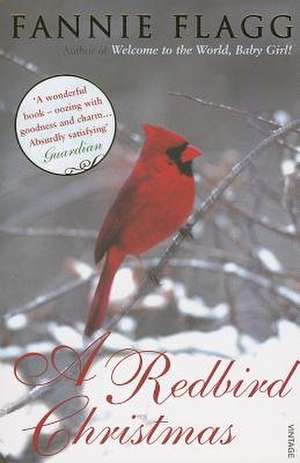
A Redbird Christmas
Autor Fannie Flaggen Limba Engleză Paperback – 3 noi 2005
Proza lui Fannie Flagg se distinge printr-o luminozitate rară, o voce caldă care transformă banalul cotidian în ceva aproape magic, fără a aluneca în sentimentalism excesiv. În acest volum, limba engleză devine un vehicul pentru o nostalgie blândă, invitându-ne într-un spațiu unde ritmul vieții este dictat de curgerea lentă a unui râu din Alabama. Considerăm că forța acestui text rezidă în capacitatea de a construi o lume — Lost River — care funcționează ca un personaj în sine, un refugiu pentru spiritele obosite. Observăm cum autoarea explorează temele credinței și ale speranței prin prisma lui Oswald T. Campbell, un bărbat care fuge de iarna aspră din Chicago pentru ceea ce crede a fi ultimul său Crăciun. În tradiția stabilită de Robyn Carr în All I Want for Christmas, acest roman reimaginează ideea de „acasă” ca fiind nu un loc de origine, ci o comunitate care te adoptă atunci când ai cea mai mare nevoie. Totuși, spre deosebire de realismul romantic al lui Carr, Flagg introduce elemente de un pitoresc aproape fabulos, precum societatea secretă a doamnelor „Royal Polka Dots” sau pasărea Jack, care devine catalizatorul unui miracol local. Poziționăm această lucrare ca o continuare tematică a explorărilor umane din Fried Green Tomatoes At The Whistle Stop Cafe. Dacă în celebrul său succes Flagg analiza prietenia și loialitatea în context istoric, aici se concentrează pe puterea vindecătoare a micilor comunități asupra individului izolat. Este o lectură cu un ton contemplativ, unde structura narativă nu mizează pe conflicte violente, ci pe dezvăluirea treptată a bunătății umane într-un cadru festiv.
Preț: 57.69 lei
Preț vechi: 78.39 lei
-26%
Carte disponibilă
Livrare economică 20 noiembrie-01 decembrie
Livrare express 03-07 noiembrie pentru 38.28 lei
Specificații
ISBN-10: 009949048X
Pagini: 224
Dimensiuni: 128 x 198 x 14 mm
Greutate: 0.16 kg
Editura: Vintage Publishing
Locul publicării:United Kingdom
V-ar putea interesa
-
 Can''t Wait to Get to HeavenFannie Flagg-25%Preț: 58.25 lei78.18 lei
 -
 Standing in the RainbowFannie FlaggPreț: 160.66 lei
 -
 -24%Preț: 55.13 lei72.79 lei
 -
 Preț: 102.82 lei
 -
 The Wonder Boy of Whistle StopFannie FlaggPreț: 104.03 lei
 -
 -26%Preț: 53.45 lei71.82 lei
 -
 -25%Preț: 70.91 lei94.21 lei
 -
 All I Want for ChristmasRobyn CarrPreț: 53.51 lei
 -
 'Tis the SeasonRobyn CarrPreț: 56.64 lei
 -
 Preț: 73.16 leiRecomandat
 -
 -12%Preț: 110.63 lei125.15 leiRecomandat
 -
 -25%Preț: 59.67 lei79.52 lei
 -
 -24%Preț: 60.77 lei80.16 lei
 -
 -23%Preț: 56.33 lei73.52 lei
 -
 -23%Preț: 86.17 lei111.26 lei
 -
 The Owl Who Came for ChristmasJohn Hay-40%Preț: 35.12 lei58.10 lei
 -
 The Bookseller's Gift: 'A festive feast of a novel' Cathy KellyFelicity Hayes-McCoy-24%Preț: 54.88 lei72.66 lei
 -
 -25%Preț: 59.90 lei79.65 lei
 -
 Christmas at the RanchJulia McKayPreț: 72.26 lei
De ce să citești această carte
Recomandăm această carte cititorilor care caută o poveste de Crăciun ce depășește clișeele de sezon. Veți descoperi o mică bijuterie literară despre a doua șansă și despre modul în care apartenența la o comunitate ne poate schimba destinul. Este un câștig cert pentru oricine apreciază atmosfera Sudului american și personajele excentrice, dar pline de demnitate, oferind o stare de bine autentică și o perspectivă luminoasă asupra fragilității vieții.
Despre autor
Fannie Flagg (născută Patricia Neal în 1944) este o figură polivalentă a culturii americane, fiind recunoscută atât ca actriță și comediană, cât și ca o voce literară de succes. A devenit celebră la nivel mondial odată cu publicarea romanului Fried Green Tomatoes At The Whistle Stop Cafe, pentru a cărui adaptare cinematografică a primit o nominalizare la premiile Oscar. Stilul său literar este profund ancorat în realitățile și farmecul statului Alabama, unde locuiește parțial. Lucrările sale sunt apreciate pentru modul în care celebrează viața în orașele mici și reziliența spiritului uman, elemente regăsite constant în opera sa vastă.
Notă biografică
Descriere
Extras
It was only November sixth but Chicago had just been hit with its second big blizzard of the season, and Mr. Oswald T. Campbell guessed he had stepped in every ice-cold ankle-deep puddle of dirty white slush it was possible to step in, trying to get to his appointment. When he finally arrived, he had used up every cussword in his rather large vocabulary of cusswords, owed in part to his short stint in the army. He was greeted by the receptionist and handed a clipboard.
“We received all your medical records and insurance forms, Mr. Campbell, but Dr. Obecheck likes to have a short personal history of his new patients, so could you please fill this out for us?”
Oh, God, he thought, why do they always make you fill something out? But he nodded cordially and sat down and started.
Name: Oswald T. Campbell
Address: Hotel De Soto, 1428 Lennon Avenue, Chicago, IL
Sex: Male
Age: 52
Hair: Some . . . Red
Eyes: Blue
Height: Five feet eight
Weight: 161 pounds
Marital status: Divorced
Children: No, thank God.
Closest living relative: Ex-wife, Mrs. Helen Gwinn, 1457 Hope Street, Lake Forest, IL
Please list your complaints below:
The Cubs need a new second baseman.
There were many more questions to fill out, but he just left them blank, signed his name, and handed it back to the girl.
Later, after his examination was over, as he sat shivering in a freezing room wearing nothing but a backless thin gray cotton gown, a nurse told him to get dressed; the doctor would meet him back in his office. Not only was he chilled to the bone and sore from just having been probed and prodded in many rude places, but now, to make matters worse, when he tried to put his shoes and socks back on they were still ice cold and sopping wet. He tried to wring the excess water out of his socks and managed to drip dye all over the floor. It was then he noticed that the dye from his socks had stained his feet a nice dark blue. “Oh, great!” he muttered to himself. He threw the socks in the trash basket and squished down the hall in cold wet leather shoes.
As he sat in the office waiting, he was bored and uncomfortable. There was nothing to read and he couldn’t smoke because he had lied to the doctor and told him he had given it up. He wiggled his toes, trying to get them warm, and glanced around the room. Everywhere he looked was gray. It was gray outside the office window and gray inside the office. Would it kill them to paint the walls a different color? The last time he had been at the VA hospital, a woman had come in and given a talk on how colors affect the mood. What idiot would pick gray? He hated going to doctors anyway, but his insurance company required him to have a physical once a year so some new bozo could tell him what he already knew. The doctor he had just seen was at least friendly and had laughed at a few of his jokes, but now he just wished the guy would hurry up. Most of the doctors they sent him to were old and ready to retire or just starting out and in need of guinea pigs to practice on. This one was old. Seventy or more, he guessed. Maybe that’s why he was taking so long. Gray walls, gray rug, gray gown, gray doctor.
Finally, the door opened and the doctor came in with his test results. Oswald said, “So, Doc, will I be able to run in the Boston Marathon again this year?”
This time the doctor ignored Oswald’s attempt to be humorous and sat down at his desk, looking rather somber.
“Mr. Campbell,” he said, “I’m not too happy about what I have to tell you. I usually like to have a family member present at a time like this. I see you have listed your ex-wife as immediate family. Would you like to call and see if she can come in?”
Oswald suddenly stopped wiggling his toes and paid attention. “No, that’s all right. Is there a problem?”
“I’m afraid so,” he said, as he opened his folder. “I’ve checked and rechecked your charts and records. I even called in another associate from down the hall, a pulmonary specialist, to consult, but unfortunately he agreed with my diagnosis. Mr. Campbell, I’m going to tell it to you straight. In your present condition you won’t live through another Chicago winter. You need to get out of here to a milder climate as soon as possible, because if you don’t—well, frankly, I’m not sure I would give you till Christmas.”
“Huh?” Oswald said, as if he were thinking it over. “Is that right?”
“Yes, it is. I’m sorry to report that since your last checkup the emphysema has progressed to the critical stage. Your lungs were already badly damaged and scarred from the childhood tuberculosis. Add all the years of heavy smoking and chronic bronchitis, and I’m afraid all it would take is one bad cold going into another bout of pneumonia.”
“Is that right? Huh,” Oswald said again. “That doesn’t sound too good.”
The doctor closed his folder and leaned forward on his desk, looked him right in the eye, and said, “No, it doesn’t. In all honesty, Mr. Campbell, considering the alarming rapidity with which this condition has advanced, even with you going to a better climate, the most optimistic prognosis I can give you is a year . . . maybe two.”
“You’re kidding,” said Oswald.
He shook his head. “No, I’m afraid not. At this stage, the emphysema is a strain on your heart and all your other organs. It’s not just the lungs that are affected. Now, I’m not telling you this to scare you, Mr. Campbell; I only tell you so you have time to make the appropriate plans. Get your estate in order.”
As stunned as he was at the news, Oswald almost laughed out loud at the word estate. He had never had more than two hundred and fifty dollars in the bank in his entire life.
The doctor continued. “Believe me, I wish the diagnosis had been better.” And the doctor meant it. He hated having to hand out bad news. He had just met Mr. Campbell, but he had liked the personable little guy at once. “Are you sure you don’t need me to call anyone for you?”
“No, that’s all right.”
“How will this news affect your future plans, Mr. Campbell?”
Oswald looked up at him. “Pretty damn adversely, I would say, wouldn’t you?”
The doctor was sympathetic. “Well, yes, of course. I just wondered what your future plans may have been.”
“I didn’t have anything in particular in mind . . . but I sure as hell hadn’t planned on this.”
“No, of course not.”
“I knew I wasn’t the picture of health, but I didn’t think I was headed for the last roundup.”
“Well, as I said, you need to get out of Chicago as soon as you can, somewhere with as little pollution as possible.”
Oswald looked puzzled. “But Chicago is my home. I wouldn’t know where else to go.”
“Do you have any friends living somewhere else—Florida? Arizona?”
“No, everybody I know is here.”
“Ah . . . and I assume you are on a limited budget.”
“Yeah, that’s right. I just have my disability pension.”
“Uh-huh. I suppose Florida might be too expensive this time of year.”
Never having been there, Oswald said, “I would imagine.”
The doctor sighed and leaned back in his chair, trying to think of some way to be of help. “Well, let’s see. . . . Wait a minute, there was a place my father used to send all his lung patients, and as I remember the rates were pretty reasonable.” He looked at Oswald as if he knew. “What was the name of that place? It was close to Florida. . . .” The doctor suddenly remembered something and stood up. “You know what? I’ve still got all his old files in the other room. Let me go and see if by any chance I can find that information for you.”
Oswald stared at the gray wall. Leave Chicago? He might as well leave the planet.
It was already dark and still freezing cold when Oswald left the office. As he rounded the corner at the Wrigley Building, the wind from the river hit him right in the face and blew his hat off. He turned and watched it flip over and over until it landed upside down in the gutter and began to float like a boat on down the block. Oh, the hell with it, he thought, until the frigid air blew through what little hair he did have left and his ears started to ache, so he decided to run after it. When he finally caught the hat and put it back on his head he realized he was now wearing wet shoes with no socks, a wet hat, and he had just missed his bus. By the time another bus finally came, he was completely numb from the cold plus the shock of the news he had just received. As he sat down, his eye caught the advertisement above his seat for Marshall Field’s department store: make this the best christmas ever. start your christmas shopping early this year. It suddenly dawned on him that, in his case, he had better start early and it might already be too late. According to the doctor, if he did live to see it, this Christmas could be his last.
Recenzii
“Satisfying . . . [Flagg’s] faith in the healing power of small towns and family is refreshing.”
–People
“[Flagg] keeps it simple, she keeps it bright, she keeps it moving right along–and, most of all, she keeps it beloved.”
–The New York Times Book Review
“You’d have to be a stone to read Welcome to the World, Baby Girl! without laughing and crying.”
–The Christian Science Monitor