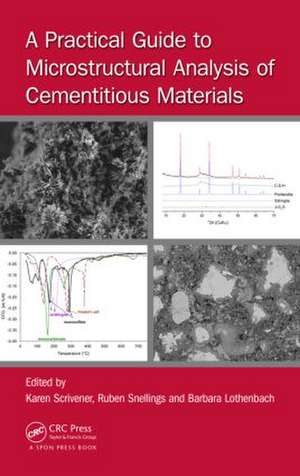
A Practical Guide to Microstructural Analysis of Cementitious Materials
Editat de Karen Scrivener, Ruben Snellings, Barbara Lothenbachen Limba Engleză Hardback – 22 dec 2015
Ne-a atras atenția A Practical Guide to Microstructural Analysis of Cementitious Materials prin modul riguros în care abordează tranziția de la concept la implementarea practică în laborator. Structura progresivă a volumului este concepută special pentru a ghida cercetătorul începător și practicianul experimentat prin toate etapele critice: de la protocolul riguros de pregătire a probelor, până la tehnici complexe de analiză a cineticii hidratării cimentului. Suntem de părere că valoarea adăugată a acestei lucrări rezidă în secțiunile dedicate „așa da/așa nu”, care ajută la evitarea erorilor comune în interpretarea rezultatelor experimentale.
Fiecare capitol este centrat pe o tehnică specifică — cum ar fi calorimetria, difracția de raze X (XRD) sau analiza termogravimetrică (TGA) — oferind nu doar fundamentul teoretic, ci și detalii aplicate despre echipamente și baze de date de referință. Pe linia practică a volumului Pore Structure of Cement-Based Materials de Kalliopi K. Aligizaki, dar cu focus pe diversitatea tehnicilor de caracterizare chimică și mineralogică, această carte devine un instrument indispensabil în laborator. De asemenea, lucrarea completează tematicile abordate de Karen Scrivener în Calcined Clays for Sustainable Concrete, oferind suportul tehnic necesar pentru a evalua performanța noilor lianți sustenabili la nivel microstructural.
Prin cele 320 de ilustrații și 39 de tabele, editorii Karen Scrivener, Ruben Snellings și Barbara Lothenbach reușesc să transforme o materie densă într-un manual operațional. Este o resursă care nu se limitează la descrierea tehnologiei, ci pune accent pe interpretarea corectă a diagramelor de fază și a datelor obținute prin microscopie electronică sau rezonanță magnetică nucleară (NMR), asigurând astfel validitatea științifică a cercetărilor în ingineria civilă.
Preț: 1509.01 lei
Preț vechi: 1995.96 lei
-24%
Carte indisponibilă temporar
Specificații
ISBN-10: 1498738656
Pagini: 560
Ilustrații: 320 black & white illustrations, 39 black & white tables
Dimensiuni: 156 x 234 x 35 mm
Greutate: 1.04 kg
Ediția:1
Editura: CRC Press
Colecția CRC Press
V-ar putea interesa
-
 A Practical Guide to Structure Determination in Organic ChemistryTimothy D. W. Claridge-12%Preț: 292.93 lei332.94 lei
 -
 Characterisation Methods in Inorganic ChemistryMark T. Weller-20%Preț: 406.58 lei511.31 lei
 -
 Concrete TechnologyA. M. Neville-15%Preț: 658.70 lei774.94 lei
 -
 Properties of ConcreteA. M. Neville-9%Preț: 608.88 lei669.10 lei
 -
 -27%Preț: 1117.84 lei1534.75 lei
 -
 Kern's Cardiac Catheterization HandbookPaul Sorajja-28%Preț: 393.87 lei544.20 leiRecomandat
 -
 Multiscale Modeling of ConcreteShanaka Kristombu Baduge-14%Preț: 1000.93 lei1163.88 lei
 -
 Preț: 437.86 lei
 -
 XAFS for EveryoneScott Calvin-9%Preț: 818.20 lei899.12 lei
 -
 -19%Preț: 509.00 lei628.39 lei
 -
 -31%Preț: 95.45 lei137.35 lei
 -
 Preț: 319.31 lei
 -
 NanocharacterisationAngus I Kirkland-14%Preț: 1348.06 lei1567.52 lei
 -
 Advances in the Characterisation of CeramicsRobert Freer-9%Preț: 1149.63 lei1263.32 lei
 -
 Preț: 333.31 lei
 -
 Techniques for Analysis of Mineral Raw MaterialsCarlos Pérez Bergmann-18%Preț: 1070.21 lei1305.13 lei
 -
 -15%Preț: 628.76 lei739.72 lei
 -
 Characterization of Condensed MatterYujun Song-14%Preț: 653.22 lei759.56 lei
 -
 Microstructural Characterisation TechniquesGunturi Venkata Sitarama SastryPreț: 374.09 lei
 -
 -18%Preț: 950.48 lei1159.13 lei
Public țintă
Professional Practice & DevelopmentDe ce să citești această carte
Recomandăm acest ghid inginerilor și cercetătorilor care au nevoie de un protocol clar pentru analiza materialelor cimentante. Veți câștiga o înțelegere profundă a limitărilor fiecărei tehnici de laborator, economisind timp prețios prin evitarea capcanelor experimentale descrise de experți. Este resursa ideală pentru a trece de la simpla colectare a datelor la o interpretare corectă și fundamentată a microstructurii cimentului.
Descriere scurtă
As advanced teaching and training in the development of cementitious materials increase, the need has emerged for an up-to-date practical guide to the field suitable for graduate students and junior and general practitioners.
Get the Best Use of Different Techniques and Interpretations of the Results
This edited volume provides the cement science community with a state-of-the-art overview of analytical techniques used in cement chemistry to study the hydration and microstructure of cements. Each chapter focuses on a specific technique, not only describing the basic principles behind the technique, but also providing essential, practical details on its application to the study of cement hydration. Each chapter sets out present best practice, and draws attention to the limitations and potential experimental pitfalls of the technique. Databases that supply examples and that support the analysis and interpretation of the experimental results strengthen a very valuable ready reference.
Utilizing the day-to-day experience of practical experts in the field, this book:
- Covers sample preparation issues
- Discusses commonly used techniques for identifying and quantifying the phases making up cementitious materials (X-ray diffraction and thermogravimetric analysis)
- Presents good practice oncalorimetry and chemical shrinkage methods for studying cement hydration kinetics
- Examines two different applications of nuclear magnetic resonance (solid state NMR and proton relaxometry)
- Takes a look at electron microscopy, the preeminent microstructural characterization technique for cementitious materials
- Explains how to use and interpret mercury intrusion porosimetry
- Details techniques for powder characterization of cementitious materials
- Outlines the practical application of phase diagrams for hydrated cements
Cuprins
Recenzii
—Pierre-Claude Aïtcin, Professor Emeritus Université de Sherbrooke, Canada
"The book is written on a high scientific level. … It incorporates all advanced testing techniques which are used in modern well-equipped laboratories."
—Hans W. Reinhardt, Professor Emeritus University of Stuttgart, Germany
"This book introduces detailed processes of micro-analyses which are useful for both researchers and practitioners. … The microstructural analysis of cementitious materials is being developed rapidly and is popular among industries and academia. The contents are very timely and can be expected to serve many engineers."
—Koichi Maekawa, The University of Tokyo, Japan