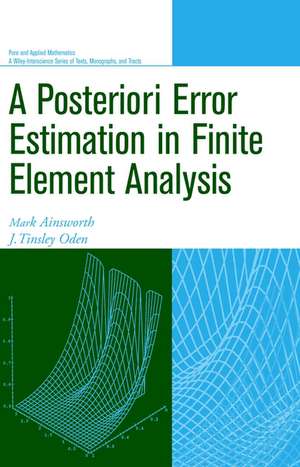
A Posteriori Error Estimation in Finite Element Analysis
Autor Mark Ainsworth, J Tinsley Odenen Limba Engleză Hardback – 4 sep 2000
Observăm că A Posteriori Error Estimation in Finite Element Analysis se constituie ca o resursă de referință unitară, menită să ofere un fundament matematic solid pentru o disciplină care a cunoscut o expansiune fulminantă în ultimii ani. Ediția de față sistematizează informația dispersată despre metodele de estimare a erorii a posteriori, esențiale pentru validarea și fiabilitatea simulărilor numerice. Notăm cu interes accentul pus pe problemele de valoare la limită eliptice, dar și extinderea către aplicații complexe, precum fluxurile incompresibile și fenomenele neliniare. Volumul tratează exhaustiv atât estimatorii impliciți, cât și pe cei expliciți, oferind o perspectivă clară asupra bazelor ierarhice și a metodei reziduurilor echilibrate. Cititorii familiarizați cu Reliable Methods for Computer Simulation vor aprecia modul în care Mark Ainsworth și J Tinsley Oden reușesc să pună bazele teoretice ale controlului erorii, trecând dincolo de simpla convergență a algoritmilor spre verificarea calitativă a soluțiilor. În timp ce alte lucrări, precum Verifying Calculations - Forty Years On, oferă o privire de ansamblu asupra evoluției istorice, acest volum se concentrează pe rigoarea analitică a instrumentelor de calcul. În contextul operei lui Mark Ainsworth, această lucrare rafinează conceptele prezentate în The Graduate Student's Guide to Numerical Analysis '98 și extinde preocupările pentru precizie demonstrate în Topics in Computational Wave Propagation. Structura este una lucidă, facilitând accesul cercetătorilor și inginerilor la metodologii de comparare a estimatorilor și la tehnici de recuperare a erorii, elemente critice în dezvoltarea algoritmilor adaptivi moderni.
Preț: 1206.36 lei
Preț vechi: 1325.67 lei
-9%
Carte tipărită la comandă
Livrare economică 02-16 septembrie
Specificații
ISBN-10: 047129411X
Pagini: 264
Dimensiuni: 161 x 240 x 19 mm
Greutate: 0.57 kg
Editura: Wiley
Locul publicării:Hoboken, United States
V-ar putea interesa
-
 ReckoningsStephen ChrisomalisPreț: 282.38 lei
 -
 Proofs 101: An Introduction to Formal MathematicsJoseph Kirtland-15%Preț: 439.90 lei517.54 lei
 -
 Abstract Intersections: A poetic journey through mathematicsKedar HardikarPreț: 97.65 lei
 -
 Matrices and DeterminiodsCullis-11%Preț: 507.29 lei570.00 lei
 -
 Handbook of Regression Analysis With Applications in RJeffrey S. Simonoff-23%Preț: 804.71 lei1045.07 lei
 -
 Fractional Order AnalysisHemen Dutta-9%Preț: 781.91 lei859.24 lei
 -
 The Physics CompanionAnthony C. Fischer-CrippsPreț: 415.84 lei
 -
 Cut the KnotAlexander BogomolnyPreț: 148.62 lei
 -
 Preț: 331.36 lei
 -
 Adjungierte Funktoren und primitive KlassenWalter FelscherPreț: 393.12 lei
 -
 Optimal Portfolio Management in Highly Volatile MarketsStoyan Stoyanov-15%Preț: 497.57 lei585.37 lei
 -
 Turbo MathematicsReena NarangPreț: 202.18 lei
 -
 Preț: 269.82 lei
 -
 Nonstandard Finite Difference Schemes: Methodology and ApplicationsRonald E Mickens-15%Preț: 694.77 lei817.38 lei
 -
 ELEMENTS OF LINEAR AND MULTILINEAR ALGEBRAJohn M ErdmanPreț: 479.01 lei
 -
 Metacyclic Groups and the D(2) ProblemFrancis E A Johnson-15%Preț: 696.76 lei819.71 lei
 -
 Global Solution for SudokuZhong-Qi MaPreț: 114.84 lei
 -
 X Games in Mathematics: Sports Training That Counts!Timothy P ChartierPreț: 256.51 lei
 -
 SCIENCE OF LEARNING MATHEMATICAL PROOFS, THEElana Reiser-15%Preț: 520.69 lei612.58 lei
 -
 INTRO TO NONAUTONOMOUS DYNAMICAL SYSTEMS & THEIR ATTRACTORPeter E Kloeden & Meihua YangPreț: 411.10 lei
 -
 EXPLORAT NUMER ANAL (PYTHON ED)Amber Sumner Mooney & V James V LambersPreț: 504.50 lei
 -
 RING THEORY 2019Shigeto Kawata Nanqing Hideto Asashiba-15%Preț: 691.01 lei812.95 lei
 -
 LINEAR ALGEBRA AND ITS APPLICATIONSMoh Tzuong-Tsieng-15%Preț: 582.52 lei685.31 lei
Public țintă
Researchers in almost any field of finite element methods. Graduate text in error estimation or in a sequel course to finite element method. Reference for Applied Mathematicians and Engineers who have an interest in error estimation and/or finite elements.De ce să citești această carte
Această lucrare este indispensabilă pentru cercetătorii și inginerii care utilizează metoda elementului finit și au nevoie de un control riguros asupra preciziei rezultatelor. Cititorul câștigă o înțelegere profundă a modului în care pot fi estimate erorile în cantități de interes practic, transformând simulările numerice din simple aproximări în instrumente de calcul fiabile și verificate matematic.
Despre autor
Mark Ainsworth este un specialist recunoscut în domeniul analizei numerice, contribuind semnificativ la literatura de specialitate prin lucrări care pun accent pe rigoarea matematică a metodelor computaționale. A coordonat și contribuit la volume esențiale precum The Graduate Student's Guide to Numerical Analysis '98 și a explorat teme avansate în Topics in Computational Wave Propagation. Expertiza sa acoperă o gamă largă de aplicații în matematică aplicată și inginerie, fiind un reper în dezvoltarea tehnicilor de estimare a erorii a posteriori.
Descriere scurtă
This volume presents the most up-to-date information available on a posteriori error estimation for finite element approximation in mechanics and mathematics. It emphasizes methods for elliptic boundary value problems and includes applications to incompressible flow and nonlinear problems.
Recent years have seen an explosion in the study of a posteriori error estimators due to their remarkable influence on improving both accuracy and reliability in scientific computing. In an effort to provide an accessible source, the authors have sought to present key ideas and common principles on a sound mathematical footing.
Topics covered in this timely reference include:
- Implicit and explicit a posteriori error estimators
- Recovery-based error estimators
- Estimators, indicators, and hierarchic bases
- The equilibrated residual method
- Methodology for the comparison of estimators
- Estimation of errors in quantities of interest