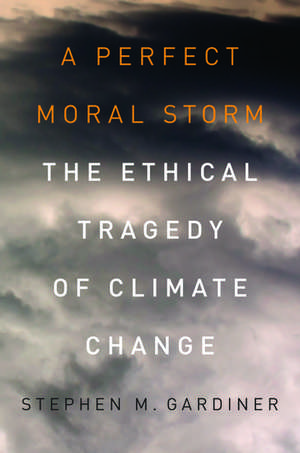
A Perfect Moral Storm: The Ethical Tragedy of Climate Change: Environmental Ethics and Science Policy Series
Autor Stephen M. Gardineren Limba Engleză Hardback – 14 iul 2011
Din seria Environmental Ethics and Science Policy Series
- 31%
 Preț: 725.33 lei
 - 23%
 Preț: 195.29 lei
 - 21%
 Preț: 348.72 lei
 - 19%
 Preț: 188.57 lei
 - 31%
 Preț: 602.40 lei
 - 21%
 Preț: 292.49 lei
 - 33%
 Preț: 1456.69 lei
 - 31%
 Preț: 773.56 lei
 - 24%
 Preț: 575.95 lei
 - 15%
 Preț: 431.58 lei
 - 31%
 Preț: 662.46 lei
 - 12%
 Preț: 310.54 lei
 - 11%
 Preț: 337.08 lei
 - 21%
 Preț: 286.64 lei
 - 28%
 Preț: 353.98 lei
Preț: 393.41 lei
Preț vechi: 494.73 lei
-20%
Puncte Express: 590
Carte tipărită la comandă
Livrare economică 03-09 decembrie
Livrare prin curier în România Termenul estimat este afișat lângă disponibilitate.
Transport gratuit de la 400.00 lei Plată online sau ramburs, în funcție de opțiunile comenzii.
Retur gratuit în 14 zile Comandă securizată și suport în română.
Specificații
ISBN-13: 9780195379440
ISBN-10: 0195379446
Pagini: 508
Ilustrații: black & white tables
Dimensiuni: 160 x 236 x 43 mm
Greutate: 0.79 kg
Editura: Oxford University Press
Colecția OUP USA
Seria Environmental Ethics and Science Policy Series
Locul publicării:New York, United States
ISBN-10: 0195379446
Pagini: 508
Ilustrații: black & white tables
Dimensiuni: 160 x 236 x 43 mm
Greutate: 0.79 kg
Editura: Oxford University Press
Colecția OUP USA
Seria Environmental Ethics and Science Policy Series
Locul publicării:New York, United States
V-ar putea interesa
-
 -18%Preț: 89.10 lei108.67 lei
 -
 Overheated: The Human Cost of Climate ChangeAndrew T. Guzman-24%Preț: 200.37 lei263.47 lei
 -
 -20%Preț: 85.33 lei106.67 lei
 -
 -31%Preț: 931.92 lei1355.20 lei
 -
 -31%Preț: 934.26 lei1354.43 lei
 -
 Down to the Wire: Confronting Climate CollapseDavid W. Orr-16%Preț: 158.12 lei188.87 lei
 -
 Climate TerrorSanjay Chaturvedi-15%Preț: 661.24 lei777.92 lei
 -
 Nitrogen and Climate ChangeD. ReayPreț: 397.29 lei
 -
 -11%Preț: 171.01 lei192.83 lei
 -
 How to Get Expelled from SchoolIan PlimerPreț: 168.74 lei
Recenzii
lucid and written with a philosopher's precision
Notă biografică
Stephen Gardiner is Associate Professor in the Department of Philosophy and the Program on Values in Society, University of Washington, Seattle.
Cuprins
- Preface
- Acknowledgements
- Introduction: A Global Environmental Tragedy
- I. Some Assumptions
- II. Introducing the Perfect Storm Metaphor
- III. Climate Change
- IV. The Wider Relevance of the Model
- V. Outline of the Book
- Part A: Overview
- 1.: A Perfect Moral Storm
- I. Why Ethics?
- II. The Global Storm
- III. The Intergenerational Storm
- IV. The Theoretical Storm
- V. The Problem of Moral Corruption
- 2.: A Consumption Tragedy
- I. What is the Point of Game Theory
- II. Motivating the Models
- III. A Green Energy Revolution?
- IV. Consumption and Happiness
- Part B: The Global Storm
- 3.: Somebody Else's Problem
- I. Past Climate Policy
- II. Somebody Else's Burden
- III. Against Optimism
- IV. Conclusion
- 4.: In the Shadow of a Common Tragedy
- I. Climate Prisoners?
- II. An Evolving Tragedy
- III. Beyond Pessimism
- IV. Lingering Tragedy
- V. Climate Policy in the Shadows
- VI. Conclusion
- Part C: The Intergenerational Storm
- 5.: The Tyranny of the Contemporary
- I. Problems with 'Generations'
- II. Intergenerational Buck-Passing
- III. Intergenerational Buck-Passing vs. The Prisoner's Dilemma
- IV. The Features of the Pure Intergenerational Problem
- V. Applications and Complications
- VI. Mitigating Factors
- VII. The Non-Identity Problem: A Quick Aside
- VIII. Against Undermining
- IX. Conclusion
- 6.: An Intergenerational Arms Race?
- I. Abrupt Climate Change
- II. Three Causes of Political Inertia
- III. Against Undermining
- IV. Conclusion
- Part D: The Theoretical Storm
- 7.: A Global Test for Political Institutions and Theories
- I. The Global Test
- II. Scenarios
- III. A Conjecture
- IV. Theoretical Vices
- V. An Illustration: Utilitarianism
- VI. Understanding the Complaint
- VII. Conclusion
- 8.: Cost-Benefit Analysis
- I. Cost-Benefit Analysis in Normal Contexts
- II. CBA for Climate Change
- III. The Presumption Against Discounting
- IV. The Basic Economics of the Discount Rate
- V. Discounting the Rich?
- VI. Declining Discount Rates
- VII. Two Objections to "Not Discounting"
- VIII. The "Devil's in the Details" Argument
- IX. Conclusions
- Part E: Moral Corruption
- 9.: Jane Austen vs. Climate Economics
- I. Corruption
- II. The Dubious Dashwoods: Initial Parallels
- III. The Opening Assault on the Status of the Moral Claim
- IV. The Assault on Content
- V. Indirect Attacks
- VI. The Moral of the Story
- 10.: Geoengineering in an Atomosphere of Evil
- I. An Idea that is Changing the World
- II. The Problem of Political Inertia Revisited
- III. Two Preliminary Arguments: Cost and "Research First"?
- IV. Arming the Future
- V. Arm the Present?
- VI. Evolving the Shadows
- VII. Underestimating 'Evil'
- VIII. An Atmosphere of Evil?
- IX. "Should We Do It?"
- Part F: What Now?
- Conclusion: The Immediate Future
- Postscript: Some Initial Ethics of the Transition
- I. Introduction
- II. The Ethics of Skepticism
- III. Past Emissions
- IV. Future Emissions
- V. Responsibility
- VI. Ideal Theory
- VII. Conclusion
- Appendices
- I. Hardin's Analysis
- II. Population as a Tragedy of the Commons
- III. Total Environmental Impact
- IV. Conclusion
- I. What the Scientists Know
- II. Certainty, Guesswork and the Missing Middle
- III. Conclusion