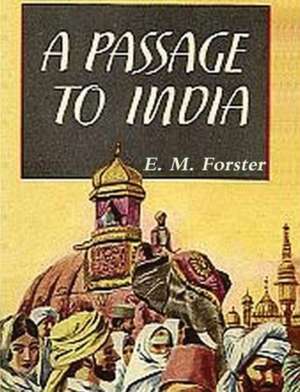
A Passage to India
Autor E. M. Forsteren Limba Engleză Paperback – 21 aug 2013
Preț: 91.25 lei
Puncte Express: 137
Carte tipărită la comandă
Livrare economică 25 noiembrie-01 decembrie
Livrare prin curier în România Termenul estimat este afișat lângă disponibilitate.
Transport gratuit de la 400.00 lei Plată online sau ramburs, în funcție de opțiunile comenzii.
Retur gratuit în 14 zile Comandă securizată și suport în română.
Specificații
ISBN-13: 9788087888087
ISBN-10: 8087888081
Pagini: 148
Dimensiuni: 189 x 246 x 8 mm
Greutate: 0.28 kg
Editura: Important Books
ISBN-10: 8087888081
Pagini: 148
Dimensiuni: 189 x 246 x 8 mm
Greutate: 0.28 kg
Editura: Important Books
V-ar putea interesa
-
 Interpreter of MaladiesJhumpa LahiriPreț: 71.98 lei
 -
 To the LighthouseVirginia WoolfPreț: 28.01 lei
 -
 To Kill a MockingbirdHarper Lee-19%Preț: 52.34 lei64.56 lei
 -
 Day Of The ScorpionPaul Scott-17%Preț: 60.44 lei72.65 lei
 -
 -18%Preț: 64.81 lei79.40 lei
 -
 Howards EndE. M. Forster-32%Preț: 49.40 lei72.96 lei
 -
 A Room with a ViewE. M. Forster-27%Preț: 47.22 lei64.74 lei
 -
 MauriceEdward Morgan Forster-26%Preț: 58.62 lei78.93 lei
 -
 Aspects of the NovelE. M. Forster-26%Preț: 57.92 lei78.50 lei
 -
 Preț: 91.18 lei
 -
 How to Get Filthy Rich In Rising AsiaMohsin Hamid-25%Preț: 59.20 lei79.27 lei
 -
 LolitaVladimir Nabokov-19%Preț: 58.66 lei72.03 lei
 -
 The PhotographPenelope Lively-57%Preț: 51.79 lei119.74 lei
 -
 -24%Preț: 60.82 lei80.55 lei
 -
 A Room with a ViewE. M. ForsterPreț: 39.76 lei
 -
 Heart of DarknessJoseph Conrad-19%Preț: 23.12 lei28.58 lei
 -
 A Room With A View. The Illustrated EditionE. M. ForsterPreț: 124.95 lei
 -
 Preț: 60.47 lei
 -
 -25%Preț: 59.52 lei79.76 lei
 -
 Preț: 123.20 lei
 -
 Where Angels Fear to TreadE. M. ForsterPreț: 46.23 lei
 -
 Forster, E: A Passage to IndiaE. M. ForsterPreț: 73.09 lei
 -
 A Sudden StormBali RaiPreț: 56.13 lei
 -
 Escape From AmritsarBali Rai-17%Preț: 35.54 lei42.71 lei
 -
 Half LightMahesh RaoPreț: 134.70 lei
 -
 What Will People Think?Vedashree Khambete-SharmaPreț: 72.85 lei
 -
 Arctic SummerDamon Galgut-36%Preț: 59.75 lei92.71 lei
 -
 Recognising the StrangerIsabella HammadPreț: 70.30 lei
 -
 Called by the HillsAnuradha RoyPreț: 92.91 lei
 -
 A Passage to IndiaEdward Morgan ForsterPreț: 109.97 lei
Notă biografică
Edward Morgan Forster was born in London in 1879, attended Tonbridge School as a day boy, and went on to King's College, Cambridge, in 1897. With King's he had a lifelong connection and was elected to an Honorary Fellowship in 1946. He declared that his life as a whole had not been dramatic, and he was unfailingly modest about his achievements. Interviewed by the BBC on his eightieth birthday, he said: 'I have not written as much as I'd like to . . . I write for two reasons: partly to make money and partly to win the respect of people whom I respect . . . I had better add that I am quite sure I am not a great novelist.' Eminent critics and the general public have judged otherwise and in his obituary The Times called him 'one of the most esteemed English novelists of his time'.He wrote six novels, four of which appeared before the First World War, Where Angels Fear to Tread (1905), The Longest Journey (1907), A Room with a View (1908), and Howard's End (1910). An interval of fourteen years elapsed before he published A Passage to India. It won both the Prix Femina Vie Heureuse and the James Tait Black Memorial Prize. Maurice, his novel on a homosexual theme, finished in 1914, was published posthumously in 1971. He also published two volumes of short stories; two collections of essays; a critical work, Aspects of the Novel; The Hill of Devi, a fascinating record of two visits Forster made to the Indian State of Dewas Senior; two biographies; two books about Alexandria (where he worked for the Red Cross in the First World War); and, with Eric Crozier, the libretto for Britten's opera Billy Budd. He died in June 1970.
Descriere
Descriere de la o altă ediție sau format:
A stunning new edition celebrating 100 years since first publication, with a new introduction by Kamila Shamsie, author of Home Fire, winner of the Women's Prize for Fiction
'There's no writer better than Forster at portraying the genuine feelings that are born from the interaction between one human being and another'
KAMILA SHAMSIE
'Forster's last and greatest novel'
DAMON GALGUT, GUARDIAN
'His great book . . . masterly in its prescience and its lucidity'
ANITA DESAI
'The first time I saw you, you were wanting to see India, not Indians, and it occurred to me: Ah, that won't take us far.'
The Indian town of Chandrapore seems to change dramatically season by season, day by day, offering different impressions from each angle it is viewed. Vulnerable to flooding, but blessed by glorious sun, it is surrounded by vast, flat expanses, except for hills to the south that house the extraordinary Marabar Caves.
When Mrs Moore and her younger travelling companion Adela arrive in town, they are frustrated and disappointed that all they can find is the claustrophobia of British colonial culture. Then a chance meeting with the charming and well-respected Dr Aziz seems to present the perfect opportunity to fulfil their desire to see the 'real India'.
But during a guided tour of the Marabar Caves, a strange incident occurs, resulting in a shocking accusation that throws Chandrapore into a fever of racial tension and the doctor straight into the heart of a scandal from which he might never recover.
A stunning new edition celebrating 100 years since first publication, with a new introduction by Kamila Shamsie, author of Home Fire, winner of the Women's Prize for Fiction
'There's no writer better than Forster at portraying the genuine feelings that are born from the interaction between one human being and another'
KAMILA SHAMSIE
'Forster's last and greatest novel'
DAMON GALGUT, GUARDIAN
'His great book . . . masterly in its prescience and its lucidity'
ANITA DESAI
'The first time I saw you, you were wanting to see India, not Indians, and it occurred to me: Ah, that won't take us far.'
The Indian town of Chandrapore seems to change dramatically season by season, day by day, offering different impressions from each angle it is viewed. Vulnerable to flooding, but blessed by glorious sun, it is surrounded by vast, flat expanses, except for hills to the south that house the extraordinary Marabar Caves.
When Mrs Moore and her younger travelling companion Adela arrive in town, they are frustrated and disappointed that all they can find is the claustrophobia of British colonial culture. Then a chance meeting with the charming and well-respected Dr Aziz seems to present the perfect opportunity to fulfil their desire to see the 'real India'.
But during a guided tour of the Marabar Caves, a strange incident occurs, resulting in a shocking accusation that throws Chandrapore into a fever of racial tension and the doctor straight into the heart of a scandal from which he might never recover.
Recenzii
“A Passage to India is one of the great books of the twentieth century and has had enormous influence. We need its message of tolerance and understanding now more than ever. Forster was years ahead of his time, and we ought to try to catch up with him.” –Margaret Drabble
“The crystal clear portraiture, the delicate conveying of nuances of thought and life, and the astonishing command of his medium show Forster at the height of his powers.” –The New York Times
“[Forster is] a supreme storyteller . . . The novel seems to me more completely ‘achieved’ than anything else he wrote.” –from the new Introduction by P. N. Furbank
“The crystal clear portraiture, the delicate conveying of nuances of thought and life, and the astonishing command of his medium show Forster at the height of his powers.” –The New York Times
“[Forster is] a supreme storyteller . . . The novel seems to me more completely ‘achieved’ than anything else he wrote.” –from the new Introduction by P. N. Furbank