
A Parametric Framework for Modelling of Bioelectrical Signals: Series in BioEngineering
Autor Yar M. Mughalen Limba Engleză Hardback – 13 ian 2016
Din seria Series in BioEngineering
- 15%
 Preț: 557.52 lei
 - 18%
 Preț: 1077.63 lei
 - 24%
 Preț: 902.61 lei
 - 13%
 Preț: 851.13 lei
 - 5%
 Preț: 1119.09 lei
 - 15%
 Preț: 621.78 lei
 - 5%
 Preț: 1376.64 lei
 - 5%
 Preț: 1540.38 lei
 - 5%
 Preț: 1057.37 lei
 - 5%
 Preț: 1239.60 lei
 - 15%
 Preț: 628.69 lei
 - 5%
 Preț: 1249.26 lei
 - 15%
 Preț: 621.36 lei
 - 5%
 Preț: 1121.17 lei
 - 5%
 Preț: 1238.88 lei
 - 18%
 Preț: 703.70 lei
 - 5%
 Preț: 1008.19 lei
 - 5%
 Preț: 1118.88 lei
 - 5%
 Preț: 689.53 lei
 - 5%
 Preț: 1241.35 lei
 - 15%
 Preț: 618.05 lei
 - 5%
 Preț: 1106.26 lei
 - 20%
 Preț: 589.97 lei
 - 5%
 Preț: 1362.57 lei
 - nou
 Preț: 868.36 lei
Preț: 614.85 lei
Preț vechi: 723.35 lei
-15%
Puncte Express: 922
Carte tipărită la comandă
Livrare economică 08-22 iunie
Specificații
ISBN-13: 9789812879684
ISBN-10: 9812879684
Pagini: 100
Ilustrații: XV, 81 p. 42 illus., 5 illus. in color.
Dimensiuni: 160 x 241 x 12 mm
Greutate: 0.33 kg
Ediția:1st edition 2016
Editura: Springer
Colecția Series in BioEngineering
Seria Series in BioEngineering
Locul publicării:Singapore, Singapore
ISBN-10: 9812879684
Pagini: 100
Ilustrații: XV, 81 p. 42 illus., 5 illus. in color.
Dimensiuni: 160 x 241 x 12 mm
Greutate: 0.33 kg
Ediția:1st edition 2016
Editura: Springer
Colecția Series in BioEngineering
Seria Series in BioEngineering
Locul publicării:Singapore, Singapore
V-ar putea interesa
-
 Neuroradiology SignsMai-Lan Ho-33%Preț: 591.75 lei882.71 lei
 -
 Emergency Radiology CasesHani H. Abujudeh-30%Preț: 788.67 lei1133.39 lei
 -
 Caffey's Pediatric Diagnostic Imaging, 2-Volume SetBrian D. Coley-25%Preț: 1493.69 lei1992.02 lei
 -
 -23%Preț: 570.27 lei741.04 lei
 -
 Fluorescence Spectroscopy and MicroscopyYves Engelborghs-5%Preț: 1392.33 lei1465.61 lei
 -
 Electron MicroscopyJohn Kuo-5%Preț: 1775.42 lei1868.86 leiRecomandat
 -
 Vascular CT Angiography ManualRobert Pelberg-5%Preț: 357.02 lei375.81 lei
 -
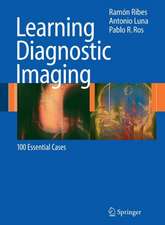 Learning Diagnostic Imaging: 100 Essential CasesRamón Ribes-5%Preț: 362.32 lei381.38 lei
 -
 Learning Cardiac ImagingRamón Ribes-5%Preț: 449.72 lei473.38 lei
 -
 High-Resolution Radiographs of the HandGiuseppe Guglielmi-5%Preț: 720.76 lei758.69 lei
 -
 Learning Musculoskeletal ImagingRamón Ribes-5%Preț: 366.69 lei385.99 lei
 -
 Radiology Illustrated: UroradiologySeung Hyup Kim-5%Preț: 2445.83 lei2574.56 lei
 -
 MDCT: From Protocols to PracticeMannudeep K. Kalra-5%Preț: 1086.53 lei1143.72 lei
Cuprins
Introduction and Motivation.- State of the Art of Modelling and Simulation of the Physiological Systems.- Proposed Novel Generic Framework for Modelling the Bioelectrical Information.- Implementation of the Framework and the Experimental Results.- Conclusions.
Textul de pe ultima copertă
This book examines non-invasive, electrical-based methods for disease diagnosis and assessment of heart function. In particular, a formalized signal model is proposed since this offers several advantages over methods that rely on measured data alone. By using a formalized representation, the parameters of the signal model can be easily manipulated and/or modified, thus providing mechanisms that allow researchers to reproduce and control such signals. In addition, having such a formalized signal model makes it possible to develop computer tools that can be used for manipulating and understanding how signal changes result from various heart conditions, as well as for generating input signals for experimenting with and evaluating the performance of e.g. signal extraction methods. The work focuses on bioelectrical information, particularly electrical bio-impedance (EBI). Once the EBI has been measured, the corresponding signals have to be modelled for analysis. This requires a structured approach in order to move from real measured data to the model of the corresponding signals. This book proposes a generic framework for this procedure. It can be used as a guide for modelling impedance cardiography (ICG) and impedance respirography (IRG) signals, as well as for developing the corresponding bio-impedance signal simulator (BISS).
Caracteristici
Presents non-invasive electrical-based methods for the diagnosis of the heart function modelling the measure signal Offers a framework to guide the modelling of the impedance cardiography and impedance respirography signals Gives freedom to the end-user to control the essential properties of the generated electrical bioimpedance signals depending on his/her needs