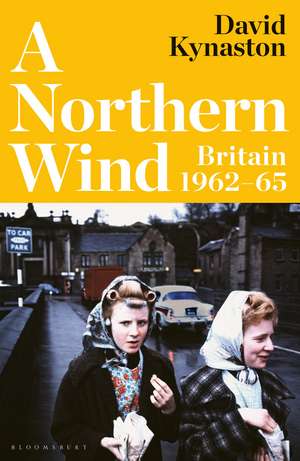
A Northern Wind: Britain 1962-65: Tales of a New Jerusalem
Autor David Kynastonen Limba Engleză Paperback – 4 iul 2024
The early sixties in Britain told as only David Kynaston ('the most entertaining historian alive' Spectator) can. Running from 1962 to 1965, A Northern Wind is the anticipated new volume in the landmark 'Tales of a New Jerusalem' series.
'From Daleks and dingy tower blocks to nuclear threats, this addictively readable book charts dizzying change . . . Sometimes moving, often comic, always fascinating'
DOMINIC SANDBROOK, SUNDAY TIMES
How much can change in two and a half years? In the case of Britain in the Sixties, the answer is: almost everything. From the seismic coming of Liverpool's the Beatles to a sex scandal that rocked the Tory government to the arrival at No 10 of Harold Wilson, a Yorkshireman utterly different from his Old Etonian predecessors.
A Northern Wind, the keenly anticipated next instalment of David Kynaston's acclaimed Tales of a New Jerusalem series, brings to vivid life the period between October 1962 and February 1965. Drawing upon an unparalleled array of diaries, newspapers and first-hand recollections, Kynaston's masterful storytelling refreshes familiar events - the Cuban Missile Crisis, the Big Freeze, the assassination of JFK, the funeral of Winston Churchill - while revealing in all their variety the experiences of the people living through this history.
Major themes complement the compelling narrative: an anti-Establishment mood epitomised by the BBC's controversial That Was The Week That Was; a welfare state only slowly becoming more responsive to the individual needs of its users; and the rise of consumer culture, as Habitat arrived and shopping centres like Birmingham's Bull Ring proliferated. Multi-voiced, multi-dimensional and immersive, Tales of a New Jerusalem has transformed how we see and understand post-war Britain. A Northern Wind continues the journey.
A WATERSTONES, TIMES, TELEGRAPH, NEW STATESMAN, SPECTATOR AND BBC HISTORY MAGAZINE BOOK OF THE YEAR
'Magnificent . . . The early Sixties have never been recounted so well'
THE TIMES, BOOKS OF THE YEAR
'A breathtaking array of treasures . . . A book to savour'
TLS
'Extraordinarily atmospheric, capturing more than anything a sense of what this moment might have felt like to live through'
FINANCIAL TIMES
'Kynaston is the most humane and even-handed chronicler of our time, and the one best-qualified to carry this mightily compelling national story onwards'
OBSERVER


Preț: 83.09 lei
Preț vechi: 109.61 lei
-24%
Puncte Express: 125
Carte disponibilă
Livrare economică 09-23 noiembrie
Livrare prin curier în România Termenul estimat este afișat lângă disponibilitate.
Transport gratuit de la 400.00 lei Plată online sau ramburs, în funcție de opțiunile comenzii.
Retur gratuit în 14 zile Comandă securizată și suport în română.
Specificații
ISBN-13: 9781526657565
ISBN-10: 1526657562
Pagini: 704
Dimensiuni: 130 x 198 x 46 mm
Greutate: 0.55 kg
Editura: Bloomsbury Publishing
Colecția Bloomsbury Publishing
Seria Tales of a New Jerusalem
Locul publicării:London, United Kingdom
ISBN-10: 1526657562
Pagini: 704
Dimensiuni: 130 x 198 x 46 mm
Greutate: 0.55 kg
Editura: Bloomsbury Publishing
Colecția Bloomsbury Publishing
Seria Tales of a New Jerusalem
Locul publicării:London, United Kingdom
V-ar putea interesa
-
 Cold War BritainCollins BooksPreț: 230.99 lei
 -
 Having It So GoodPeter Hennessy-18%Preț: 118.06 lei143.62 lei
 -
 Never AgainPeter HennessyPreț: 123.43 lei
 -
 Winds of ChangePeter Hennessy-17%Preț: 78.43 lei94.37 lei
 -
 The People's Peace: Britain Since 1945Kenneth O. Morgan-18%Preț: 130.95 lei159.24 lei
 -
 Never Had It So Good: A History of Britain from Suez to the BeatlesDominic Sandbrook-24%Preț: 105.72 lei139.84 lei
 -
 White Heat: A History of Britain in the Swinging SixtiesDominic Sandbrook-23%Preț: 97.15 lei126.38 lei
 -
 Austerity Britain, 1945-1951David Kynaston-32%Preț: 94.68 lei138.79 lei
 -
 -19%Preț: 115.40 lei143.23 lei
 -
 Family Britain, 1951-1957David Kynaston-31%Preț: 95.55 lei139.31 lei
 -
 Modernity Britain: 1957-1962David Kynaston-31%Preț: 97.28 lei140.33 lei
 -
 On the Cusp: Days of '62David Kynaston-50%Preț: 53.22 lei106.70 lei
 -
 Deep into the Sixties: Britain 1965–66David Kynaston-26%Preț: 206.68 lei279.17 leiNou
 -
 To See OurselvesAlistair MoffatPreț: 136.75 lei
 -
 A Classless SocietyAlwyn W. Turner-19%Preț: 115.70 lei142.24 lei
 -
 Glynne-Jones, T: Born in the 60sTim Glynne-JonesPreț: 51.94 lei
 -
 Everything Is NowJ. HobermanPreț: 207.36 lei
 -
 Britain, 1947David Kirby-20%Preț: 210.02 lei261.05 lei
Recenzii
From Daleks and dingy tower blocks to nuclear threats, this addictively readable book charts dizzying change . . . To readers addicted to David Kynaston's mighty chronicle of Britain's history since 1945, this collage, sometimes moving, often comic, always fascinating, will seem reassuringly familiar. Once again he weaves diaries, newspapers, TV listings and sports fixtures into a vast, multi-coloured tapestry, depicting almost every conceivable aspect of our national life . . . As always in Kynaston's series, dizzying change jostles with profound continuity . . . His tireless research turns up plenty of gems . . . It's the perfect note, democratic and hopeful, on which to end the latest instalment of this terrific series. I can't wait for the next
With a beady but compassionate eye, Kynaston ranges over public records and private diaries, political speeches and TV interviews, in conjuring this fresco of the panoramic and the intimate . . . Much of it chimes weirdly with our present moment . . . It is characteristic of Kynaston to present such opposing views and somehow to harmonise them. He is the most humane and even-handed chronicler of our time, and the one best qualified to carry this mightily compelling national story onwards
As in the earlier volumes of this vivid history of postwar Britain, Kynaston's primary aim is to document "a ceaseless pageant as, in all its daily variousness, it moves through time". This he achieves with a breathtaking array of treasures: diaries, provincial newspapers, political speeches, films and novels are woven together to provide a kaleidoscope of contrasting perspectives, defying any attempt to create a neat story of progress or nationhood . . . This is a richly evocative, thought-provoking and, above all, compassionate study of those who lived through the much-mythologised 1960s. We can only hope that when historians write about our own times, they will extend the same generosity of spirit
The latest volume in a magisterial series on post-war Britain reveals a nation poised for change . . . Moves continuously and skilfully between moments of high politics and the daily rumble of normal people's lives . Extraordinarily atmospheric, capturing more than anything a sense of what this moment in the early 1960s might have felt like to live through . . . Kynaston's assessment is clear and erudite . . . What Kynaston is doing with this book and the Tales of a New Jerusalem series more widely is providing a chronicle from the bottom up of contemporary British history
Here is an intricate tapestry that conveys the essence of the time . . . A Northern Wind is not a superficial exercise in heritage history, an attempt to dress up the past . . . It analyses complexities, teases out nuances and gauges the currents of continuity and change, many of which still flow today
A collage of fragments interlaced with penetrating analysis, this book is always humane, often hilarious, devoid of dogma and never condescending
Let us be grateful for the collage of little pictures that Kynaston gives us, surely the most hyperreal of historical accounts of this period we will ever have. And let us hope for more volumes soon
PRAISE FOR 'Tales of a New Jerusalem' : Volumes full of treasure, serious history with a human face
No other writer evokes Britain's past so well
Kynaston has created a living, breathing, talking, singing, dancing, grumbling and complaining portrait of the British . . . Groundbreaking
Few historians have the power to make you feel you actually inhabit the times they are writing about. Kynaston does
One of the most remarkable literary projects of this century
The real strength of the book, and the series, is Kynaston's focus on the voices from below. Drawing on a daunting array of diaries, letters and cultural ephemera ranging from the most pop to the highest brow, the book frames history through the ordinary person's experience
[A] readable and richly detailed social history of the post-war period: it catalogues under two-and-a-half years in which, it seemed, the whole country changed . . . For all its documentary richness, the book reminds us - indeed warns us - how so much can change so quickly'
With a beady but compassionate eye, Kynaston ranges over public records and private diaries, political speeches and TV interviews, in conjuring this fresco of the panoramic and the intimate . . . Much of it chimes weirdly with our present moment . . . It is characteristic of Kynaston to present such opposing views and somehow to harmonise them. He is the most humane and even-handed chronicler of our time, and the one best qualified to carry this mightily compelling national story onwards
As in the earlier volumes of this vivid history of postwar Britain, Kynaston's primary aim is to document "a ceaseless pageant as, in all its daily variousness, it moves through time". This he achieves with a breathtaking array of treasures: diaries, provincial newspapers, political speeches, films and novels are woven together to provide a kaleidoscope of contrasting perspectives, defying any attempt to create a neat story of progress or nationhood . . . This is a richly evocative, thought-provoking and, above all, compassionate study of those who lived through the much-mythologised 1960s. We can only hope that when historians write about our own times, they will extend the same generosity of spirit
The latest volume in a magisterial series on post-war Britain reveals a nation poised for change . . . Moves continuously and skilfully between moments of high politics and the daily rumble of normal people's lives . Extraordinarily atmospheric, capturing more than anything a sense of what this moment in the early 1960s might have felt like to live through . . . Kynaston's assessment is clear and erudite . . . What Kynaston is doing with this book and the Tales of a New Jerusalem series more widely is providing a chronicle from the bottom up of contemporary British history
Here is an intricate tapestry that conveys the essence of the time . . . A Northern Wind is not a superficial exercise in heritage history, an attempt to dress up the past . . . It analyses complexities, teases out nuances and gauges the currents of continuity and change, many of which still flow today
A collage of fragments interlaced with penetrating analysis, this book is always humane, often hilarious, devoid of dogma and never condescending
Let us be grateful for the collage of little pictures that Kynaston gives us, surely the most hyperreal of historical accounts of this period we will ever have. And let us hope for more volumes soon
PRAISE FOR 'Tales of a New Jerusalem' : Volumes full of treasure, serious history with a human face
No other writer evokes Britain's past so well
Kynaston has created a living, breathing, talking, singing, dancing, grumbling and complaining portrait of the British . . . Groundbreaking
Few historians have the power to make you feel you actually inhabit the times they are writing about. Kynaston does
One of the most remarkable literary projects of this century
The real strength of the book, and the series, is Kynaston's focus on the voices from below. Drawing on a daunting array of diaries, letters and cultural ephemera ranging from the most pop to the highest brow, the book frames history through the ordinary person's experience
[A] readable and richly detailed social history of the post-war period: it catalogues under two-and-a-half years in which, it seemed, the whole country changed . . . For all its documentary richness, the book reminds us - indeed warns us - how so much can change so quickly'
Notă biografică
David Kynaston was born in Aldershot in 1951. He holds a degree from the University of Oxford and a PhD from the London School of Economics and Political Science (LSE). He is the author of Austerity Britain, 1945-51; Family Britain, 1951-57; Modernity Britain 1957-1962; On the Cusp; Days of '62; and A Northern Wind: Britain 1962-65, all volumes in a series covering the history of post-war Britain (1945-79) under the collective title 'Tales of a New Jerusalem'. Till Time's Last Sand: A History of the Bank of England, 1694-2013 was published in 2017. He is also author of Arlott, Swanton and the Soul of English Cricket, co-authored with Stephen Fay, Engines of Privilege, co-authored with Francis Green, Shots in the Dark, an account of the 2016/17 season of David's football team, Aldershot and Richie Benaud's Blue Suede Shoes: The Story of an Ashes Classic co-authored with Harry Ricketts.