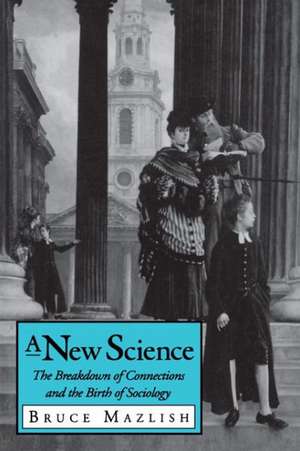
A New Science
Autor Bruce Mazlishen Limba Engleză Paperback – 21 mai 2004
Preț: 278.75 lei
Puncte Express: 418
Carte tipărită la comandă
Livrare economică 26 noiembrie-10 decembrie
Livrare prin curier în România Termenul estimat este afișat lângă disponibilitate.
Transport gratuit de la 400.00 lei Plată online sau ramburs, în funcție de opțiunile comenzii.
Retur gratuit în 14 zile Comandă securizată și suport în română.
Specificații
ISBN-13: 9780271025872
ISBN-10: 0271025875
Pagini: 348
Dimensiuni: 152 x 229 x 21 mm
Greutate: 0.57 kg
Editura: Pennsylvania State University Press
ISBN-10: 0271025875
Pagini: 348
Dimensiuni: 152 x 229 x 21 mm
Greutate: 0.57 kg
Editura: Pennsylvania State University Press
V-ar putea interesa
-
 The Space of Opinion: Media Intellectuals and the Public SphereRonald N. Jacobs-10%Preț: 250.49 lei279.28 lei
 -
 Stories of GlobalizationAlessandro BonannoPreț: 279.45 lei
 -
 Folkloric PovertyRebecca Overmyer-VelázquezPreț: 265.50 lei
 -
 ExitSara Lawrence-LightfootPreț: 115.42 lei
 -
 Approaches to the Qur'anG. R. Hawting-15%Preț: 469.69 lei552.57 lei
 -
 -23%Preț: 779.84 lei1012.78 lei
 -
 The Children of Immigrants at SchoolRichard AlbaPreț: 294.01 lei
 -
 Almost HomeKevin RyanPreț: 112.09 lei
 -
 -23%Preț: 685.58 lei890.36 lei
 -
 Cloning Wild LifeCarrie FriesePreț: 266.54 lei
 -
 Providing a Sure StartNaomi EisenstadtPreț: 257.04 lei
 -
 Wirtschaftsenglisch für Studium und BerufGabi GalsterPreț: 350.60 lei
Notă biografică
Bruce Mazlish is Professor of History at the Massachusetts Institute of Technology. He is a Fellow of the American Academy of Arts and Sciences and was awarded the Toynbee Prize for 1986-87. His books include The Fourth Discontinuity (1993), James and John Stuart Mill (1975), and The Western Intellectual Tradition, with J. Bronowski (1960).
Descriere
Descriere de la o altă ediție sau format:
In this book Bruce Mazlish examines the historical origins of sociology, especially in terms of its relationship to the humanities and to economics. He is particularly concerned with how omnipresent substitution of money for personal relations changed the nature of human relations in the nineteenth century. He examines the works of Wordsworth, Edmund Burke, Adam Smith, Thomas Carlyle, and particularly novelists such as Dickens, Elizabeth Gaskell, and George Eliot, and Benjamin Disraeli. Mazlish explores the influence of Darwin and his theories and presents Engels and Marx as precursors of the science of sociology. He then discusses the major founding figures of sociology: August Comte, Ferdinand Tonnies, Georg Simmel, Emile Durkheim, and Max Weber.
In this book Bruce Mazlish examines the historical origins of sociology, especially in terms of its relationship to the humanities and to economics. He is particularly concerned with how omnipresent substitution of money for personal relations changed the nature of human relations in the nineteenth century. He examines the works of Wordsworth, Edmund Burke, Adam Smith, Thomas Carlyle, and particularly novelists such as Dickens, Elizabeth Gaskell, and George Eliot, and Benjamin Disraeli. Mazlish explores the influence of Darwin and his theories and presents Engels and Marx as precursors of the science of sociology. He then discusses the major founding figures of sociology: August Comte, Ferdinand Tonnies, Georg Simmel, Emile Durkheim, and Max Weber.
Recenzii
'energetic and learned'Times Literary Supplement
'thoroughly engaging, breathing new life into a distinctly jaded subject ... The richness of the cultural references, and the urgency of the arguments, make A New Science an excellent text book for undergraduates. The passionate concern to make the history of the social sciences a matter of moral and political importance for today ought to ensure that the book also commands the attention of teachers in a number of disciplines.'Graham McCann, King's College, Cambridge, Social History of Medicine, Volume 3, Number 3, December 1990
'thoroughly engaging, breathing new life into a distinctly jaded subject ... The richness of the cultural references, and the urgency of the arguments, make A New Science an excellent text book for undergraduates. The passionate concern to make the history of the social sciences a matter of moral and political importance for today ought to ensure that the book also commands the attention of teachers in a number of disciplines.'Graham McCann, King's College, Cambridge, Social History of Medicine, Volume 3, Number 3, December 1990