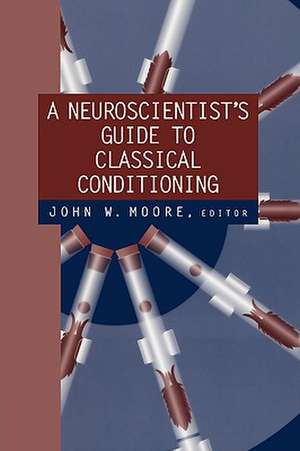
A Neuroscientist’s Guide to Classical Conditioning
Editat de John W. Mooreen Limba Engleză Paperback – 2002
Preț: 672.56 lei
Preț vechi: 791.25 lei
-15%
Puncte Express: 1009
Carte tipărită la comandă
Livrare economică 17 noiembrie-01 decembrie
Livrare prin curier în România Termenul estimat este afișat lângă disponibilitate.
Transport gratuit pentru acest produs Plată online sau ramburs, în funcție de opțiunile comenzii.
Retur gratuit în 14 zile Comandă securizată și suport în română.
Specificații
ISBN-13: 9780387988054
ISBN-10: 038798805X
Pagini: 323
Ilustrații: XX, 323 p.
Dimensiuni: 155 x 235 x 18 mm
Greutate: 0.49 kg
Ediția:Softcover reprint of the original 1st ed. 2002
Editura: Springer
Colecția Springer
Locul publicării:New York, NY, United States
ISBN-10: 038798805X
Pagini: 323
Ilustrații: XX, 323 p.
Dimensiuni: 155 x 235 x 18 mm
Greutate: 0.49 kg
Ediția:Softcover reprint of the original 1st ed. 2002
Editura: Springer
Colecția Springer
Locul publicării:New York, NY, United States
V-ar putea interesa
-
 The Gift of TherapyIrvin Yalom-5%Preț: 102.96 lei108.38 lei
 -
 The Meme MachineSusan Blackmore-20%Preț: 85.40 lei106.75 lei
 -
 Necessary KnowledgeHenry Plotkin-28%Preț: 408.22 lei567.69 lei
 -
 Beyond the Learning Curve: The construction of mindCraig Speelman-33%Preț: 575.87 lei853.92 lei
 -
 Brilliant Tactics to Pass Aptitude TestsSusan HodgsonPreț: 79.46 lei
 -
 The Learning SelfTennantPreț: 275.87 lei
 -
 Learning and AwarenessFerence MartonPreț: 423.78 lei
 -
 The Bullies' Predatory FootprintTerri RyanPreț: 84.70 lei
 -
 The Wiley Handbook on the Cognitive Neuroscience of LearningRobin A Murphy-23%Preț: 968.19 lei1257.39 lei
 -
 Facilitating Learning with the Adult Brain in MindKathleen TaylorPreț: 341.90 lei
 -
 AQA Psychology: AS and A-level Year 1Michael EysenckPreț: 380.19 lei
 -
 Mediated LearningMandia MentisPreț: 351.06 lei
 -
 Introduction to Brain-Compatible LearningEric JensenPreț: 219.64 lei
 -
 Keeping the Brain in MindShawn CarsonPreț: 157.99 lei
Public țintă
ResearchDescriere
Classical conditioning (CC) refers to the general paradigm for scientific studies of learning and memory initiated by Pavlov and his followers. As a model system associative learning in human and animals, CC continues to play a central role in research and an expanding role in evaluating disorders of learning and memory (aging, drug abuse, teratology). The book is aimed at the growing population of scientists and medical specialists who employ CC methods.Despite the current high level of interest in CC within neuroscience. There is presently no single source that provides up-to-date comprehensive coverage of core topics. CC is a very large field. Nevertheless, some organisms and behaviors have dominated the neuroscience scene. Foremost of these are classical eyeblink conditioning (rats, cats, rabbits, and humans) and 'fear' conditioning. This handbook of CC focuses on these systems.
Cuprins
Preface by John W. Moore, editor * Circumstances and Themes in the History of Classical Conditioning by S. R. Coleman * Cellular Mechanisms of Classical Conditioning by B. G. Schreurs and D. L. Alkon * Functional Utility and Neurobiology of Conditioned Autonomic Responses by R. W. Winters, P. M. McCabe and N. Schneiderman * The Functional Anatomy of Skeletal Conditioning by Germund Hesslow and Christopher H. Yeo * Classical Conditioning: Applications and Extensions to Clinical Neuroscience by P. R. Solomon * Fundamental Behavioral Methods and Findings in Classical Conditioning by E. J. Kehoe and M. Macrae * Computational Theories of Classical Conditioning by S. E. Brandon, E. H. Vogel, and A. R. Wagner *Index