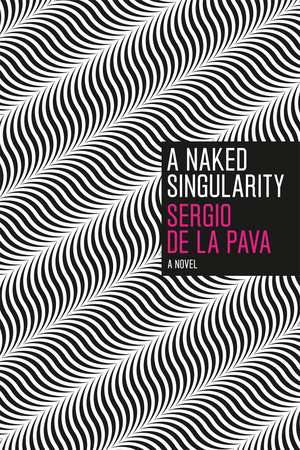
A Naked Singularity: A Novel
Autor Sergio De La Pavaen Limba Engleză Paperback – 19 apr 2012
*ONE OF THE WALL STREET JOURNAL'S TEN BEST BOOKS OF THE YEAR*
The mind-bending, brilliant, often hilarious PEN Award-winning classic novel of justice, the law, and the brutal gap between the two.
A Naked Singularity tells the story of Casi, a child of Colombian immigrants who lives in Brooklyn and works in Manhattan as a public defender--one who, tellingly has never lost a trial. Never. In the book, we watch what happens when his sense of justice and even his sense of self begin to crack--and how his world then slowly devolves. It’s a huge, ambitious novel clearly in the vein of DeLillo, Foster Wallace, Pynchon, and even Melville, and it's told in a distinct, frequently hilarious voice, with a striking human empathy at its center. Its panoramic reach takes readers through crime and courts, immigrant families and urban blight, media savagery and media satire, scatology and boxing, and even a breathless heist worthy of any crime novel. If InfiniteJest stuck a pin in the map of mid-90s culture and drew our trajectory from there, A Naked Singularity does the same for the feeling of surfeit, brokenness, and exhaustion that permeates our civic and cultural life today. In the opening sentence of William Gaddis’s A Frolic of His Own, a character sneers, "Justice? You get justice in the next world. In this world, you get the law." A Naked Singularity reveals the extent of that gap, and lands firmly on the side of those who are forever getting the law.
The mind-bending, brilliant, often hilarious PEN Award-winning classic novel of justice, the law, and the brutal gap between the two.
A Naked Singularity tells the story of Casi, a child of Colombian immigrants who lives in Brooklyn and works in Manhattan as a public defender--one who, tellingly has never lost a trial. Never. In the book, we watch what happens when his sense of justice and even his sense of self begin to crack--and how his world then slowly devolves. It’s a huge, ambitious novel clearly in the vein of DeLillo, Foster Wallace, Pynchon, and even Melville, and it's told in a distinct, frequently hilarious voice, with a striking human empathy at its center. Its panoramic reach takes readers through crime and courts, immigrant families and urban blight, media savagery and media satire, scatology and boxing, and even a breathless heist worthy of any crime novel. If InfiniteJest stuck a pin in the map of mid-90s culture and drew our trajectory from there, A Naked Singularity does the same for the feeling of surfeit, brokenness, and exhaustion that permeates our civic and cultural life today. In the opening sentence of William Gaddis’s A Frolic of His Own, a character sneers, "Justice? You get justice in the next world. In this world, you get the law." A Naked Singularity reveals the extent of that gap, and lands firmly on the side of those who are forever getting the law.
Preț: 152.09 lei
Puncte Express: 228
Carte disponibilă
Livrare economică 31 octombrie-14 noiembrie
Livrare prin curier în România Termenul estimat este afișat lângă disponibilitate.
Transport gratuit de la 400.00 lei Plată online sau ramburs, în funcție de opțiunile comenzii.
Retur gratuit în 14 zile Comandă securizată și suport în română.
Specificații
ISBN-13: 9780226141794
ISBN-10: 0226141799
Pagini: 688
Dimensiuni: 152 x 229 x 43 mm
Greutate: 0.93 kg
Editura: University of Chicago Press
Colecția University of Chicago Press
ISBN-10: 0226141799
Pagini: 688
Dimensiuni: 152 x 229 x 43 mm
Greutate: 0.93 kg
Editura: University of Chicago Press
Colecția University of Chicago Press
V-ar putea interesa
-
 -26%Preț: 53.20 lei71.48 lei
 -
 Lost EmpressSergio De La Pava-24%Preț: 71.23 lei94.34 lei
 -
 The Cut Throat TrialThe Secret Barrister-31%Preț: 74.80 lei109.00 lei
 -
 All That We See or SeemKen Liu-25%Preț: 108.71 lei144.40 lei
 -
 Great Black HopeRob Franklin-18%Preț: 89.08 lei108.46 lei
 -
 Every Arc Bends Its RadianSergio De La PavaPreț: 67.88 leiRecomandat
 -
 -19%Preț: 85.33 lei105.88 leiRecomandat
 -
 Doing JusticePreet Bharara-25%Preț: 54.40 lei72.72 lei
 -
 The Round HouseLouise Erdrich-25%Preț: 60.36 lei80.29 lei
 -
 The SystemRyan Gattis-32%Preț: 49.11 lei72.71 lei
 -
 The Silver StateGabriel Urza-32%Preț: 127.39 lei187.00 lei
 -
 Looking for CazabonLawrence ScottPreț: 76.46 lei
 -
 The Strange Case of Jane O.Karen Thompson WalkerPreț: 99.94 lei
 -
 -25%Preț: 82.65 lei109.89 lei
 -
 The Naked EyeYoko TawadaPreț: 124.16 lei
 -
 Brooklyn Crime NovelJonathan Lethem-18%Preț: 58.79 lei71.94 lei
 -
 Lawful Vol. 1Greg Pak-23%Preț: 70.98 lei92.05 lei
Notă biografică
Sergio De La Pava is a writer who does not live in Brooklyn.
Extras
[bod-y (bŏd ́ē) n., pl.—ies. 9. CJS. Inarguably odious term used by N.Y.C. Department of Correction and other court personnel to denote incarcerated criminal defendants: There are three hundred bodies in the system so we should be busy. He’s bringing the next batch of bodies down now, I’ll let you know if your guy’s one of them.]
And this was before anything even remotely insane had happened when I still occasionally thought about things like how it was that people were reduced to bodies, meaning the process. How you needed cops to do it and how their master, The System, needed to be constantly fed former people in order to properly function so that in a year typical to the city where the following took place about half a million bodies were forcibly conscripted. And if you learn only one thing from the ensuing maybe let it be this: the police were not merely interested observers who occasionally witnessed criminality and were then basically compelled to make an arrest, rather the police had the special ability to in effect create Crime by making an arrest almost whenever they wished, so widespread was wrongdoing. Consequently, the decision on who would become a body was often affected by overlooked factors like the candidate’s degree of humility, the neighborhood it lived in, and most often the relevant officers’ need for overtime.
None of which tells you the exact process by which someone, let’s say You, becomes a body, which account I sort of impliedly semi-promised, so imagine you are on the street, then in an incident, then a stranger’s hand is on your melon making sure it doesn’t bang the half-blue/half-white American-only car with the colorful bar across the top. Imagine that, easy if you try. Now the police have twenty-four hours to get you in front of a judge for your criminal court arraignment but if you’re the perceptive sort you will monitor Time’s ceaseless consumption of this period yet rightly detect no corresponding increase in ambient urgency.
Your first stop is the appropriate precinct where the arresting officer or A/O stands you before another cop known as the Desk Sergeant. He tells him the tale of your alleged sin and the two, speaker and audience, join their heads to decide what section(s) of the New York Penal Law to charge you with. Now you’ve been informally charged and with that out of the way you may be asked to remove all your clothes (the propriety of this being debated at the time) and kindly spread open your ass. This strip search is one of several ways that additional charges can still arise so while you may have been arrested for a triviality like displaying an open bottle of Heineken to the public—a prosecution normally conducted in a decidedly minor key and resolved right at arraignments—your glove-clad searcher may now discover what you most sought to conceal, that you are currently holding one of the area’s surfeit of readily-available-yet-technically-illicit anesthetics in amounts ranging anywhere from the ghostly residue of celebrations past to multiple powder bricks and in locations as presumably inviolable as within your underwear or even up your ass or maybe you possess one of the other less popular forms of the all-inclusive law enforcement term contraband. In that way can minor breaches be converted into major faults and this happens often, not occasionally. The police know this and are therefore unlikely to ignore even nonsense like the above Consumption of Alcohol in a Public Place (AC §10.125). People like you know this as well yet permit it to alter their conduct not in the slightest, ensuring in the process that the number of bodies will always remain fairly constant.
Another way you have to be careful not to pick up more charges is by resisting capture, even if only verbally, because such conduct can incite some of your lesser blue pacifists into a bit of retributory violence, with said violence then necessitating that you be charged with Resisting Arrest (PL §205.30) if only by way of explaining your injuries; which injuries better be minor lest they result in the added felony charge of Assault in the Second Degree (PL §120.05[3]), a more extensive explanation whereby a misdemeanor assault becomes a felony one by virtue of involving a police officer.
Still at the precinct, you are printed, each of your fingers rolled in black ink then onto vestal white paper. The resulting bar code is sent to Albany for the purpose of producing a rap sheet, an accordiony collection of onion paper that means everything where you are. It means everything because sentencing like Physics and other sciences builds on what came before so that the worse your past was, the worse your present will be, and no sane person doubts the rap sheet’s depiction of the past since it’s based on unalterable fingerprints and not relative ephemera like names or social security numbers. I say no sane person because when once confronted by an individual who steadfastly claimed not to recall in the slightest what I deemed to be a highly memorable conviction on his sheet and one that substantially increased his exposure, I asked him if he planned to launch a Lockean defense whereby he could not be held responsible for something he didn’t remember as such act was not properly attributable to his personal identity at which point he gave me the blankest of stares in response then started saying increasingly odd things in rapid succession until I realized that he not only sort of knew what I was talking about, which was weird enough, but that he was undeniably insane and my ill-advised Locke reference was like the thing coming after the final straw to tip him over the Axis-II-Cluster-A edge, as it were, so that I thenceforth stopped doing things like that.
Now there’s all this paperwork the A/O has to fill out and he’ll stick you in the precinct’s cell while he fills. But first, if the case has any seriousness whatsoever, he and his friends want to accumulate evidence against you and since the best evidence is quite often the very words you emit, they mostly want you to make a statement, and trust me when I tell you that by the time they’re through with you you’ll probably want you to make a statement as well. Because while the police operated under something called the forty-eight hour rule which stated that an officer charged with any kind of official misconduct cannot be questioned about it for forty-eight hours—giving him time to, among other things, retain a criminal defense attorney—you are currently operating under a different forty-eight hour rule. This one says the police can harass, intimidate, lie, cheat, steal, cajole, make false promises, and delay your arraignment (where you would be assigned an attorney who would most assuredly not allow you to speak to the police) for forty-eight hours if that’s what it takes to extract your statement. And it is following all that, not at the very instant you’re arrested as mass entertainment would have you believe, that they will advise you of your Miranda rights so your ensuing statement will be admissible.
And this is as good a time as any for you, gentle reader, to learn that I can wander a bit while storytelling so that the very imminent digressive passage on the judicial creation of Miranda warnings can be entirely skipped by the uncurious without the slightest loss of narrative steam.
Digression begins. So Ernesto Miranda is the Miranda of the warnings and the same year a famous shooter(s) would later scatter John Fitzgerald all over Jackie he was twenty-three and creating smaller-scale mayhem. A high school dropout with the mental development of an eighth-grader, Miranda had already served one year on an attempted rape conviction. In a perpendicular universe, an eighteen-year-old Phoenix girl who I’m Digression begins. So Ernesto Miranda is the Miranda of the warnings and the same year a famous shooter(s) would later scatter John Fitzgerald all over Jackie he was twenty-three and creating smaller-scale mayhem. A high school dropout with the mental development of an eighth-grader, Miranda had already served one year on an attempted rape conviction. In a perpendicular universe, an eighteen-year-old Phoenix girl who I’m going to say strove to dress like the glossy girls she saw in magazines and to listen to the same records as her more desirable classmates indisputably acted as attendant to some movie theater’s candy counter, the true home of such an operation’s profits incidentally. She sold synthetic butter and liquid Real Things and when done tried to go home. Enter Miranda who interrupted her trip home. He grabbed her, dragged her into his car, and drove her out into the Red, Brown, and Purple of the Painted Desert where he raped her.
Fast forward one week when the girl briefly saw what she thought was the car driven by her assailant, a 1953 Packard. She reported this belief to the police, telling them the license plate of the car was DFL312. That plate turned out to be registered to an Oldsmobile but the police discovered that DFL317 was registered to a Packard—a Packard owned by Twila N. Hoffman, Ernesto Miranda’s girlfriend. Off to 2525 West Mariposa (Oeste Butterfly) Street where Miranda was found to fit the description given by the girl. He was arrested and placed in a line-up. The girl said he most resembled the rapist but failed to make an unequivocally positive identification.
Detectives took Miranda into Interrogation Room Two where he was told he had been identified as the rapist and asked if he wanted to make a statement. He did, a signed written confession that took two hours to elicit following his initial denial of guilt and that included a section saying he understood his rights. Miranda was charged and assigned an attorney. The attorney, Alvin Moore, had plenty on his neck, however, and for a well-spent $100 he objected that the confession had been illegally obtained because no one told Ernesto, prior to his statement, that he had the right to an attorney. The trial judge said no way to that and after the jury consequently heard the confession, and was surely impressed by it, he got to prescribe twenty to thirty years in special housing as a remedy. Ernesto wondered if he could appeal and he could.
The ACLU grabbed the case and 976 days later they were in front of the court that never gets overruled with John Flynn saying, and this is a direct quote (no it isn’t): “look dudes, and I refer to you thusly because this is way pre-O’Connor/Ginsberg, your Fifth Amendment deal is only protecting the rich and powerful: those who are brainy enough to know what their rights are or who have the dough to rent a lawyer.” The Warren Supremes actually agreed and, in the kind of decision that makes maybe five people happy, held that before future police could torment some illiterate sap who nobody cares about into confessing his sins, real or imagined, they would have to inform him of certain rights not covered in your average eighth-grade Social Studies class. As is customary in these all-too-rare instances, Miranda’s conviction was reversed and his case set down for retrial—a trial to be conducted without his now tainted confession, without any physical evidence of a struggle, and with a dubious identification. In a stroke of all-too-common prosecutorial serendipity, however, Miranda’s common-law wife, the previously-mentioned Twila, emerged to testify that Miranda had admitted the rape to her. The fact that she and Miranda were then involved in a bitter custody dispute—are these ever otherwise described?—was conveniently ignored and the new jury said something to the effect of where are your Supremes now because we agree with the first jury. Miranda was eventually paroled then, the same year his country celebrated its two-hundredth birthday party, stabbed and killed in a Phoenix bar fight. As the police arrested one of his assailants they took care to read him his Miranda rights in English and Spanish. Digression ends.
Recenzii
"One of the 10 best fiction books of 2012. . . . A propulsive, mind-bending experience. . . . The novel's chaotic sprawl, black humor and madcap digressions make it a thrilling rejoinder to the tidy story arcs portrayed on television and in most crime fiction. . . . Whatever the book loses in polish it amply repays in its uncompromising originality."
Winner of the PEN/Robert W. Bingham Prize for Best Debut Novel of 2012
“Strange and mesmerizing, alternating between trenchant social realism and madcap Pynchon-esque farce, it’s a great book that remains, in a word, singular.”
"A Naked Singularity is not about physics. It's about the American criminal justice system in a large and chaotic city, a place slowly crushed by hopelessness in the same way that an ancient star is gradually crushed by gravity. . . . The novel is a densely packed and offhandedly poetic 678 pages. . . . It is about a city that teeters on the edge of total collapse and complete disaster, but that has the capacity to right itself (whew!) at the last possible second. . . . The novel is a cross between Moby-Dick and Police Academy. Between Descartes and Disneyland. Between Henry James and Henry Winkler."
"Mesmerising."
"This book is ambitious. It's 678 octavo pages--about 13,000 tweets. It's the sort of book you write if you're not sure anyone will ever let you write another one. . . . Even while the lives it describes are often bleak, the book is funny, consistently so. . . . The heist is discussed so exhaustively that when it finally transpires it's thrilling. Casi's defendants, all messes, are lovely and authentic. I could have done with a whole book about them, or rather I enjoyed the whole book about them I read in the middle of this much larger book about other things. A story of a death penalty case begins drenched in irony and grows ever more serious. . . . It's a fine thing for an author to bring forth something so unapologetically maximalist."
"Casi's voice is the combination of brashness and world-weary humanity you'd find in a cynic who'd been scratched to reveal the disappointed idealist beneath. . . . The whole feels like The Recognitions as legal thriller, a glorious mess with dashes of Powers, minor Pynchon, and White Noise, among many others. . . . [I]n its ambitions and shortcomings and shaggy glory, A Naked Singularity is perhaps most reminiscent of The Broom of the System. So that bodes well."
"One of the best and most original novels of the decade. . . . It's one of those fantastic, big, messy books like Darconville's Cat or Infinite Jest or Women and Men, though it's not really like any of those books or those writers. . . . . But see here: I refuse to divulge too much of the plot, because watching it unfold is one of the great joys of the novel. . . . . What I keep coming back to is the audacity of this novel, which is truly a towering, impressive work--De La Pava's not hesitant to break and then mirror the narrative with the story of professional boxer Wilfred Benitez, or insert a recipe, none of which hinder the narrative but rather shape the entirety of the book, making the actual story and its effect on the characters (and the characters' actions that shape the story, et cetera) more profound. . . . If you like The Wire, if you like rewarding, difficult fiction, if you like literary, high-quality artistic and hilarious yet moving novels that are difficult to put down, I can’t recommend A Naked Singularity enough."
"A Naked Singularity looks like an unreadable brick, bloated at 700 pages and likely dense with esoterica. Instead it is a fine encyclopedic romp in the Joyce/Pynchon/Wallace tradition, one with an effortless flow and arresting setting: the American judicial system as vortical funhouse."
"Weird, brilliant."
"The manic prose fights viciously against an ultimate collapse of good into evil--but not only is there no escape; there was never any such thing."
"A work of amazing breadth and humor. . . . Challenging, addictively entertaining and not to be missed, A Naked Singularity heralds the arrival of a tremendous talent."
"I strongly encourage you to overcome whatever hesitation the phrase 700-page self-published novel may inspire in you and pick it up. It is a beautiful monster of a book, a novel that left this reviewer, at least, feeling like maybe there's some point in reading novels--and writing them--after all."
"It's staggering to think this novel is De La Pava's major publishing launch: A Naked Singularity is considerably better than most debuts and has unquestionably rendered De La Pava an author to watch."
"'Buzz' is a dirty word in reviewing circles, being a close cousin to 'hype' and often having the same air about it of ad copy generated by publicity departments. It's the kind of word that should put you immediately on guard: Just where is this buzz coming from? Who is doing the buzzing? That said, sometimes buzz can be a good thing. Sergio De La Pava's A Naked Singularity is a case in point. . . . A Naked Singularity is . . . a great American novel: large, ambitious, and full of talk. . . . We can be thankful that this time the buzz did its work."
"When I started reading A Naked Singularity, after a page or two I realized I was going to love it--and I did--but why? I've never sat down to analyze what it is that makes me read a book voraciously from cover to cover, fretting when I have to put it down and longing through the day to get back to it. I like, admire, appreciate a whole range of books and am happy to devote my time and attention to them, but the ones that take me over are rarer. . . . Casi's voice is astonishing, cynical but compassionate, alive to the ridiculous and the pitiful and the horrific but never losing its commitment to morality."
A Philadelphia City Paper Book of the Year
"Exuberant, hyperverbal . . . a minor masterpiece of humor, paranoia, and even flashy technique."
"Sergio De La Pava brings linguistic energy and grim hilarity to this furious novel about the dysfunctional criminal-justice system. His novel evokes such maximalist masterpieces of the 1970s as Robert Coover's Public Burning and William Gaddis's J R--he has Coover's rage and Gaddis's ear--yet also grapples with current issues hot off the AP wire. Socially engaged, formally inventive, and intellectually challenging, A Naked Singularity is a remarkable performance."
"One of the best books of 2012."
Descriere
Descriere de la o altă ediție sau format:
NOW A MAJOR FILM STARRING JOHN BOYEGA, OLIVIA COOKE AND BILL SKARSGÅRD
"The Wire written by Voltaire" Sunday Times
"Crime and Punishment as reimagined by the Coen Brothers" The Millions
Casi is a hotshot public defender working on the front line of America's War on Drugs. So far he's on the winning side. He's never lost a case. But nothing lasts forever, and pride like his has a long way to fall.
Funny, smart and always surprising, A Naked Singularity speaks a language all of its own and reads like nothing else ever written. Casi's beautiful mind and planetary intelligence make him an inimitable and unforgettable narrator.
In De La Pava's hands, the labyrinthine miseries of the New York Justice System are as layered and diabolical as Dante's nine circles of Hell. But the Devil doesn't hog the best lines. There are plenty here to go around.
NOW A MAJOR FILM STARRING JOHN BOYEGA, OLIVIA COOKE AND BILL SKARSGÅRD
"The Wire written by Voltaire" Sunday Times
"Crime and Punishment as reimagined by the Coen Brothers" The Millions
Casi is a hotshot public defender working on the front line of America's War on Drugs. So far he's on the winning side. He's never lost a case. But nothing lasts forever, and pride like his has a long way to fall.
Funny, smart and always surprising, A Naked Singularity speaks a language all of its own and reads like nothing else ever written. Casi's beautiful mind and planetary intelligence make him an inimitable and unforgettable narrator.
In De La Pava's hands, the labyrinthine miseries of the New York Justice System are as layered and diabolical as Dante's nine circles of Hell. But the Devil doesn't hog the best lines. There are plenty here to go around.