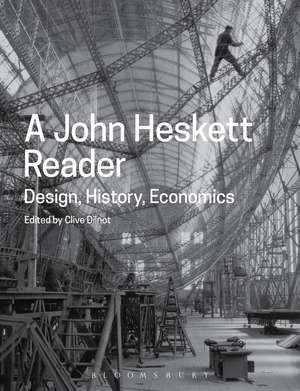
A John Heskett Reader: Design, History, Economics
Editat de Clive Dilnot Autor John Hesketten Limba Engleză Paperback – 28 iul 2016
Heskett, who passed away in early 2014, was a pioneering British-born writer and lecturer. His research was foundational for the study of industrial design, and his research into the relationship between design, policy and economic value is still a regular reference-point for academics and students alike. This anthology represents well the great range of his work, covering such varied topics as the growth of Japanese industrialism, modernism in the Third Reich, and 1980's corporate design management. Including both hard-to-access and previously unpublished material like Crafts, Commerce and Industry and Economic Value of Design, the book demonstrates Heskett's passionate interest in exploring the relationship of design and making with economic value across the entirety of human history.
Featured texts include, What is Design, Chinese Design: what can we learn from the past?, The 'American System' and Mass Production, The Industrial Applications of Tubular Steel, Creative Destruction: the nature and consequences of change through design, Reflections on Design and Hong Kong, besides many others.
Preț: 261.82 lei
Preț vechi: 308.05 lei
-15%
Puncte Express: 393
Carte tipărită la comandă
Livrare economică 25 noiembrie-09 decembrie
Livrare prin curier în România Termenul estimat este afișat lângă disponibilitate.
Transport gratuit de la 400.00 lei Plată online sau ramburs, în funcție de opțiunile comenzii.
Retur gratuit în 14 zile Comandă securizată și suport în română.
Specificații
ISBN-13: 9781474221269
ISBN-10: 1474221262
Pagini: 382
Ilustrații: 30 bw illus
Dimensiuni: 154 x 234 x 24 mm
Greutate: 0.59 kg
Editura: Bloomsbury Publishing
Colecția Bloomsbury Academic
Locul publicării:London, United Kingdom
ISBN-10: 1474221262
Pagini: 382
Ilustrații: 30 bw illus
Dimensiuni: 154 x 234 x 24 mm
Greutate: 0.59 kg
Editura: Bloomsbury Publishing
Colecția Bloomsbury Academic
Locul publicării:London, United Kingdom
V-ar putea interesa
-
 Design: A Very Short IntroductionJohn Heskett-19%Preț: 57.52 lei71.35 lei
 -
 -13%Preț: 134.60 lei154.31 lei
 -
 Hot DeskLaura DickermanPreț: 109.71 lei
 -
 Sega Mega Drive/Genesis: Ultimate WorksKeith StuartPreț: 403.31 lei
 -
 Thomas HeatherwickThomas Heatherwick-13%Preț: 292.62 lei334.75 lei
 -
 -21%Preț: 267.18 lei336.77 lei
 -
 50 Design Ideas You Really Need to KnowJohn Jervis-28%Preț: 50.78 lei70.05 lei
 -
 -30%Preț: 133.32 lei190.75 lei
 -
 Designing for PeopleHenry DreyfussPreț: 119.42 lei
 -
 Preț: 193.36 lei
 -
 Year of the RatHarry ShukmanPreț: 106.72 lei
 -
 Take Me to the RiverJackie KempPreț: 144.22 lei
 -
 On the Shadow TracksClare HammondPreț: 94.27 lei
 -
 Preț: 274.34 lei
 -
 History of Modern Design Second EditionDavid Raizman-23%Preț: 276.32 lei358.01 lei
 -
 The Shortest History of EconomicsAndrew LeighPreț: 72.12 lei
 -
 The Nature of FashionCarry SomersPreț: 160.49 lei
 -
 The Designs of Arne JacobsenThomas Dickson-8%Preț: 401.35 lei436.25 lei
 -
 Designed to StayGestalten-8%Preț: 434.08 lei471.83 lei
 -
 Culture DesignJames D. WhitePreț: 187.28 lei
Cuprins
Introduction: Clive Dilnot
I. Key Themes
Introduction
1. What is Design?
2. Commerce or Culture? Industrialization and Design
3. Design from the Standpoint of Economics/Economics
from the Standpoint of Design
II. Design in History & the History of Design
Introduction
(A) Designing and Making in the Pre-Industrial World
4. Some Lessons of Design History
5. Crafts, Commerce, Industry
6. Chinese Design: What Can We Learn from the Past?
7. Three moments in the History of Making: Nomads, Traders, Slaves
(B) Designing in the Industrial World
8. The 'American System' and Mass Production
9. Writing the History of Design in the Industrial World
10. The Growth of Industrial Design in Japan
(C) Design in Germany 1870-1945
11. Government Policy & German Design 1870-1918
12. The Industrial Applications of Tubular Steel
13. Modernism and Archaism in Design in the Third Reich
III. Design, Business, Economics
Introduction
(A) Corporate design strategies
Sharon Helmer Poggenpohl: Design between Economics and Practice
14. GM: The Price of Corporate Arrogance
15. Everything Changes, Nothing Alters
16. Design Management in Phillips in the 1980s
17. Teaching an Old Dog New Tricks: How RCA is using
Design as a Strategic Tool
18. Current and Future Demands on Hong Kong Designers
(B) National Design Policies
Carlos Texeiria: John Heskett and design policy
19. National Design Policy and Economic Change
20. Learning from Germany's Integrated Design Policy
21. Design and Industry in China
22. A Design Policy for the UK: Three Suggestions
(C) Creating Value by Design
Tore Kristensen: John Heskett's contribution to the business
and economics of design
23. Creative Destruction: The Nature and Consequences
of Change through Design
24. Product Integrity
25. Cultural Human Factors
26: Creating Economic Value by Design
IV. Reflections
Introduction
27. Past, Present and Future in Design
28. Reflections on Design and Hong Kong
29. On Writing
V. Last Words
30. Can the Centre Hold?
List of acronyms
Contributors
Permissions and Acknowledgments
Appendix: A first bibliography of John Heskett's published work
Index
I. Key Themes
Introduction
1. What is Design?
2. Commerce or Culture? Industrialization and Design
3. Design from the Standpoint of Economics/Economics
from the Standpoint of Design
II. Design in History & the History of Design
Introduction
(A) Designing and Making in the Pre-Industrial World
4. Some Lessons of Design History
5. Crafts, Commerce, Industry
6. Chinese Design: What Can We Learn from the Past?
7. Three moments in the History of Making: Nomads, Traders, Slaves
(B) Designing in the Industrial World
8. The 'American System' and Mass Production
9. Writing the History of Design in the Industrial World
10. The Growth of Industrial Design in Japan
(C) Design in Germany 1870-1945
11. Government Policy & German Design 1870-1918
12. The Industrial Applications of Tubular Steel
13. Modernism and Archaism in Design in the Third Reich
III. Design, Business, Economics
Introduction
(A) Corporate design strategies
Sharon Helmer Poggenpohl: Design between Economics and Practice
14. GM: The Price of Corporate Arrogance
15. Everything Changes, Nothing Alters
16. Design Management in Phillips in the 1980s
17. Teaching an Old Dog New Tricks: How RCA is using
Design as a Strategic Tool
18. Current and Future Demands on Hong Kong Designers
(B) National Design Policies
Carlos Texeiria: John Heskett and design policy
19. National Design Policy and Economic Change
20. Learning from Germany's Integrated Design Policy
21. Design and Industry in China
22. A Design Policy for the UK: Three Suggestions
(C) Creating Value by Design
Tore Kristensen: John Heskett's contribution to the business
and economics of design
23. Creative Destruction: The Nature and Consequences
of Change through Design
24. Product Integrity
25. Cultural Human Factors
26: Creating Economic Value by Design
IV. Reflections
Introduction
27. Past, Present and Future in Design
28. Reflections on Design and Hong Kong
29. On Writing
V. Last Words
30. Can the Centre Hold?
List of acronyms
Contributors
Permissions and Acknowledgments
Appendix: A first bibliography of John Heskett's published work
Index
Recenzii
The Heskett reader is a must for designers, historians, economists, and students who are considering the charged relationship between design and the world. In a remarkable collection, Dilnot has brought together essays that make Heskett's global and multidisciplinary reach evident. It is a pleasure to see Heskett's classic texts - along with some of his unpublished work - brought together in one marvellous book.
John Heskett's personal voice, quiet intensity, and certain integrity bring to his writings on design an unshakeable sense of its profound implications. This collection encompasses early work in design history, reflections on design in business, and observations on design in Hong Kong, and also summarizes events of his substantial career.
From design history's early years in the 1970s to governments worldwide reengaging with design in the 2000s, Heskett brought a clear, inimitable voice to design writing, thinking and practice and shaped how generations of designers and historians learnt to see design: embedded in economic and social structures, and having real social and economic impact. The readings collected here underscore the importance of design for policymaking, past and present, and show how economics and policymaking benefit from a historian's eye. His ideas are as fresh and important now as when first written.
Heskett's distinctive contribution to the early shaping of design history introduced social, political and economic history as integral dimensions of study and research in the field. He later contributed insights into design economics, policy and management at a time when such terms were too often bandied about imprecisely.
Clive Dilnot's edition of A John Heskett Reader: Design, History, Economics is a curious anomaly to all of the above Reader categories. This is the first Reader in design history that is singularly arranged around the oeuvre of one of its pioneers.Dilnot's mission is to present a selection of Heskett's writing-not to pick it apart but to provide starting points for further enquiry.
John Heskett's personal voice, quiet intensity, and certain integrity bring to his writings on design an unshakeable sense of its profound implications. This collection encompasses early work in design history, reflections on design in business, and observations on design in Hong Kong, and also summarizes events of his substantial career.
From design history's early years in the 1970s to governments worldwide reengaging with design in the 2000s, Heskett brought a clear, inimitable voice to design writing, thinking and practice and shaped how generations of designers and historians learnt to see design: embedded in economic and social structures, and having real social and economic impact. The readings collected here underscore the importance of design for policymaking, past and present, and show how economics and policymaking benefit from a historian's eye. His ideas are as fresh and important now as when first written.
Heskett's distinctive contribution to the early shaping of design history introduced social, political and economic history as integral dimensions of study and research in the field. He later contributed insights into design economics, policy and management at a time when such terms were too often bandied about imprecisely.
Clive Dilnot's edition of A John Heskett Reader: Design, History, Economics is a curious anomaly to all of the above Reader categories. This is the first Reader in design history that is singularly arranged around the oeuvre of one of its pioneers.Dilnot's mission is to present a selection of Heskett's writing-not to pick it apart but to provide starting points for further enquiry.
Notă biografică
Clive Dilnot is professor of Design Studies at Parsons The New School for Design, New York, USA. Recent publications include Ethics? Design? (2005) and the text for Chris Killip: Pirelli Work (2007).