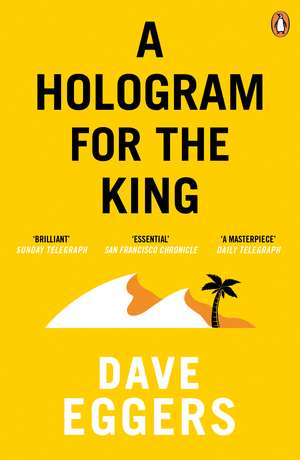
A Hologram for the King
Autor David Eggersen Limba Engleză Paperback – 5 sep 2013
Recomandăm A Hologram for the King cititorului care caută în literatură nu doar o poveste, ci o oglindă a vulnerabilității umane în fața mecanismelor reci ale globalizării. Este o lectură esențială pentru cei fascinați de intersecția dintre eșecul personal și cel sistemic, oferind o perspectivă melancolică asupra a ceea ce înseamnă să încerci să „faci ceva măreț” atunci când lumea pe care o cunoșteai se transformă radical. Subliniem modul în care David Eggers construiește figura lui Alan Clay, un comis-voiajor modern care așteaptă, într-un decor deșertic și aproape ireal din Arabia Saudită, o audiență cu regele care nu mai vine. Departe de America măcinată de recesiune, Clay devine un simbol al „deplasării” — atât fizice, cât și existențiale. Pe același raft cu A Calling for Charlie Barnes de Joshua Ferris, această carte se distinge prin atmosfera sa de așteptare febrilă și prin modul în care tehnologia (holograma promisă) devine o metaforă pentru fragilitatea speranțelor noastre. Notăm cu interes cum Eggers se îndepărtează de tonul confesiv din A Heartbreaking Work of Staggering Genius pentru a adopta o proză mai sobră, dar la fel de empatică. Dacă în The Parade autorul explora moștenirea colonialismului, aici el chestionează prezentul imediat, punând sub lupă presiunea de a rămâne relevant într-o economie care pare să fi depășit individul. Stilul este precis, cu accente comice care subliniază tragismul situației, transformând periplul lui Clay într-o elegie modernă pentru clasa de mijloc americană.
Preț: 58.82 lei
Preț vechi: 120.80 lei
-51%
Carte disponibilă
Livrare economică 30 octombrie-10 noiembrie
Livrare express 14-20 octombrie pentru 82.96 lei
Specificații
ISBN-10: 0241145864
Pagini: 336
Dimensiuni: 130 x 198 x 27 mm
Greutate: 0.24 kg
Editura: Penguin Books
Locul publicării:London, United Kingdom
V-ar putea interesa
-
 Behold the DreamersImbolo MbuePreț: 78.83 lei
 -
 WHO WILL REMAIN HBKasim AliPreț: 139.45 lei
 -
 SLEEP HBHonor JonesPreț: 138.88 lei
 -
 WorkhorseCaroline Palmer-18%Preț: 86.29 lei105.79 lei
 -
 A Love Story from the End of the WorldJuhea KimPreț: 105.53 lei
 -
 Some Bright NowhereAnn PackerPreț: 133.83 lei
 -
 How to Get Filthy Rich In Rising AsiaMohsin Hamid-27%Preț: 57.03 lei78.03 lei
 -
 Here I AmJonathan Safran Foer-34%Preț: 61.54 lei93.76 lei
 -
 The CircleDavid EggersPreț: 65.67 lei
 -
 A Calling for Charlie BarnesJoshua Ferris-19%Preț: 50.26 lei62.38 lei
 -
 -25%Preț: 85.49 lei114.62 lei
 -
 VigilGeorge SaundersPreț: 153.00 lei
 -
 Caledonian RoadAndrew O'HaganPreț: 76.06 lei
 -
 Swords of IceLatife TekinPreț: 60.68 lei
 -
 Super Sad True Love StoryGary ShteyngartPreț: 78.82 lei
 -
 The Garbage KingElizabeth Laird-33%Preț: 38.66 lei57.42 lei
 -
 -19%Preț: 86.84 lei106.79 lei
 -
 -19%Preț: 85.33 lei105.88 leiRecomandat
 -
 The Literati: A NovelSusan CollPreț: 78.41 lei
 -
 The Pentecost PapersFerdinand Mount-26%Preț: 100.59 lei135.69 lei
 -
 Take Me to the RiverJackie KempPreț: 144.22 lei
 -
 Help Wanted: A Barack Obama Reading Pick 2024Adelle Waldman-19%Preț: 57.94 lei71.42 lei
 -
 PalaverBryan WashingtonPreț: 108.48 lei
 -
 One Day, Everyone Will Have Always Been Against ThisOmar El AkkadPreț: 121.88 lei
 -
 Vera, Or FaithGary ShteyngartPreț: 105.54 lei
 -
 Super Sad True Love StoryGary ShteyngartPreț: 71.45 lei
 -
 Every Time We Say GoodbyeIvana SajkoPreț: 77.34 lei
De ce să citești această carte
Această carte este pentru cei care apreciază romanele de atmosferă ce explorează criza de identitate a bărbatului modern. Veți găsi o poveste despre reziliență și eșec, scrisă cu o claritate tăioasă. Este o oportunitate de a înțelege, prin ochii unui personaj memorabil, cum forțele economice globale ne modelează cele mai intime dorințe și obligații familiale.
Despre autor
David Eggers (născut la 12 martie 1970) este o figură centrală a literaturii americane contemporane, fiind scriitor, editor și filantrop. S-a făcut remarcat prin volumul de memorii A Heartbreaking Work of Staggering Genius, devenind ulterior un susținător activ al cauzelor sociale. Este fondatorul prestigioasei reviste literare McSweeney's și al proiectului educațional 826 Valencia. Opera sa, care include titluri precum Zeitoun sau The Every, oscilează între ficțiune speculativă și reportaj literar, fiind mereu ancorată în problemele etice și sociale ale prezentului.
Notă biografică
He is the founder of McSweeney's and the cofounder of 826 Valencia, a youth writing center that has inspired similar programs around the world, and of ScholarMatch, which connects donors with students to make college accessible. He is the winner of the Dayton Literary Peace Prize and is the cofounder of Voice of Witness, a book series that illuminates human rights crises through oral history.
He is a member of the American Academy of Arts and Letter. His work has been translated into forty- two languages.
www.Internationalcongressofyouthvoices.org
www.826valencia.org
www.scholarmatch.org
www.voiceofwitness.org
www.valentinoachakdeng.org
www.mcsweeneys.net
www.daveeggers.net
Recenzii
A spare but moving elegy for the American century
Completely engrossing
Dave Eggers is a prince among men when it comes to writing deeply felt, socially conscious books that meld reportage with fiction. [Hologram] is a strike against the current state of global economic in justice
Descriere scurtă
In a rising Saudi Arabian city, far from weary, recession-scarred America, a struggling businessman pursues a last-ditch attempt to stave off foreclosure, pay his daughter's college tuition, and finally do something great. In A Hologram for the King, Dave Eggers takes us around the world to show how one man fights to hold himself and his splintering family together in the face of the global economy's gale-force winds. This taut, richly layered, and elegiac novel is a powerful evocation of our contemporary moment - and a moving story of how we got here.
Praise for A Hologram for the King:
'Absorbing . . . modest and equally satisfying: the writing of a comic but deeply affecting tale about one man's travails that also provides a bright, digital snapshot of our times' Michiko Kakutani, New York Times
'A fascinating novel' New Yorker
'A spare but moving elegy for the American century' Publishers Weekly
'Eggers understands the pressures of American downward-mobility, and in the protagonist of his novel, Alan Clay, has created an Everyman, a post-modern Willy Loman . . . The novel operates on a grand and global scale, but it also is intimate' Chicago Tribune
'Completely engrossing' Fortune
'Eggers can do fiction as well as he likes' Los Angeles Times
Dave Eggers is the author of six previous books: A Heartbreaking Work of Staggering Genius, How We Are Hungry, You Shall Know Our Velocity, What is the What, The Wild Things and Zeitoun. Zeitoun was the winner of the American Book Award and the Dayton Literary Peace Prize and What is the What was a finalist for the 2006 National Book Critics Circle Award and won France's Prix Médicis. Eggers is the founder and editor of McSweeney's, an independent publishing house based in San Francisco. A native of Chicago, he lives in Northern California with his wife and two children.
Extras
Alan Clay woke up in Jeddah, Saudi Arabia. It was May 30, 2010. He had spent two days on planes to get there.
In Nairobi he had met a woman. They sat next to each other while they waited for their flights. She was tall, curvy, with tiny gold earrings. She had ruddy skin and a lilting voice. Alan liked her more than many of the people in his life, people he saw every day. She said she lived in upstate New York. Not that far away from his home in suburban Boston.
If he had courage he would have found a way to spend more time with her. But instead he got on his flight and he flew to Riyadh and then to Jeddah. A man picked him up at the airport and drove him to the Hilton.
With a click, Alan entered his room at the Hilton at 1:12 a.m. He quickly prepared to go to bed. He needed to sleep. He had to travel an hour north at seven for an eight o’clock arrival at the King Abdullah Economic City. There he and his team would set up a holographic teleconference system and would wait to present it to King Abdullah himself. If Abdullah was impressed, he would award the IT contract for the entire city to Reliant, and Alan’s commission, in the mid-six figures, would fix everything that ailed him.
So he needed to feel rested. To feel prepared. But instead he had spent four hours in bed not sleeping.
He thought of his daughter, Kit, who was in college, a very good and expensive college. He did not have the money to pay her tuition for the fall. He could not pay her tuition because he had made a series of foolish decisions in his life. He had not planned well. He had not had courage when he needed it.
His decisions had been short sighted.
The decisions of his peers had been short sighted.
These decisions had been foolish and expedient.
But he hadn’t known at the time that his decisions were short sighted, foolish or expedient. He and his peers did not know they were making decisions that would leave them, leave Alan, as he now was — virtually broke, nearly unemployed, the proprietor of a one-man consulting firm run out of his home office.
He was divorced from Kit’s mother, Ruby. They had now been apart longer than they had been together. Ruby was an unholy pain in the ass who now lived in California and contributed nothing financially to Kit’s finances. College is your thing, she told him. Be a man about it, she said.
Now Kit would not be in college in the fall. Alan had put his house on the market but it had not yet sold. Otherwise he was out of options. He owed money to many people, including $18k to a pair of bicycle designers who had built him a prototype for a new bicycle he thought he could manufacture in the Boston area. For this he was called an idiot. He owed money to Jim Wong, who had loaned him $45k to pay for materials and the first and last on a warehouse lease. He owed another $65k or so to a half-dozen friends and would-be partners.
So he was broke. And when he realized he could not pay Kit’s tuition, it was too late to apply for any other aid. Too late to transfer.
Was it a tragedy that a healthy young woman like Kit would take a semester off of college? No, it was not a tragedy. The long, tortured history of the world would take no notice of a missed semester of college for a smart and capable young woman like Kit. She would survive. It was no tragedy. Nothing like tragedy.
They said it was a tragedy what had happened to Charlie Fallon. Charlie Fallon froze to death in the lake near Alan’s house. The lake next to Alan’s house.
Alan was thinking of Charlie Fallon while not sleeping in the room at the Jeddah Hilton. Alan had seen Charlie step into the lake that day. Alan was driving away, on his way to the quarry. It had not seemed normal that a man like Charlie Fallon would be stepping into the shimmering black lake in September, but neither was it extraordinary.
Charlie Fallon had been sending Alan pages from books. He had been doing this for two years. Charlie had discovered the Transcendentalists late in life and felt a kinship with them. He had seen that Brook Farm was not far from where he and Alan lived, and he thought it meant something. He traced his Boston ancestry, hoping to find a connection, but found none. Still, he sent Alan pages, with passages highlighted.
The workings of a privileged mind, Alan thought. Don’t send me more of that shit, he told Charlie. But Charlie grinned and sent more.
So when Alan saw Charlie stepping into the lake at noon on a Saturday he saw it as a logical extension of the man’s new passion for the land. He was only ankle-deep when Alan passed him that day.
II.
When Alan woke in the Jeddah Hilton he was already late. It was 8:15. He had fallen asleep just after five.
He was expected at the King Abdullah Economic City at eight. It was at least an hour away. After he showered and dressed and got a car to the site it would be ten. He would be two hours late on the first day of his assignment here. He was a fool. He was more a fool every year.
He tried Cayley’s cellphone. She answered, her husky voice. In another lifetime, a different spin of the wheel wherein he was younger and she older and both of them stupid enough to attempt it, he and Cayley would have been something terrible.
—Hello Alan! It’s beautiful here. Well, maybe not beautiful. But you’re not here.
He explained. He did not lie. He could no longer muster the energy, the creativity required.
—Well, don’t worry, she said, with a small laugh — that voice of hers implied the possibility of, celebrated the existence of a fantastic life of abiding sensuality — we’re just setting up. But you’ll have to get your own ride. Any of you know how Alan will get a ride out here?
She seemed to be yelling to the rest of the team. The space sounded cavernous. He pictured a dark and hollow place, three young people holding candles, waiting for him and his lantern.
—He can’t rent a car, she said to them.
And now to him: —Can you rent a car, Alan?
—I’ll figure it out, he said.
He called the lobby.
—Hello. Alan Clay here. What’s your name?
He asked names. A habit Joe Trivole instilled back in the Fuller Brush days. Ask names, repeat names. You remember people’s names, they remember you.
The clerk said his name was Edward.
—Edward?
—Yes sir. My name is Edward. Can I help you?
—Where are you from, Edward?
—Jakarta, Indonesia, sir.
—Ah, Jakarta, Alan said. Then realized he had nothing to say about Jakarta. He knew nothing about Jakarta.
—Edward, what do you think of me renting a car through the hotel?
—Do you have an international driver’s license?
—No.
—Then no, I don’t think you should do this.
Alan called the concierge. He explained he needed a driver to take him to the King Abdullah Economic City.
—This will take a few minutes, the concierge said. His accent was not Saudi. There were apparently no Saudis working at this Saudi hotel. Alan had assumed as much. There were few Saudis working anywhere, he’d been told. They imported their labor in all sectors. We must find someone appropriate to drive you, the concierge said.
—You can’t just call a taxi?
—Not exactly, sir.
Alan’s blood went hot, but this was a mess of his making. He thanked the man and hung up. He knew you couldn’t just call a taxi in Jeddah or Riyadh — or so said the guidebooks, all of which were overwrought when it came to elucidating the dangers of the Kingdom of Saudi Arabia to foreign travelers. The State Department had Saudi on the highest alert. Kidnapping was not unlikely. Alan might be sold to al-Qaeda, ransomed, transported across borders. But Alan had never felt in danger anywhere, and his assignments had taken him to Juarez in the nineties, Guatemala in the eighties.
* * *
The phone rang.
—We have a driver for you. When would you like him?
—As soon as possible.
—He’ll be here in twelve minutes.
Alan showered and shaved his mottled neck. He put on his undershirt, his white button-down, khakis, loafers, tan socks. Just dress like an American businessman, he’d been told. There were the cautionary tales of overzealous Westerners wearing thobes, headdresses. Trying to blend in, making an effort. This effort was not appreciated.
While fixing the collar of his shirt, Alan felt the lump on his neck that he’d first discovered a month earlier. It was the size of a golf ball, protruding from his spine, feeling like cartilage. Some days he figured it was part of his spine, because what else could it be?
It could be a tumor.
There on his spine, a lump like that — it had to be invasive and deadly. Lately he’d been cloudy of thought and clumsy of gait, and it made a perfect and terrible sense that there was something growing there, eating away at him, sapping him of vitality, squeezing away all acuity and purpose.
He’d planned to see someone about it, but then had not. A doctor could not operate on something like that. Alan didn’t want radiation, didn’t want to go bald. No, the trick was to touch it occasionally, track attendant symptoms, touch it some more, then do nothing.
In twelve minutes Alan was ready.
He called Cayley.
—I’m leaving the hotel now.
—Good. We’ll be all set up by the time you get here.
The team could get there without him, the team could set up without him. And so why was he there at all? The reasons were specious but had gotten him here. The first was that he was older than the other members of the team, all of them children, really, none beyond thirty. Second, Alan had once known King Abdullah’s nephew when they had been part of a plastics venture in the mid-nineties, and Eric Ingvall, the Reliant VP in New York, felt that this was a good enough connection that it would get the attention of the King. Probably not true, but Alan had chosen not to change their minds.
Alan was happy for the work. He needed the work. The eighteen months or so before the call from Ingvall had been humbling. Filing a tax return for $22,350 in taxable income was an experience he hadn’t expected to have at his age. He’d been home consulting for seven years, each year with dwindling revenue. No one was spending. Even five years ago business had been good; old friends threw him work, and he was useful to them. He’d connect them with vendors he knew, pull favors, cut deals, cut fat. He’d felt worthwhile.
Now he was fifty-four years old and was as intriguing to corporate America as an airplane built from mud. He could not find work, could not sign clients. He had moved from Schwinn to Huffy to Frontier Manufacturing Partners to Alan Clay Consulting to sitting at home watching DVDs of the Red Sox winning the Series in ’04 and ’07. The game when they hit four consecutive home runs against the Yankees. April 22, 2007. He’d watched those four and a half minutes a hundred times and each viewing brought him something like joy. A sense of rightness, of order. It was a victory that could never be taken away.
Alan called the concierge.
—Is the car there?
—I’m sorry, he will be late.
—Is this the guy from Jakarta?
—It is.
—Edward.
—Yes.
—Hi again, Edward. How late will the car be?
—Twenty more minutes. Can I send some food up to you?
Alan went to the window and looked out. The Red Sea was calm, unremarkable from this height. A six-lane highway ran just alongside it. A trio of men in white fished at the pier.
Alan looked at the balcony next to his. He could see his reflection in the glass. He looked like an average man. When shaved and dressed, he passed for legitimate. But something had darkened under his brow. His eyes had retreated and people were noticing. At his last high school reunion, a man, a former football player whom Alan had despised, said, Alan Clay, you’ve got a thousand-mile stare. What happened to you?
A gust of wind came from the sea. In the distance, a container ship moved across the water. Here and there a few other boats, tiny as toys.
There had been a man next to him on the flight from Boston to London. He was drinking gin and tonics and monologuing.
—It was good for a while, right? he’d said. What was it, thirty years or so? Maybe twenty, twenty-two? But it was over, without a doubt it was, and now we had to be ready to join western Europe in an era of tourism and shopkeeping. Wasn’t that the gist of what that man on the plane had said? Something like that.
He wouldn’t shut up, and the drinks kept coming.
—We’ve become a nation of indoor cats, he’d said. A nation of doubters, worriers, overthinkers. Thank God these weren’t the kind of Americans who settled this country. They were a different breed! They crossed the country in wagons with wooden wheels! People croaked along the way, and they barely stopped. Back then, you buried your dead and kept moving.
The man, who was drunk and maybe unhinged, too, was, like Alan, born into manufacturing and somewhere later got lost in worlds tangential to the making of things. He was soaking himself in gin and tonics and was finished with it all. He was on his way to France, to retire near Nice, in a small house his father had built after WWII. That was that.
Alan had humored the man, and they had compared some thoughts about China, Korea, about making clothes in Vietnam, the rise and fall of the garment industry in Haiti, the price of a good room in Hyderabad. Alan had spent a few decades with bikes, then bounced around between a dozen or so other stints, consulting, helping companies compete through ruthless efficiency, robots, lean manufacturing, that kind of thing. And yet year by year, there was less work for a guy like him. People were done manufacturing on American soil. How could he or anyone argue for spending five to ten times what it cost in Asia? And when Asian wages rose to untenable levels — $5 an hour, say — there was Africa. The Chinese were already making sneakers in Nigeria. Jack Welch said manufacturing should be on a perpetual barge, circling the globe for the cheapest conditions possible, and it seemed the world had taken him at his word. The man on the plane wailed in protest: It should matter where something was made!
Descriere
In a rising Saudi Arabian city, far from weary, recession-scarred America, a struggling businessman pursues a last-ditch attempt to stave off foreclosure, pay his daughter's college tuition, and finally do something great.