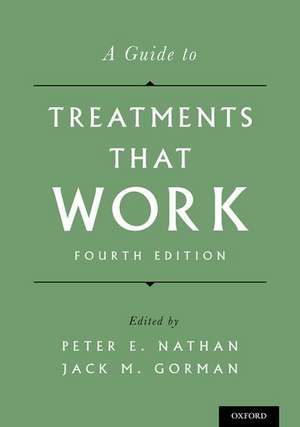
A Guide to Treatments That Work
Editat de Peter E. Nathan, Jack M. Gormanen Limba Engleză Hardback – 20 aug 2015
Subliniem, încă de la început, rigoarea academică a acestui volum coordonat de Peter E. Nathan și Jack M. Gorman, care reunește experți de renume din centre clinice de elită, majoritatea fiind cercetători care au definit literatura de specialitate în ultimele decenii. A patra ediție a A Guide to Treatments That Work nu este doar o actualizare, ci o recalibrare a standardelor de practică bazată pe dovezi în psihiatrie și psihologie clinică.
Descoperim aici o structură clinică precisă: fiecare capitol pornește de la indicii de diagnostic, analizează tranziția terminologică către DSM-5 și culminează cu o revizuire sistematică a cercetărilor recente. Reținem introducerea unor secțiuni curajoase care problematizează limitele biomarkerilor în diagnostic și etica cercetării farmaceutice, elemente ce reflectă maturitatea disciplinei. Față de lucrări precum What Works for Whom? de Peter Fonagy, care se concentrează predilect pe populația pediatrică și adolescentină, volumul de față oferă o perspectivă panoramică asupra întregului spectru de tulburări psihiatrice ale adultului, menținând totodată capitole noi, specializate pe patologia pediatrică. Dacă Effective Treatments in Psychiatry de Peter Tyrer acoperă necesitățile imediate ale clinicianului sub formă de ghid de buzunar, acest tratat aprofundează fundamentul metodologic și calitatea dovezilor de eficacitate.
Poziționăm această lucrare în continuarea preocupărilor lui Peter E. Nathan pentru rigoarea empirică, vizibile în lucrări precum Clinical Case Studies in the Behavioral Treatment of Alcoholism, dar la o scară mult mai vastă, transformând datele brute de cercetare într-o matrice de decizie clinică indispensabilă.
Preț: 1270.51 lei
Preț vechi: 1585.30 lei
-20%
Carte tipărită la comandă
Livrare economică 11-17 iunie
Specificații
ISBN-10: 0199342210
Pagini: 988
Dimensiuni: 191 x 254 x 56 mm
Greutate: 1.88 kg
Ediția:Revised
Editura: Oxford University Press
Colecția OUP USA
Locul publicării:New York, United States
V-ar putea interesa
-
 -26%Preț: 978.74 lei1327.70 lei
 -
 New Oxford Textbook of PsychiatryJohn R. Geddes-26%Preț: 2444.60 lei3321.36 lei
 -
 PsychiatryJohn Geddes-5%Preț: 271.35 lei285.64 lei
 -
 Massachusetts General Hospital Comprehensive Clinical PsychiatryTheodore A. Stern-5%Preț: 1732.63 lei1823.82 lei
 -
 Massachusetts General Hospital Handbook of General Hospital PsychiatryTheodore A. Stern-28%Preț: 485.31 lei671.43 lei
 -
 Preț: 368.96 lei
 -
 Selecting Effective TreatmentsLourie W Reichenberg-8%Preț: 423.02 lei459.81 lei
 -
 Preț: 403.04 lei
 -
 Dsm-5-Tr in ActionSophia F Dziegielewski-19%Preț: 545.19 lei673.07 lei
 -
 -5%Preț: 616.39 lei648.84 lei
 -
 Treatment of Disorders in Childhood and Adolescence, Fourth EditionMitchell J. Prinstein-5%Preț: 876.05 lei922.15 lei
 -
 -5%Preț: 794.15 lei835.95 lei
 -
 Handbook of PTSD, Third Edition: Science and PracticeMatthew J. Friedman-5%Preț: 825.62 lei869.07 lei
 -
 Psychopathology: From Science to Clinical PracticeLouis G. Castonguay-15%Preț: 488.23 lei574.39 lei
 -
 Psychodynamic Psychiatry in Clinical PracticeGlen O. Gabbard-5%Preț: 875.65 lei921.73 lei
 -
 -5%Preț: 558.97 lei588.39 lei
 -
 -5%Preț: 614.06 lei646.39 lei
 -
 -23%Preț: 591.03 lei764.79 lei
 -
 -22%Preț: 468.09 lei601.14 lei
De ce să citești această carte
Această resursă este esențială pentru psihiatri și psihologi clinicieni care doresc să își fundamenteze protocoalele de tratament pe date empirice solide, nu pe intuiție. Cititorul câștigă acces la o sinteză critică a celor mai eficiente intervenții farmacologice și psihosociale actuale. Este, în esență, instrumentul de referință pentru a naviga între noile criterii DSM-5 și realitatea terapeutică a fiecărui sindrom major.
Despre autor
Peter E. Nathan este profesor distins la University of Iowa Foundation și o figură centrală în psihologia clinică americană. Cariera sa este marcată de un efort constant de a aduce rigoarea științifică în tratamentul tulburărilor comportamentale, fiind autorul unor lucrări fundamentale despre alcoolism și psihologie clinică aplicată. Expertiza sa în metodologie și evaluarea eficacității tratamentelor a transformat seria „A Guide to Treatments That Work” într-un standard de aur pentru practicienii care aderă la modelul practicii bazate pe dovezi (Evidence-Based Practice).
Descriere
Recenzii
In this book, you will find detailed research and experience-based information on pharmacological and psychological treatments, that work on a long list of disorders relating to human thought and action.