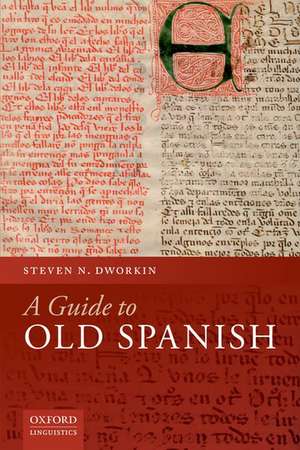
A Guide to Old Spanish
Autor Steven N. Dworkinen Limba Engleză Paperback – 23 sep 2021
Evoluția lingvisticii istorice a marcat trecerea de la simple cronologii etimologice la analize structurale complexe, care integrează contextul cultural cu mecanismele interne de schimbare a limbii. Putem afirma că A Guide to Old Spanish, semnat de Steven N. Dworkin, reflectă această maturizare a domeniului, oferind o resursă esențială pentru mediul academic anglofon. Lucrarea servește drept introducere generală în structurile idiomurilor romanice vernaculare cunoscute sub numele colectiv de spaniolă veche, așa cum apar acestea în manuscrisele dintre secolele XI și XV.
Structura volumului este una riguroasă, fiind împărțită în două secțiuni complementare. Prima parte este dedicată descrierii sistematice a sistemelor de scriere, foneticii, morfologiei și sintaxei, în timp ce a doua parte ancorează teoria în practică printr-o antologie de texte comentate. Apreciem în mod deosebit modul în care Steven N. Dworkin utilizează experiența acumulată în lucrări precum A History of the Spanish Lexicon sau Etymology and Derivational Morphology pentru a explica nu doar ce s-a schimbat, ci și procesele cognitive și sociale din spatele evoluției lexicale.
În contextul bibliografiei de specialitate, acest ghid completează perspectiva oferită de A History of the Spanish Language through Texts de Christopher Pountain. În timp ce Pountain urmărește evoluția limbii până în prezent prin diverse genuri textuale, Dworkin se concentrează strict pe perioada medievală, oferind o profunzime analitică superioară asupra stadiului incipient al limbii spaniole. Tonul este precis, academic, dar accesibil studenților care au deja baze solide în lingvistică, facilitând înțelegerea tranziției de la latina vulgară la spaniola pre-modernă.
Preț: 292.26 lei
Preț vechi: 337.52 lei
-13%
Carte disponibilă
Livrare economică 30 octombrie-10 noiembrie
Specificații
ISBN-10: 0199687323
Pagini: 176
Dimensiuni: 156 x 235 x 10 mm
Greutate: 0.26 kg
Ediția:1
Editura: OUP OXFORD
Colecția OUP Oxford
Locul publicării:Oxford, United Kingdom
V-ar putea interesa
-
 Word Origins ... And How We Know Them: Etymology for EveryoneAnatoly Liberman-12%Preț: 298.17 lei339.98 lei
 -
 -28%Preț: 447.77 lei623.45 lei
 -
 -32%Preț: 1149.17 lei1686.68 lei
 -
 -29%Preț: 369.13 lei517.64 lei
 -
 The Oxford Gothic GrammarD. Gary Miller-32%Preț: 980.19 lei1444.38 lei
 -
 The Rise of the To-InfinitiveBettelou Los-24%Preț: 634.65 lei837.16 lei
 -
 -11%Preț: 339.69 lei381.68 lei
 -
 -33%Preț: 1541.51 lei2291.25 lei
 -
 -29%Preț: 423.08 lei592.70 lei
 -
 -33%Preț: 977.07 lei1455.44 lei
 -
 Hittite and the Indo-European VerbJay H. Jasanoff-29%Preț: 497.45 lei695.99 lei
 -
 A History of the Spanish Lexicon: A Linguistic PerspectiveSteven N. Dworkin-31%Preț: 822.73 lei1198.41 lei
 -
 The Oxford Guide to Middle High GermanHoward Jones-25%Preț: 1090.25 lei1448.46 lei
 -
 Preț: 44.24 lei
 -
 LahcotahJ. K. HyerPreț: 96.74 lei
 -
 Preț: 154.71 lei
 -
 Culture and Language Vol. 1McGregor, MS Sheila a.Preț: 108.71 lei
 -
 Mer to MoorCozmo ElPreț: 75.97 lei
 -
 "Edward" and "Sven I Rosengård"Archer TaylorPreț: 95.94 lei
 -
 Ars GrammaticaDositheusPreț: 153.29 lei
 -
 Preț: 254.45 lei
 -
 Preț: 79.38 lei
 -
 Le caractère par le prénomAlbert de RochetalPreț: 124.46 lei
 -
 Etymology and Derivational MorphologySteven N. Dworkin-23%Preț: 876.28 lei1138.03 lei
De ce să citești această carte
Această lucrare este indispensabilă studenților și cercetătorilor specializați în lingvistică romanică și studii medievale spaniole. Cititorul câștigă o înțelegere clară a modului în care s-au format structurile gramaticale și fonetice ale spaniolei moderne. Este primul manual de acest tip în engleză care combină descrierea teoretică riguroasă cu o antologie practică de texte comentate, fiind un instrument de lucru ideal pentru seminarele de istoria limbii.
Despre autor
Steven N. Dworkin este un reputat specialist în lingvistică istorică și profesor emerit, cunoscut pentru contribuțiile sale fundamentale în studiul evoluției limbii spaniole. Expertiza sa se concentrează pe lexicologie, etimologie și morfologie derivațională, teme explorate pe larg în volume precum A History of the Spanish Lexicon. De asemenea, a coordonat lucrări de referință precum The Routledge Handbook of Spanish Historical Linguistics, consolidându-și statutul de autoritate în analiza diacronică a limbilor romanice. Opera sa este caracterizată prin rigoare metodologică și o capacitate deosebită de a sintetiza date lingvistice complexe pentru publicul academic.
Descriere
Recenzii
Dworkin succeeds in focusing on the essential. He presents the controversies in an even-handed manner and provides the reader with the information and references necessary to form their own judgement.
Dworkin's categorization of his book as a "guide" as opposed to a "grammar" is highly accurate, not in terms of what it does not cover, but in the sense that it accomplishes more than what one would expect from a grammar. In fact, Dworkin's use of the term is quite fortuitous in that it reflects the notion of a Spanish "guion" in its true augmentative sense as a 'large or comprehensive guide' rather than its more common usage as a 'script' or 'outline.' Both its accessibility and the comprehensive nature of its content make it an appealing read for a wide audience of undergraduate and graduate students, as well as scholars both within and outside of Hispanofilia.