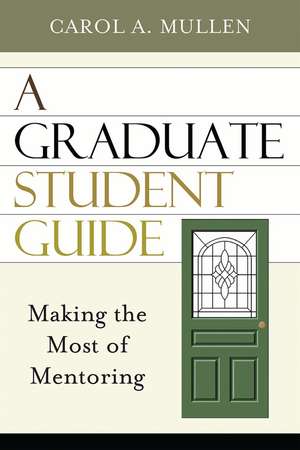
A Graduate Student Guide: Making the Most of Mentoring
Autor Carol A. Mullenen Limba Engleză Hardback – 13 feb 2006
| Toate formatele și edițiile | Preț | Express |
|---|---|---|
| Paperback (1) | 300.42 lei 6-8 săpt. | |
| Bloomsbury Publishing – 11 ian 2006 | 300.42 lei 6-8 săpt. | |
| Hardback (1) | 463.84 lei 6-8 săpt. | |
| Bloomsbury Publishing – 13 feb 2006 | 463.84 lei 6-8 săpt. |
Preț: 463.84 lei
Preț vechi: 668.30 lei
-31%
Puncte Express: 696
Preț estimativ în valută:
82.01€ • 96.78$ • 71.82£
82.01€ • 96.78$ • 71.82£
Carte tipărită la comandă
Livrare economică 14-28 aprilie
Specificații
ISBN-13: 9781578863471
ISBN-10: 1578863473
Pagini: 163
Dimensiuni: 174 x 236 x 21 mm
Greutate: 0.56 kg
Ediția:New.
Editura: Bloomsbury Publishing
Colecția R&L Education
Locul publicării:New York, United States
ISBN-10: 1578863473
Pagini: 163
Dimensiuni: 174 x 236 x 21 mm
Greutate: 0.56 kg
Ediția:New.
Editura: Bloomsbury Publishing
Colecția R&L Education
Locul publicării:New York, United States
Cuprins
Part 1 Getting Started: Strategies and Options
Chapter 2 Creating Mentoring Maps of the Academy
Chapter 3 Establishing Contact with Faculty and Peers
Chapter 4 Finding Out about Resources and Opportunities
Part 5 Becoming Immersed: Relating and Learning
Chapter 6 Making Every Minute and Day Count
Chapter 7 Joining Mentoring Networks and Programs
Chapter 8 Practicing Comentoring and Reciprocity
Part 9 Establishing Leadership: Receiving and Giving
Chapter 10 Gaining Disseminating and Publishing Skills
Chapter 11 Recognizing and Overcoming Job-Marketing Constraints
Chapter 12 Planning a Two-Way Mentorship Agenda
Chapter 13 Postscript: Closing the Academy's Door
Chapter 14 Appendix A: Program Dos for Thesis/Dissertation Writers
Chapter 15 Appendix B: Reflecting Student Input in a Faculty Supporting Letter
Chapter 16 Appendix C: Initiating Communications with Doctoral Committee
Chapter 17 Appendix D: Documenting Changes on a Graduate Defense Form
Chapter 18 Appendix E: Listing Amendments on a Dissertation Review Form
Chapter 19 Appendix F: Cover Letter Accompanying Manuscript Submission
Chapter 20 Appendix G: Summary of Changes Accompanying Reworked Paper
Chapter 21 Appendix H: Academic Review of a Paper Submitted to a Journal
Chapter 22 Appendix I: Cover Letter for an Assistant Professor Position
Chapter 2 Creating Mentoring Maps of the Academy
Chapter 3 Establishing Contact with Faculty and Peers
Chapter 4 Finding Out about Resources and Opportunities
Part 5 Becoming Immersed: Relating and Learning
Chapter 6 Making Every Minute and Day Count
Chapter 7 Joining Mentoring Networks and Programs
Chapter 8 Practicing Comentoring and Reciprocity
Part 9 Establishing Leadership: Receiving and Giving
Chapter 10 Gaining Disseminating and Publishing Skills
Chapter 11 Recognizing and Overcoming Job-Marketing Constraints
Chapter 12 Planning a Two-Way Mentorship Agenda
Chapter 13 Postscript: Closing the Academy's Door
Chapter 14 Appendix A: Program Dos for Thesis/Dissertation Writers
Chapter 15 Appendix B: Reflecting Student Input in a Faculty Supporting Letter
Chapter 16 Appendix C: Initiating Communications with Doctoral Committee
Chapter 17 Appendix D: Documenting Changes on a Graduate Defense Form
Chapter 18 Appendix E: Listing Amendments on a Dissertation Review Form
Chapter 19 Appendix F: Cover Letter Accompanying Manuscript Submission
Chapter 20 Appendix G: Summary of Changes Accompanying Reworked Paper
Chapter 21 Appendix H: Academic Review of a Paper Submitted to a Journal
Chapter 22 Appendix I: Cover Letter for an Assistant Professor Position
Recenzii
Carol Mullen has done it again! A Graduate Student Guide will no doubt become an essential reference book in every graduate student's personal library. Brilliantly written, this volume speaks clearly about the many decisions required of doctoral students in navigating the often-stormy waters of mentor/mentee relationships inherent in graduate research environments. Through her history of commitment to graduate student success, Carol is now providing a far-reaching audience with her insights into the dynamic and transformational nature of mentoring relationships within the academy. I highly recommend this book to all graduate students and to all faculty members dedicated to bringing out the best in their collaborative inquiries.
With this book you are about to embark upon an exciting journey, moving through open doors onto pathways that will enhance your role as mentee and mentor in the academy and in your professional life. Dr. Mullen takes your hand and leads you gently through and around the barriers that might hinder your success. She has used a unique blend of individual case studies, coupled with her research findings on mentoring experiences, to present a comprehensive perspective of reality. Carol has fashioned a crystal door into the academy that automatically opens at the touch of the hand, making transparent the graduate experience and entry into an academic career.
Mullen ... shows how to make every minute (of mentoring) count, organize or join mentoring networks and programs, and practice mentoring and reciprocity.
The reader fortunate enough to come in contact with Carol Mullen's new book, A Graduate Student Guide, will soon realize that the text is so written as to function as a mentor in and of itself. Through an opening case scenario, each chapter explores some aspect of mentoring in higher education and includes lessons learned, practical, reflective exercises, and a glossary of terms for engaging the material. And like a good mentor, the warmth and support of the author radiates from the pages. Regardless of one's role in the academy or how experienced in mentoring one may or may not be, there is much to be learned in this exceedingly readable, yet well-researched guide to mentorship. In short, Dr. Mullen demystifies graduate education for both students and faculty as she explores 'the process of becoming successfully mentored and of mentoring effectively' (p. 167). This book is a 'must read' for new graduate students and for faculty dedicated to facilitating academic progress and professional development.
With this book you are about to embark upon an exciting journey, moving through open doors onto pathways that will enhance your role as mentee and mentor in the academy and in your professional life. Dr. Mullen takes your hand and leads you gently through and around the barriers that might hinder your success. She has used a unique blend of individual case studies, coupled with her research findings on mentoring experiences, to present a comprehensive perspective of reality. Carol has fashioned a crystal door into the academy that automatically opens at the touch of the hand, making transparent the graduate experience and entry into an academic career.
Mullen ... shows how to make every minute (of mentoring) count, organize or join mentoring networks and programs, and practice mentoring and reciprocity.
The reader fortunate enough to come in contact with Carol Mullen's new book, A Graduate Student Guide, will soon realize that the text is so written as to function as a mentor in and of itself. Through an opening case scenario, each chapter explores some aspect of mentoring in higher education and includes lessons learned, practical, reflective exercises, and a glossary of terms for engaging the material. And like a good mentor, the warmth and support of the author radiates from the pages. Regardless of one's role in the academy or how experienced in mentoring one may or may not be, there is much to be learned in this exceedingly readable, yet well-researched guide to mentorship. In short, Dr. Mullen demystifies graduate education for both students and faculty as she explores 'the process of becoming successfully mentored and of mentoring effectively' (p. 167). This book is a 'must read' for new graduate students and for faculty dedicated to facilitating academic progress and professional development.