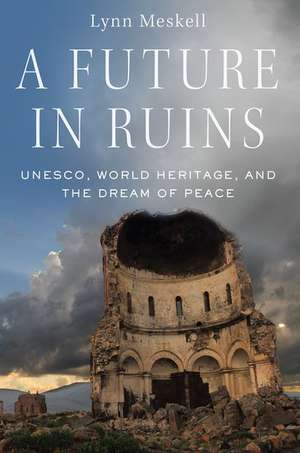
A Future in Ruins: UNESCO, World Heritage, and the Dream of Peace
Autor Lynn Meskellen Limba Engleză Hardback – 2 aug 2018
Preț: 309.42 lei
Preț vechi: 351.71 lei
-12%
Puncte Express: 464
Carte tipărită la comandă
Livrare economică 04-15 decembrie
Livrare prin curier în România Termenul estimat este afișat lângă disponibilitate.
Transport gratuit de la 400.00 lei Plată online sau ramburs, în funcție de opțiunile comenzii.
Retur gratuit în 14 zile Comandă securizată și suport în română.
Specificații
ISBN-13: 9780190648343
ISBN-10: 0190648341
Pagini: 400
Dimensiuni: 236 x 160 x 28 mm
Greutate: 0.7 kg
Editura: Oxford University Press
Colecția OUP USA
Locul publicării:New York, United States
ISBN-10: 0190648341
Pagini: 400
Dimensiuni: 236 x 160 x 28 mm
Greutate: 0.7 kg
Editura: Oxford University Press
Colecția OUP USA
Locul publicării:New York, United States
Recenzii
A timely and important work that combines anthropology, politics, and archaeology to consider the history and legacy of UNESCO (United Nations Educational, Scientific and Cultural Organization).... The author's honest, thought-provoking treatment brings into question the abilities and benefits of UNESCO while highlighting some of the complex political and historical actions that have brought about the precarious role it now plays. Highly recommended.
A trustworthy guide through the thicket of committees, conventions, and campaigns that have defined World Heritage at the international level... Meskell builds an exemplary work of international history of World Heritage by weaving together case studies from around the world
Reading A Future in Ruins is a valuable experience that needs to be shared widely across archaeology, cultural heritage studies, and related disciplines. It is a process of revisiting the consequences of allowing the bureaucratic machine of 'world heritage production' to roll on unchallenged, a journey which is best undertaken without predetermined notions coming from a detailed review of its contents.
A Future in Ruins transcends the boundaries of history, archaeology, politics and anthropology... an enlightening and enjoyable book to read.
This is a highly original and timely reassessment of UNESCO's checkered global mission since the late 1940s. While Meskell's book is ostensibly about UNESCO, world heritage, and the changing practices of archaeology, it is also a powerful rereading of international history and the broader politics of preservation in today's world. For those interested in the history of internationalism, contemporary global politics, and heritage studies, this is a must read.
A Future in Ruins represents the first in-depth analysis of UNESCO from its heady beginnings in a postwar world to the very different political and cultural attitudes to heritage in the present. Meskell brings her considerable analytical skills to bear on the personalities and structures of the organization and the material remains on which they focused. This is a book for anyone concerned with the past and present of global heritage.
This timely book's insight and subtlety will set the diplomatic world by its ears. Meskell shows how UNESCO's pious pose of cultural universalism masks nationalistic -- and Eurocentric -- pursuits. Her argument steadily moves us toward the unexpected revelation that UNESCO's interventions, understood by the world's disenfranchised as redolent of Western arrogance, increase the threat to the cultural treasures they are supposed to protect.
A trustworthy guide through the thicket of committees, conventions, and campaigns that have defined World Heritage at the international level... Meskell builds an exemplary work of international history of World Heritage by weaving together case studies from around the world
Reading A Future in Ruins is a valuable experience that needs to be shared widely across archaeology, cultural heritage studies, and related disciplines. It is a process of revisiting the consequences of allowing the bureaucratic machine of 'world heritage production' to roll on unchallenged, a journey which is best undertaken without predetermined notions coming from a detailed review of its contents.
A Future in Ruins transcends the boundaries of history, archaeology, politics and anthropology... an enlightening and enjoyable book to read.
This is a highly original and timely reassessment of UNESCO's checkered global mission since the late 1940s. While Meskell's book is ostensibly about UNESCO, world heritage, and the changing practices of archaeology, it is also a powerful rereading of international history and the broader politics of preservation in today's world. For those interested in the history of internationalism, contemporary global politics, and heritage studies, this is a must read.
A Future in Ruins represents the first in-depth analysis of UNESCO from its heady beginnings in a postwar world to the very different political and cultural attitudes to heritage in the present. Meskell brings her considerable analytical skills to bear on the personalities and structures of the organization and the material remains on which they focused. This is a book for anyone concerned with the past and present of global heritage.
This timely book's insight and subtlety will set the diplomatic world by its ears. Meskell shows how UNESCO's pious pose of cultural universalism masks nationalistic -- and Eurocentric -- pursuits. Her argument steadily moves us toward the unexpected revelation that UNESCO's interventions, understood by the world's disenfranchised as redolent of Western arrogance, increase the threat to the cultural treasures they are supposed to protect.
Notă biografică
Lynn Meskell is Professor, Department of Anthropology, Stanford University and author of Global Heritage: A Reader (Wiley-Blackwell, 2015), The Nature of Heritage: The New South Africa (Wiley-Blackwell, 2012), Cosmopolitan Archaeologies (Duke University Press, 2009), and Private Life in New Kingdom Egypt (PUP, 2002).
Cuprins
- Preface
- Acknowledgements
- Abbreviations
- Chapter 1: Utopia
- Chapter 2: Internationalism
- Chapter 3: Technocracy
- Chapter 4: Conservation
- Chapter 5: Inscription
- Chapter 6: Conflict
- Chapter 7: Danger
- Chapter 8: Dystopia
- Bibliography