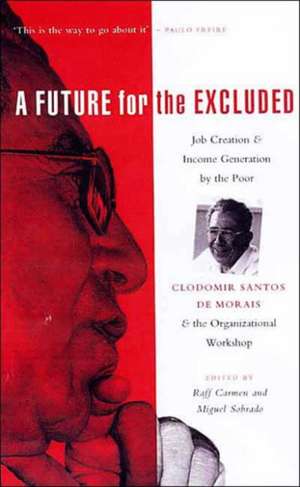
A Future for the Excluded: Job Creation and Income Generation by the Poor: Clodomir Santos de Morais and the Organization Workshop
Editat de Raff Carmen, Miguel Sobradoen Limba Engleză Paperback – mai 2000
This highly distinctive grassroots development approach to empowering socially excluded strata in economic and organizational terms holds out the prospect of becoming a very important factor in the struggle against poverty.
Preț: 260.33 lei
Preț vechi: 308.86 lei
-16%
Puncte Express: 390
Carte tipărită la comandă
Livrare economică 02-16 decembrie
Livrare prin curier în România Termenul estimat este afișat lângă disponibilitate.
Transport gratuit de la 400.00 lei Plată online sau ramburs, în funcție de opțiunile comenzii.
Retur gratuit în 14 zile Comandă securizată și suport în română.
Specificații
ISBN-13: 9781856497039
ISBN-10: 1856497038
Pagini: 256
Ilustrații: glossary, notes, bibliography, index
Dimensiuni: 138 x 216 x 19 mm
Greutate: 0.33 kg
Editura: Bloomsbury Publishing
Colecția Zed Books
Locul publicării:London, United Kingdom
ISBN-10: 1856497038
Pagini: 256
Ilustrații: glossary, notes, bibliography, index
Dimensiuni: 138 x 216 x 19 mm
Greutate: 0.33 kg
Editura: Bloomsbury Publishing
Colecția Zed Books
Locul publicării:London, United Kingdom
V-ar putea interesa
-
 Chinese WhispersHsiao-Hung PaiPreț: 115.50 lei
 -
 Employment and Economic Performance: Jobs, Inflation, and GrowthJonathan Michie-30%Preț: 497.31 lei711.49 lei
 -
 -28%Preț: 378.90 lei527.73 lei
 -
 -21%Preț: 351.50 lei442.65 lei
 -
 -28%Preț: 418.63 lei579.20 lei
 -
 Freedom of Contract and PaternalismP. Cserne-15%Preț: 661.39 lei778.11 lei
 -
 Moodle for DummiesRadana DvorakPreț: 169.79 lei
 -
 Closing the Deficit: How Much Can Later Retirement Help?Gary Burtless-25%Preț: 142.30 lei188.74 lei
 -
 PayKevin F. HallockPreț: 263.08 lei
 -
 Employment-Based Immigration: Economic ConsiderationsClark M Butler-26%Preț: 502.77 lei676.31 lei
 -
 -18%Preț: 29.94 lei36.50 lei
 -
 -16%Preț: 31.39 lei37.34 lei
 -
 -12%Preț: 34.60 lei39.27 lei
 -
 Job Quality by Entrepreneurial SpinoffsJohan M Kuhn-17%Preț: 30.62 lei36.90 lei
Cuprins
Preface - Raff Carmen & Miguel Sobrado
Part I: Context and History
1. Setting the Scene: 'Those who don't eat and those who don't sleep' - Raff Carmen and Miguel Sobrado
2. Clodomir Santos de Morais and the Origins of his Largescale Capacitation Theory and Method - Miguel Sobrado
Part II: Theoretical Perspectives
3. The Largescale Capacitation Method and Social Participation: Theoretical Perspectives - Clodomir Santos de Morais
4. From Paulo Freire to Clodomir Santos de Morais: From Critical to Organizational Consciousness - Jacinta Castello Branco Correia
Part III: The Organization Workshop in Practice
5. From Navvies to Entrepreneurs: The Organization Workshop in Costa Rica - Miguel Sobrado
6. Sacked Agricultural Workers Take on the Multinationals in Honduras - Benjamin Erazo
7. The Mexican Experience with Organization Workshops - Juan Jose Rojas Herrera
8. The Organization Workshop in Panama, Colombia, Venezuela, Ecuador and Peru - Miguel Sobrado
9. Three Decades of Work with OWs in Latin America: An Institutional Perspective - Leopoldo Sandoval
10. 'Doing Enterprises' in war-time and post-war Mozambique - Isabel and Ivan de Labra
11. In Angola, Guinea Bissau, Sao Tome and Principe - Paulo Roberto da Silva
12. Hard Learning in Zimbabwe and in post civil-war Mozambique - Isabel and Ivan Labra
13. Organization Development (OD) and Morais's Organization Workshop (OW) - South Africa and Botswana - Gavin Andersson
14. The Potential of the the OW in former Soviet Bloc Countries and Economies in Crisis - Miguel Sobrado
15. In Post-Salazar Portugal - Isabel and Ivan Labra
16. The Crisis of Work in Post-Industrial Western Countries - Raff Carmen
Part IV: From Local OWs to National Employment Generation Systems
17. The Brazilian PROGEI-SIPGEIs - Jacinta C. B. Correia
18. 'More than a Job: A Future': The PAE Self-Employment Programme in Brazil - Walter Barelli
19. The OW and Civil Society Organizations in Brazil - Jacinta C. B. Correia
20. OW's Potential: Concluding Observations - Miguel Sobrado
Part I: Context and History
1. Setting the Scene: 'Those who don't eat and those who don't sleep' - Raff Carmen and Miguel Sobrado
2. Clodomir Santos de Morais and the Origins of his Largescale Capacitation Theory and Method - Miguel Sobrado
Part II: Theoretical Perspectives
3. The Largescale Capacitation Method and Social Participation: Theoretical Perspectives - Clodomir Santos de Morais
4. From Paulo Freire to Clodomir Santos de Morais: From Critical to Organizational Consciousness - Jacinta Castello Branco Correia
Part III: The Organization Workshop in Practice
5. From Navvies to Entrepreneurs: The Organization Workshop in Costa Rica - Miguel Sobrado
6. Sacked Agricultural Workers Take on the Multinationals in Honduras - Benjamin Erazo
7. The Mexican Experience with Organization Workshops - Juan Jose Rojas Herrera
8. The Organization Workshop in Panama, Colombia, Venezuela, Ecuador and Peru - Miguel Sobrado
9. Three Decades of Work with OWs in Latin America: An Institutional Perspective - Leopoldo Sandoval
10. 'Doing Enterprises' in war-time and post-war Mozambique - Isabel and Ivan de Labra
11. In Angola, Guinea Bissau, Sao Tome and Principe - Paulo Roberto da Silva
12. Hard Learning in Zimbabwe and in post civil-war Mozambique - Isabel and Ivan Labra
13. Organization Development (OD) and Morais's Organization Workshop (OW) - South Africa and Botswana - Gavin Andersson
14. The Potential of the the OW in former Soviet Bloc Countries and Economies in Crisis - Miguel Sobrado
15. In Post-Salazar Portugal - Isabel and Ivan Labra
16. The Crisis of Work in Post-Industrial Western Countries - Raff Carmen
Part IV: From Local OWs to National Employment Generation Systems
17. The Brazilian PROGEI-SIPGEIs - Jacinta C. B. Correia
18. 'More than a Job: A Future': The PAE Self-Employment Programme in Brazil - Walter Barelli
19. The OW and Civil Society Organizations in Brazil - Jacinta C. B. Correia
20. OW's Potential: Concluding Observations - Miguel Sobrado
Recenzii
One of the few books to cross the boundary between social and organizational change, and a 'must' for all organization and social development practitioners.
The kind of book that comes only once in a while. Important for progressive educators, community organizers, and all those concerned with non-formal education.
In the link de Morais establishes between autonomy, self-organization, and creative
The success of these worker-owned enterprises makes this book essential reading for anyone concerned with issues of poverty and development.
At last a book that offers the English-speaking world a window into a startling body of theory and practice on building democratic forms of economic organization.
The kind of book that comes only once in a while. Important for progressive educators, community organizers, and all those concerned with non-formal education.
In the link de Morais establishes between autonomy, self-organization, and creative
The success of these worker-owned enterprises makes this book essential reading for anyone concerned with issues of poverty and development.
At last a book that offers the English-speaking world a window into a startling body of theory and practice on building democratic forms of economic organization.