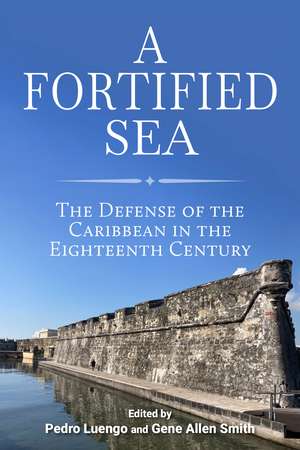
A Fortified Sea: The Defense of the Caribbean in the Eighteenth Century: Maritime Currents: History and Archaeology
Editat de Pedro Luengo, Gene Allen Smith, Jr. Contribuţii de Mónica Cejudo Collera, Pedro Cruz Freire, María Mercedes Fernández Martín, Manuel Gámez Casado, Aaron Graham, Francisco Javier Herrera García, Nuria Hinarejos Martín, Ignacio J. López-Hernández, Alfredo J. Morales, José Miguel Morales Folguera, Juan Miguel Muñoz Corbalán, Jesús María Ruiz Carrasco, Germán Segura García, Christopher K. Watersen Limba Engleză Paperback – 20 aug 2024
A multinational, interdisciplinary study illuminating how fortifications reshaped the Caribbean as a contested imperial borderland in the eighteenth century.
A Fortified Sea illuminates the key role of military forts in the greater Caribbean during the long eighteenth century. The historical Caribbean, with its multiple contested boundaries at the periphery of European western expansion, typically has been analyzed as part of an empire. European powers, including Spain, the Netherlands, England, and Denmark, carved up the Caribbean Sea into a cultural patchwork. These varied cultural contexts were especially evident during regional and national conflicts throughout the eighteenth century and prompted the construction of more fortifications to protect imperial interests. The emergence of Anglo-American colonies during the eighteenth century and later the United States gradually altered previous geopolitical balances, redefining the cultural and geopolitical boundaries of the region.
This collection of essays incorporates several historiographical traditions—from Spanish to American—all portraying the borderland as a breakthrough contested cultural, social, economic, and military boundary. A multinational roster of contributors approaches topics through a war studies lens as well as architecturally and historically, enriching a usually monothematic view. As well, discussion of cultural management of the historical remains of forts shows local communities trying to preserve and interpret the role of forts in society.
Part I defines the training of military engineers in Spain. Part II engages with British defensive military plans and settlements in the Caribbean and shows how the British dealt with the rhetorical image of the empire. Part III clarifies the building processes of fortifications in Santiago de Cuba, Cartagena de Indias, Havana, and Veracruz, among other places. Copious period maps complement the prodigious research. The book will appeal to readers interested in the history of the Caribbean, military history, and European imperial expansion.
CONTRIBUTORS
Mónica Cejudo Collera / Pedro Cruz Freire / María Mercedes Fernández Martín / Aaron Graham / Manuel Gámez Casado / Francisco Javier Herrera García / Nuria Hinarejos Martín / Pedro Luengo / Ignacio J. López-Hernández / José Miguel Morales Folguera / Alfredo J. Morales / Juan Miguel Muñoz Corbalán / Jesús Maria Ruiz Carrasco / Germán Segura García / Gene Allen Smith / Christopher K. Waters
Din seria Maritime Currents: History and Archaeology
-
 Preț: 193.15 lei
 -
 Preț: 370.71 lei
 -
 Preț: 266.14 lei
 -
 Preț: 231.32 lei
 -
 Preț: 243.00 lei
 -
 Preț: 187.10 lei
 -
 Preț: 160.85 lei
 -
 Preț: 241.10 lei
 -
 Preț: 279.21 lei
 -
 Preț: 231.86 lei
 -
 Preț: 188.28 lei
 -
 Preț: 434.62 lei
 - 8%
 Preț: 417.15 lei
 -
 Preț: 372.12 lei
 -
 Preț: 198.93 lei
 -
 Preț: 232.33 lei
 -
 Preț: 234.64 lei
 - nou
 Preț: 279.21 lei
Preț: 280.34 lei
Puncte Express: 421
Carte disponibilă
Livrare economică 23 iunie-07 iulie
Livrare prin curier în România Termenul estimat este afișat lângă disponibilitate.
Transport gratuit de la 400.00 lei Plată online sau ramburs, în funcție de opțiunile comenzii.
Retur gratuit în 14 zile Comandă securizată și suport în română.
Specificații
ISBN-13: 9780817361525
ISBN-10: 0817361529
Pagini: 316
Ilustrații: 45 B&W figures - 14 maps
Dimensiuni: 152 x 229 x 25 mm
Greutate: 0.48 kg
Editura: University Of Alabama Press
Colecția University Alabama Press
Seria Maritime Currents: History and Archaeology
ISBN-10: 0817361529
Pagini: 316
Ilustrații: 45 B&W figures - 14 maps
Dimensiuni: 152 x 229 x 25 mm
Greutate: 0.48 kg
Editura: University Of Alabama Press
Colecția University Alabama Press
Seria Maritime Currents: History and Archaeology
Notă biografică
Pedro Luengo is professor of the history of art at the Universidad de Sevilla. He is author of Global Architecture for Eighteenth-Century Beijing: Building Qing Enlightenments and Manila, 1645 and coeditor of From Colonies to Countries in the North Caribbean: Military Engineers in the Development of Cities and Territories.
Gene Allen Smith is professor of history at Texas Christian University. He is author of The Slaves’ Gamble: Choosing Sides in the War of 1812, coeditor of From Colonies to Countries in the North Caribbean: Military Engineers in the Development of Cities and Territories, coauthor of In Harm’s Way: A History of the American Military Experience, and coeditor of Nexus of Empire: Negotiating Loyalty and Identity in the Revolutionary Borderlands, 1760s–1820s, among other works.
Gene Allen Smith is professor of history at Texas Christian University. He is author of The Slaves’ Gamble: Choosing Sides in the War of 1812, coeditor of From Colonies to Countries in the North Caribbean: Military Engineers in the Development of Cities and Territories, coauthor of In Harm’s Way: A History of the American Military Experience, and coeditor of Nexus of Empire: Negotiating Loyalty and Identity in the Revolutionary Borderlands, 1760s–1820s, among other works.
Cuprins
Introduction
Gene Allen Smith and Pedro Luengo
Abbreviations
Part I. A Common Background: Early Modern Caribbean and the Training of Military Engineers
Chapter 1. Fortification and Pedagogy: Theoretical Military Engineering and Cartography between Academic Institutional Rigor and Ludic Poliorcetics
Juan Miguel Muñoz Corbalán
Chapter 2. Military Engineers and the Real Academia de Bellas Artes de San Fernando’s Censure
Jesús María Ruiz Carrasco
Part II. The British Plan: Warfare, Intelligence, and Rhetoric of the Empire
Chapter 3. Fortification, Engineering, and Empire in Mid-Eighteenth-Century Jamaica
Aaron Graham
Chapter 4. Vernacular Architecture and the Defense of Antigua, 1670–1785
Christopher K. Waters
Chapter 5. The English Settlement of Guantánamo, Cuba: Urban and Defensive Features
Pedro Luengo
Chapter 6. Fortification Systems Designed to Counter Charles Knowles’s Attacks in Cuba and Saint-Domingue in 1748
Ignacio J. López-Hernández
Chapter 7. The Versatility of the Military Engineer Luis Huet: Engineer, Urban Planner, and Spy
Pedro Cruz Freire
Chapter 8. Text and Image: The 1762 Capture of Havana
Alfredo J. Morales
Part III. The Spanish Plan: Fortifying the Caribbean Sea
Chapter 9. The Interior Defense of Santiago de Cuba: The Fort of San Francisco
María Mercedes Fernández Martín
Chapter 10. Engineering and the Articulation of Territory: Juan de Herrera y Sotomayor and the Canal del Dique Improvement Project in Cartagena de Indias, 1725–1728
Francisco Javier Herrera García
Chapter 11. Projects and Defensive Reforms at the End of the Viceregal Cartagena: The Military Engineer Manuel de Anguiano and the Martyrs of Independence
Manuel Gámez Casado
Chapter 12. The Fort of San Carlos de Perote: The Historical Context of Its Construction
Mónica Cejudo Collera and Germán Segura García
Chapter 13. The Three Defensive Lines Built on the East Front of Puerta de Tierra, San Juan, Puerto Rico
Nuria Hinarejos Martín
Chapter 14. The Defense of New Orleans as a Capital of the Government of Louisiana and Western Florida
José Miguel Morales Folguera
Chapter 15. “Without Any Fighting or Disturbance”: Conquering Spanish Baton Rouge and Mobile
Gene Allen Smith
Epilogue
Pedro Luengo and Gene Allen Smith
Notes
Bibliography
List of Contributors
Index
Gene Allen Smith and Pedro Luengo
Abbreviations
Part I. A Common Background: Early Modern Caribbean and the Training of Military Engineers
Chapter 1. Fortification and Pedagogy: Theoretical Military Engineering and Cartography between Academic Institutional Rigor and Ludic Poliorcetics
Juan Miguel Muñoz Corbalán
Chapter 2. Military Engineers and the Real Academia de Bellas Artes de San Fernando’s Censure
Jesús María Ruiz Carrasco
Part II. The British Plan: Warfare, Intelligence, and Rhetoric of the Empire
Chapter 3. Fortification, Engineering, and Empire in Mid-Eighteenth-Century Jamaica
Aaron Graham
Chapter 4. Vernacular Architecture and the Defense of Antigua, 1670–1785
Christopher K. Waters
Chapter 5. The English Settlement of Guantánamo, Cuba: Urban and Defensive Features
Pedro Luengo
Chapter 6. Fortification Systems Designed to Counter Charles Knowles’s Attacks in Cuba and Saint-Domingue in 1748
Ignacio J. López-Hernández
Chapter 7. The Versatility of the Military Engineer Luis Huet: Engineer, Urban Planner, and Spy
Pedro Cruz Freire
Chapter 8. Text and Image: The 1762 Capture of Havana
Alfredo J. Morales
Part III. The Spanish Plan: Fortifying the Caribbean Sea
Chapter 9. The Interior Defense of Santiago de Cuba: The Fort of San Francisco
María Mercedes Fernández Martín
Chapter 10. Engineering and the Articulation of Territory: Juan de Herrera y Sotomayor and the Canal del Dique Improvement Project in Cartagena de Indias, 1725–1728
Francisco Javier Herrera García
Chapter 11. Projects and Defensive Reforms at the End of the Viceregal Cartagena: The Military Engineer Manuel de Anguiano and the Martyrs of Independence
Manuel Gámez Casado
Chapter 12. The Fort of San Carlos de Perote: The Historical Context of Its Construction
Mónica Cejudo Collera and Germán Segura García
Chapter 13. The Three Defensive Lines Built on the East Front of Puerta de Tierra, San Juan, Puerto Rico
Nuria Hinarejos Martín
Chapter 14. The Defense of New Orleans as a Capital of the Government of Louisiana and Western Florida
José Miguel Morales Folguera
Chapter 15. “Without Any Fighting or Disturbance”: Conquering Spanish Baton Rouge and Mobile
Gene Allen Smith
Epilogue
Pedro Luengo and Gene Allen Smith
Notes
Bibliography
List of Contributors
Index
Recenzii
“A Fortified Sea focuses on fortifications as a site to examine imperial rivalries and contested spaces in the greater Caribbean. More importantly, the multilingual, transnational body of scholars involved in this edition is truly impressive. . . it is an ambitious work!” —Sharika Crawford, author of The Last Turtlemen of the Caribbean: Waterscapes of Labor, Conservation, and Boundary Making
“This volume will be especially useful to experts on Caribbean naval engagements and scholars at the intersection of art history, archaeology, and military history.”—The Americas
“[A Fortified Sea] brings together an impressive international group of contributors to compare the British and Spanish empires while showing how military fortifications articulated imperial practices, which is an aspect of Atlantic history that is not well appreciated by scholars in the field generally. . . . It is impressive: multi-archival, multi-lingual, undertaken in multiple countries. It represents a real dedication to the historian’s craft.” —David Head, author of A Crisis of Peace: George Washington, the Newburgh Conspiracy, and the Fall of the American Revolution
“The book . . . is a comprehensive tool for maritime historians interested in the defence of the imperial Caribbean in the eighteenth century.” —International Journal of Maritime History
“This volume offers an invaluable comparative approach to the agenda of two colonial European powers in the Caribbean through the defensive architecture, designs, ideas, and policies that emerged from a contested imperial context. Importantly, it reexamines the diverse cultural traditions and technical knowledge that merged in this fortified landscape, and sheds light on the individuals at work, from understudied engineers to the essential labor force, including enslaved workers, that materialized and repaired these edifices and settlements.” —Luis Gordo Peláez, coeditor of Architecture and Extraction in the Atlantic World, 1500–1850
“Editors Luengo and Smith have made a significant contribution to our understanding of the fortification of the West Indies and the coast of the Gulf of Mexico by assembling a set of authors offering unique insights. . . It provides a slightly different approach to studying this originally nebulous borderland’s solidification into the more rigidly divided region it became.” —The Northern Mariner / Le marin du nord
“This volume will be especially useful to experts on Caribbean naval engagements and scholars at the intersection of art history, archaeology, and military history.”—The Americas
“[A Fortified Sea] brings together an impressive international group of contributors to compare the British and Spanish empires while showing how military fortifications articulated imperial practices, which is an aspect of Atlantic history that is not well appreciated by scholars in the field generally. . . . It is impressive: multi-archival, multi-lingual, undertaken in multiple countries. It represents a real dedication to the historian’s craft.” —David Head, author of A Crisis of Peace: George Washington, the Newburgh Conspiracy, and the Fall of the American Revolution
“The book . . . is a comprehensive tool for maritime historians interested in the defence of the imperial Caribbean in the eighteenth century.” —International Journal of Maritime History
“This volume offers an invaluable comparative approach to the agenda of two colonial European powers in the Caribbean through the defensive architecture, designs, ideas, and policies that emerged from a contested imperial context. Importantly, it reexamines the diverse cultural traditions and technical knowledge that merged in this fortified landscape, and sheds light on the individuals at work, from understudied engineers to the essential labor force, including enslaved workers, that materialized and repaired these edifices and settlements.” —Luis Gordo Peláez, coeditor of Architecture and Extraction in the Atlantic World, 1500–1850
“Editors Luengo and Smith have made a significant contribution to our understanding of the fortification of the West Indies and the coast of the Gulf of Mexico by assembling a set of authors offering unique insights. . . It provides a slightly different approach to studying this originally nebulous borderland’s solidification into the more rigidly divided region it became.” —The Northern Mariner / Le marin du nord
Descriere
A Fortified Sea offers a sweeping, multidisciplinary exploration of how military forts shaped the geopolitical and cultural landscape of the eighteenth‑century Caribbean. Edited by Pedro Luengo, this landmark collection brings together Spanish, British, and American historiographical traditions to reveal how rival empires built, expanded, and defended their Caribbean holdings through networks of coastal fortifications. With case studies spanning major strategic ports—Havana, Cartagena de Indias, Santiago de Cuba, Veracruz, and more—the volume illustrates how fort architecture, engineering, warfare, and local community engagement intersected in one of the world’s most contested maritime regions. Rich with archival insight and period maps, A Fortified Sea reframes the Caribbean as a dynamic military borderland central to global imperial expansion.