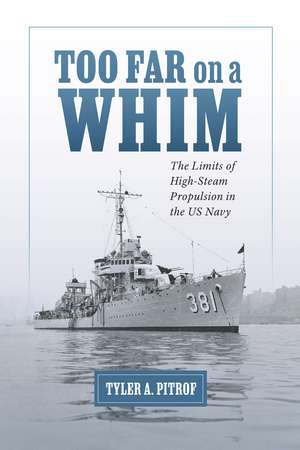
Too Far on a Whim: The Limits of High-Steam Propulsion in the US Navy: Maritime Currents: History and Archaeology
Autor Tyler A. Pitrofen Limba Engleză Paperback – 30 apr 2024
Argues that the US Navy’s commitment to high-steam propulsion for its World War II fleet was a tactical, technological, and bureaucratic failure
In Too Far on a Whim, Tyler A. Pitrof presents a high-spirited revision of the US Navy’s commitment to high-steam propulsion systems, the mainstay of its World War II fleets. Pitrof’s research persuasively demonstrates that in its war against the Imperial Japanese Navy, the US Navy succeeded despite its high-steam propulsion systems rather than because of them.
War with an aggressive Japan and a resurgent Germany loomed in the dark days of the late 1930s. Rear Admiral Harold G. Bowen Sr., head of the US Navy’s Bureau of Engineering, advanced a radical vision: a new fleet based on high-steam propulsion, a novel technology that promised high speeds with smaller engines and better fuel efficiency. High-steam engines had drawbacks—smaller operational ranges and maintenance issues. Nevertheless, trusting its engineers to resolve these issues, the US Navy put high-steam propulsion at the heart of its warship design from 1938 to 1945.
The official record of high-steam technology’s subsequent performance has relied heavily on Bowen’s own memoir, in which he painted high-steam innovation in heroic colors. Pitrof’s empirical review of primary sources such as ship’s maintenance records, however, illuminates the opposite—that the heroism lay in the ability of American seamen to improvise solutions to keep these difficult engines running.
Pitrof artfully explains engineering concepts in layman’s terms and provides an account that extends far beyond technology and into matters of naval hierarchies and bureaucracy, strategic theory, and ego. He offers a cautionary tale—as relevant to any endeavor as it is to military undertakings—about how failures arise when technical experts lack managers who understand their work. Admiral Bowen wielded excessive power because no one else in the US Navy knew enough to countermand him.
Compulsively readable, Too Far on a Whim is a landmark for those interested in naval history and technology but also for readers interested in the interplay between innovation, decision-making, and engineering.
Din seria Maritime Currents: History and Archaeology
-
 Preț: 199.21 lei
 -
 Preț: 374.05 lei
 -
 Preț: 287.55 lei
 -
 Preț: 231.21 lei
 -
 Preț: 248.36 lei
 -
 Preț: 198.20 lei
 -
 Preț: 164.99 lei
 -
 Preț: 241.84 lei
 -
 Preț: 285.58 lei
 -
 Preț: 194.98 lei
 -
 Preț: 188.61 lei
 -
 Preț: 435.43 lei
 - 8%
 Preț: 430.09 lei
 -
 Preț: 383.62 lei
 -
 Preț: 198.83 lei
 -
 Preț: 231.91 lei
 -
 Preț: 233.89 lei
 - nou
 Preț: 268.08 lei
Preț: 265.67 lei
Puncte Express: 399
Carte disponibilă
Livrare economică 30 octombrie-13 noiembrie
Livrare express 16-22 octombrie pentru 27.11 lei
Livrare prin curier în România Termenul estimat este afișat lângă disponibilitate.
Transport gratuit de la 400.00 lei Plată online sau ramburs, în funcție de opțiunile comenzii.
Retur gratuit în 14 zile Comandă securizată și suport în română.
Specificații
ISBN-13: 9780817361402
ISBN-10: 0817361405
Pagini: 232
Ilustrații: 15
Dimensiuni: 152 x 229 x 18 mm
Greutate: 0.4 kg
Editura: University Of Alabama Press
Colecția University Alabama Press
Seria Maritime Currents: History and Archaeology
ISBN-10: 0817361405
Pagini: 232
Ilustrații: 15
Dimensiuni: 152 x 229 x 18 mm
Greutate: 0.4 kg
Editura: University Of Alabama Press
Colecția University Alabama Press
Seria Maritime Currents: History and Archaeology
Notă biografică
Tyler A. Pitrof is a historian in the Public History and Education Team in the histories and archives division of the Naval History and Heritage Command.
Cuprins
List of Illustrations
Acknowledgments
Introduction
Part I. Genesis of the High-Steam Navy, 1918–1941
Chapter 1. The Rise of Steam Power
Chapter 2. The Through Ticket to Manila
Chapter 3. Crossroads
Chapter 4. Robinson, Bowen, and American High Steam, 1932–1938
Chapter 5. Bowen versus the World
Chapter 6. Full Steam Ahead
Part II. High Steam at War, 1939–1945
Chapter 7. The Shipyard Revolution
Chapter 8. Riding the Wildcat
Chapter 9. The “Battle of the Fuel Oil,” 1941–1945
Chapter 10. The Impact of High Steam on the Pacific War
Conclusion. Bowen’s Legacy
Notes
Bibliography
Index
Acknowledgments
Introduction
Part I. Genesis of the High-Steam Navy, 1918–1941
Chapter 1. The Rise of Steam Power
Chapter 2. The Through Ticket to Manila
Chapter 3. Crossroads
Chapter 4. Robinson, Bowen, and American High Steam, 1932–1938
Chapter 5. Bowen versus the World
Chapter 6. Full Steam Ahead
Part II. High Steam at War, 1939–1945
Chapter 7. The Shipyard Revolution
Chapter 8. Riding the Wildcat
Chapter 9. The “Battle of the Fuel Oil,” 1941–1945
Chapter 10. The Impact of High Steam on the Pacific War
Conclusion. Bowen’s Legacy
Notes
Bibliography
Index
Recenzii
“Tyler Pitrof’s meticulous scholarship highlights an important aspect of military innovation: the dangers of relying on single-source expertise when fielding new technologies like high-steam propulsion. This work is a cautionary tale that goes beyond mere history and is applicable today, especially in light of the Titan maritime disaster in the Atlantic.” —John T. Kuehn, professor of military history, US Army Command and General Staff College
“Too Far on a Whim: The Limits of High-Steam Propulsion in the US Navy is ground-breaking work in what is obviously an under-served aspect of U.S. Navy history. . . Pitrof’s narrative is well organized, and his writing is crisp and concise. . . It will resonate beyond naval historians to include historians of science and technology, and lay audiences.”—Craig Felker, author of Testing American Sea Power: U.S. Navy Strategic Exercises, 1923-1940
“Too Far on a Whim: The Limits of High-Steam Propulsion in the US Navy is ground-breaking work in what is obviously an under-served aspect of U.S. Navy history. . . Pitrof’s narrative is well organized, and his writing is crisp and concise. . . It will resonate beyond naval historians to include historians of science and technology, and lay audiences.”—Craig Felker, author of Testing American Sea Power: U.S. Navy Strategic Exercises, 1923-1940
Descriere
In Too Far on a Whim, Tyler A. Pitrof captures the restless energy of following impulse—intellectual, emotional, and physical—past comfort and into discovery. This book traces moments when curiosity overrides certainty and movement becomes a way of thinking. Too Far on a Whim examines how choices made lightly can carry lasting weight, revealing meaning in missteps, detours, and acts of quiet bravery. Thoughtful and engaging, the work will appeal to readers drawn to contemporary literary nonfiction that values voice, experience, and exploration.