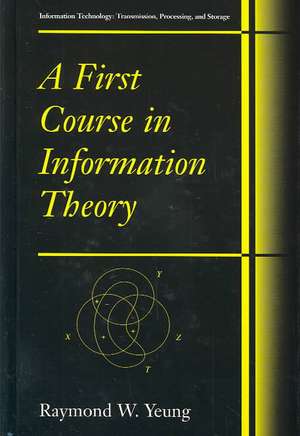
A First Course in Information Theory
Autor Raymond W Yeungen Limba Engleză Hardback – 30 apr 2002
Preț: 1270.66 lei
Preț vechi: 1549.59 lei
-18%
Puncte Express: 1906
Carte tipărită la comandă
Livrare economică 07-21 decembrie
Livrare prin curier în România Termenul estimat este afișat lângă disponibilitate.
Transport gratuit pentru acest produs Plată online sau ramburs, în funcție de opțiunile comenzii.
Retur gratuit în 14 zile Comandă securizată și suport în română.
Specificații
ISBN-13: 9780306467912
ISBN-10: 0306467917
Pagini: 412
Ilustrații: XXIII, 412 p.
Dimensiuni: 167 x 241 x 30 mm
Greutate: 0.81 kg
Ediția:2002. Corr. 3rd Printing. 2006 edition
Editura: Springer Us
Locul publicării:New York, NY, United States
ISBN-10: 0306467917
Pagini: 412
Ilustrații: XXIII, 412 p.
Dimensiuni: 167 x 241 x 30 mm
Greutate: 0.81 kg
Ediția:2002. Corr. 3rd Printing. 2006 edition
Editura: Springer Us
Locul publicării:New York, NY, United States
V-ar putea interesa
-
 The InformationJames GleickPreț: 108.84 lei
 -
 -10%Preț: 345.51 lei382.54 lei
 -
 The Winner's CurseRichard H. ThalerPreț: 241.30 lei
 -
 The Mathematical Theory of CommunicationClaude E ShannonPreț: 171.03 lei
 -
 -19%Preț: 436.56 lei538.97 lei
 -
 -19%Preț: 105.31 lei130.65 lei
 -
 The Physical Nature of InformationGregory Falkovich-14%Preț: 404.82 lei470.72 lei
 -
 Probability Theory for Quantitative ScientistsLuca Leuzzi-8%Preț: 450.33 lei489.49 lei
 -
 Preț: 227.87 leiRecomandat
 -
 Preț: 123.51 lei
 -
 Quantum Computation and Quantum InformationJ. M. Landsberg-9%Preț: 648.74 lei712.90 lei
 -
 The Dark Forest Theory of the InternetBogna KoniorPreț: 87.00 lei
 -
 Inequality Theory & ApplicationsYeol Je Cho-26%Preț: 842.79 lei1140.74 lei
 -
 Information Theory: New ResearchPierre Deloumeaux-27%Preț: 1253.01 lei1704.84 lei
 -
 Probability Theory: A Comprehensive CourseAchim Klenke-15%Preț: 522.85 lei615.12 lei
 -
 Preț: 243.32 lei
 -
 Information Theoretic Principles for Agent LearningJerry D. GibsonPreț: 398.13 lei
 -
 Statistics for ScientistsUmberto Michelucci-20%Preț: 279.62 lei349.53 lei
 -
 Markov ChainsRandal Douc-15%Preț: 603.62 lei710.14 lei
Public țintă
ResearchCuprins
1. The Science of Information.- Information Measures.- 2.1 Independence and Markov Chains.- 2.2 Shannon’s Information Measures.- 2.3 Continuity of Shannon’s Information Measures.- 2.4 Chain Rules.- 2.5 Informational Divergence.- 2.6 The Basic Inequalities.- 2.7 Some Useful Information Inequalities.- 2.8 Fano’s Inequality.- 2.9 Entropy Rate of Stationary Source.- Problems.- Historical Notes.- 3. Zero-Error Data Compression.- 3.1 The Entropy Bound.- 3.2 Prefix Codes.- 3.3 Redundancy of Prefix Codes.- Problems.- Historical Notes.- 4. Weak Typicality.- 4.1 The Weak.- 4.2 The Source Coding Theorem.- 4.3 Efficient Source Coding.- 4.4 The Shannon-McMillan-Breiman Theorem.- Problems.- Historical Notes.- 5. Strong Typicality.- 5.1 Strong.- 5.2 Strong Typicality Versus Weak Typicality.- 5.3 Joint Typicality.- 5.4 An Interpretation of the Basic Inequalities.- Problems.- Historical Notes.- The I-measure.- 6.1 Preliminaries.- 6.2 The I-Measure for Two Random Variables.- 6.3 Construction of the I-Measure ?*.- 6.4 ?* Can be Negative.- 6.5 Information Diagrams.- 6.6 Examples of Applications.- Appendix 6.A: A Variation of the Inclusion-Exclusion Formula.- Problems.- Historical Notes.- 7. Markov Structures.- 7.1 Conditional Mutual Independence.- 7.2 Full Conditional Mutual Independence.- 7.3 Markov Random Field.- 7.4 Markov Chain.- Problems.- Historical Notes.- 8. Channel Capacity.- 8.1 Discrete Memoryless Channels.- 8.2 The Channel Coding Theorem.- 8.3 The Converse.- 8.4 Achievability of the Channel Capacity.- 8.5 A Discussion.- 8.6 Feedback Capacity.- 8.7 Separation of Source and Channel Coding.- Problems.- Historical Notes.- 9. Rate-Distortion Theory.- 9.1 Single-Letter Distortion Measures.- 9.2 The Rate-Distortion Function R(D).- 9.3 The Rate-Distortion Theorem.- 9.4 The Converse.- 9.5 Achievability of RI(D).- Problems.- Historical Notes.- The Blahut-Arimoto Algorithms.- 10.1 Alternating Optimization.- 10.2 The Algorithms.- 10.3 Convergence.- Problems.- Historical Notes.- 11. Single-Source Network Coding.- 11.1 A Point-to-Point Network.- 11.2 What is Network Coding?.- 11.3 A Network Code.- 11.4 The Max-Flow Bound.- 11.5 Achievability of the Max-Flow Bound.- Problems.- Historical Notes.- 12. Information Inequalities.- 12.1 The Region ?*n.- 12.2 Information Expressions in Canonical Form.- 12.3 A Geometrical Framework.- 12.4 Equivalence of Constrained Inequalities.- 12.5 The Implication Problem of Conditional Independence.- Problems.- Historical Notes.- 13. Shannon-Type Inequalities.- 13.1 The Elemental Inequalities.- 13.2 A Linear Programming Approach.- 13.3 A Duality.- 13.4 Machine Proving.- 13.5 Tackling the Implication Problem.- 13.6 Minimality of the Elemental Inequalities.- Appendix 13.A: The Basic Inequalities and the Polymatroidal Axioms.- Problems.- Historical Notes.- Problems.- Historical Notes.- 14. Beyond Shannon-Type Inequalities.- 14.1 Characterizations of ?*2,?*3, and ?*n.- 14.2 A Non-Shannon-Type Unconstrained Inequality.- 14.3 A Non-Shannon-TypeConstrained Inequality.- 14.4 Applications.- Problems.- Historical Notes.- 978-1-4419-8608-5_15.- 15.1 Two Characteristics.- 15.2 Examples of Application.- 15.3 A Network Code for Acyclic Networks.- 15.4 An Inner Bound.- 15.5 An Outer Bound.- 15.6 The LP Bound and Its Tightness.- 15.7 Achievability of Rin.- Appendix 15.A: Approximation of Random Variables with Infinite Alphabets.- Problems.- Historical Notes.- 16. Entropy and Groups.- 16.1 Group Preliminaries.- 16.2 Group-Characterizable Entropy Functions.- 16.3 A Group Characterization of ?*n.- 16.4 Information Inequalities and Group Inequalities.- Problems.- Historical Notes.