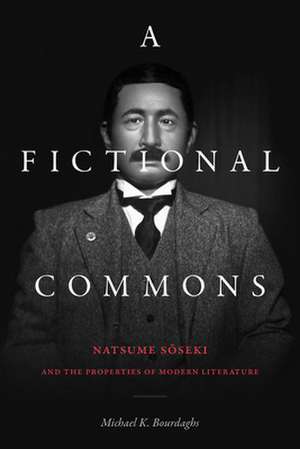
A Fictional Commons
Autor Michael K. Bourdaghsen Limba Engleză Paperback – 17 sep 2021
Preț: 194.31 lei
Puncte Express: 291
Carte tipărită la comandă
Livrare economică 28 noiembrie-12 decembrie
Livrare prin curier în România Termenul estimat este afișat lângă disponibilitate.
Transport gratuit de la 400.00 lei Plată online sau ramburs, în funcție de opțiunile comenzii.
Retur gratuit în 14 zile Comandă securizată și suport în română.
Specificații
ISBN-13: 9781478014621
ISBN-10: 1478014628
Pagini: 236
Dimensiuni: 152 x 229 x 13 mm
Greutate: 0.32 kg
Editura: Duke University Press
ISBN-10: 1478014628
Pagini: 236
Dimensiuni: 152 x 229 x 13 mm
Greutate: 0.32 kg
Editura: Duke University Press
Cuprins
Note on Usage ix
Acknowledgments xi
Introduction. Owning up to S¿seki 1
1. Fables of Property: Nameless Cats, Trickster Badgers, Stray Sheep 13
2. House under a Shadow: Disowning the Psychology of Possessive Individualism in The Gate 51
3. Property and Sociological Knowledge: S¿seki and the Gift of Narrative 91
4. The Tragedy of the Market:Younger Brothers, Women, and Colonial Subjects in Kokoro 121
Conclusion. Who Owns S¿seki? Or, How Not to Belong in World Literature 147
Notes 177
Bibliography 205
Index 219
Acknowledgments xi
Introduction. Owning up to S¿seki 1
1. Fables of Property: Nameless Cats, Trickster Badgers, Stray Sheep 13
2. House under a Shadow: Disowning the Psychology of Possessive Individualism in The Gate 51
3. Property and Sociological Knowledge: S¿seki and the Gift of Narrative 91
4. The Tragedy of the Market:Younger Brothers, Women, and Colonial Subjects in Kokoro 121
Conclusion. Who Owns S¿seki? Or, How Not to Belong in World Literature 147
Notes 177
Bibliography 205
Index 219
Descriere
Descriere de la o altă ediție sau format:
Michael K. Bourdaghs presents a radical reframing of the works of Natsume Soseki-widely considered to be Japan's greatest modern novelist-as critical and creative responses to the emergence of new forms of property ownership in nineteenth-century Japan.
Michael K. Bourdaghs presents a radical reframing of the works of Natsume Soseki-widely considered to be Japan's greatest modern novelist-as critical and creative responses to the emergence of new forms of property ownership in nineteenth-century Japan.