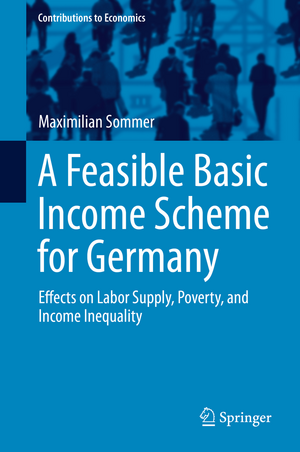
A Feasible Basic Income Scheme for Germany: Contributions to Economics
Autor Maximilian Sommeren Limba Engleză Hardback – 10 mar 2016
Din seria Contributions to Economics
- 18%
 Preț: 1096.48 lei
 - 18%
 Preț: 979.65 lei
 - 18%
 Preț: 1072.68 lei
 - 18%
 Preț: 1217.13 lei
 - 15%
 Preț: 512.41 lei
 - 18%
 Preț: 1068.04 lei
 - 15%
 Preț: 624.86 lei
 - 15%
 Preț: 645.13 lei
 - 15%
 Preț: 616.67 lei
 - 15%
 Preț: 628.52 lei
 - 15%
 Preț: 622.37 lei
 - 15%
 Preț: 644.90 lei
 - 15%
 Preț: 619.51 lei
 - 15%
 Preț: 620.55 lei
 - 15%
 Preț: 620.35 lei
 - 15%
 Preț: 640.73 lei
 -
 Preț: 368.79 lei
 - 18%
 Preț: 923.26 lei
 - 15%
 Preț: 624.49 lei
 - 15%
 Preț: 636.90 lei
 -
 Preț: 363.99 lei
 -
 Preț: 367.68 lei
 -
 Preț: 391.49 lei
 - 15%
 Preț: 624.36 lei
 - 15%
 Preț: 625.75 lei
 -
 Preț: 388.51 lei
 -
 Preț: 397.45 lei
 -
 Preț: 373.40 lei
 - 15%
 Preț: 641.11 lei
 - 20%
 Preț: 624.51 lei
 - 18%
 Preț: 726.06 lei
 -
 Preț: 374.14 lei
 - 15%
 Preț: 609.53 lei
 -
 Preț: 373.16 lei
 -
 Preț: 381.75 lei
 -
 Preț: 371.03 lei
 - 15%
 Preț: 639.42 lei
 -
 Preț: 383.27 lei
 - 15%
 Preț: 638.58 lei
 -
 Preț: 372.67 lei
 - 15%
 Preț: 626.40 lei
 -
 Preț: 371.73 lei
 - 15%
 Preț: 619.20 lei
 -
 Preț: 372.70 lei
 -
 Preț: 368.62 lei
 - 15%
 Preț: 623.96 lei
 -
 Preț: 384.50 lei
 -
 Preț: 370.30 lei
 -
 Preț: 383.79 lei
 -
 Preț: 368.05 lei
Preț: 645.39 lei
Preț vechi: 759.27 lei
-15%
Puncte Express: 968
Carte tipărită la comandă
Livrare economică 13-27 noiembrie
Livrare prin curier în România Termenul estimat este afișat lângă disponibilitate.
Transport gratuit pentru acest produs Plată online sau ramburs, în funcție de opțiunile comenzii.
Retur gratuit în 14 zile Comandă securizată și suport în română.
Specificații
ISBN-13: 9783319240626
ISBN-10: 3319240625
Pagini: 220
Ilustrații: XXI, 198 p. 31 illus. in color.
Dimensiuni: 160 x 241 x 18 mm
Greutate: 0.5 kg
Ediția:1st edition 2016
Editura: Springer
Colecția Contributions to Economics
Seria Contributions to Economics
Locul publicării:Cham, Switzerland
ISBN-10: 3319240625
Pagini: 220
Ilustrații: XXI, 198 p. 31 illus. in color.
Dimensiuni: 160 x 241 x 18 mm
Greutate: 0.5 kg
Ediția:1st edition 2016
Editura: Springer
Colecția Contributions to Economics
Seria Contributions to Economics
Locul publicării:Cham, Switzerland
V-ar putea interesa
-
 Public Finance, Global EditionHarvey Rosen-21%Preț: 508.75 lei643.98 lei
 -
 Treasure IslandsNicholas Shaxson-31%Preț: 63.96 lei92.13 lei
 -
 Public Procurement Reforms in Africa: Challenges in Institutions and GovernanceChristine Léon de Mariz-31%Preț: 787.86 lei1145.69 lei
 -
 Debt Relief Initiatives, Development Assistance and Service Delivery in AfricaThe African Development Bank-31%Preț: 555.04 lei806.25 lei
 -
 -31%Preț: 806.27 lei1170.40 lei
 -
 -12%Preț: 292.14 lei332.25 lei
 -
 Governance Challenges and Innovations: Financial and Fiscal GovernanceHelmut K. Anheier-31%Preț: 806.33 lei1170.42 lei
 -
 The Theory, Principles and Management of Taxation: An introductionJane Frecknall-Hughes-18%Preț: 1355.02 lei1652.47 lei
 -
 The Theory, Principles and Management of Taxation: An introductionJane Frecknall-Hughes-15%Preț: 455.36 lei535.71 lei
 -
 -15%Preț: 665.98 lei783.50 lei
 -
 Monitoring the Quality of Health CareThomas T. H. Wan-18%Preț: 913.43 lei1113.94 lei
 -
 Federalist Government in Principle and PracticeDonald P. Racheter-15%Preț: 644.90 lei758.71 lei
 -
 -15%Preț: 608.90 lei716.36 lei
 -
 Public Decision-Making Processes and Asymmetry of InformationMassimo Marrelli-15%Preț: 612.55 lei720.65 lei
 -
 The European Debt Crisis: A PrimerRobert GodbyPreț: 138.65 lei
 -
 Social Security and Economic GlobalizationPaul J. J. WelfensPreț: 374.88 lei
 -
 Tax Policy for Aging SocietiesA. Okamoto-15%Preț: 637.75 lei750.29 lei
Public țintă
ResearchCuprins
Introduction.- The Normative Argument for an Unconditional Basic Income.- Implementation of a Basic Income by a Negative Income Tax.- A Negative Income Tax Proposal for Germany.- Modeling Political Reforms: The Discrete Approach to Labor Supply.- Implications on the Proposed Basic Income Reform.
Textul de pe ultima copertă
This book analyzes the consequences that would arise if Germany’s means-tested unemployment benefits were replaced with an unconditional basic income. The basic income scheme introduced is based on a negative income tax and calibrated to be both financially feasible and compatible with current constitutional legislation. Using data from the German Socio-Economic Panel (GSOEP) the author examines the impact of the reform on the household labor supply as well as on both poverty and inequality measures. It is shown that by applying reasonable values for both the basic income and the implied marginal tax rate imposed on earned incomes, efficiency gains can be reconciled with generally accepted value statements. Furthermore, as the proposal includes a universal basic income for families, child poverty could be reduced considerably. The estimates are based on the discrete choice approach to labor supply.
Caracteristici
Proposes a concept for a feasible basic income scheme that completely reconciles socio-political and economic requirements Applies the latest microeconomics methods, concretely analyzing allocation and distribution effects on different household types Based on up-to-date empirical data Includes supplementary material: sn.pub/extras