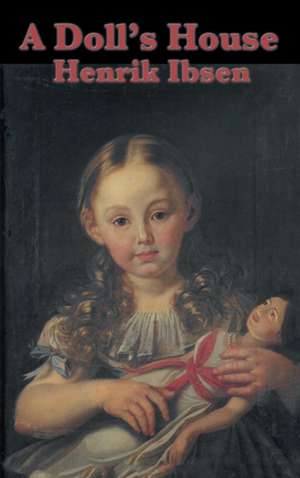
A Doll's House
Autor Henrik Johan Ibsenen Limba Engleză Hardback – 3 apr 2018
Preț: 129.91 lei
Puncte Express: 195
Carte tipărită la comandă
Livrare economică 01-15 decembrie
Livrare prin curier în România Termenul estimat este afișat lângă disponibilitate.
Transport gratuit de la 400.00 lei Plată online sau ramburs, în funcție de opțiunile comenzii.
Retur gratuit în 14 zile Comandă securizată și suport în română.
Specificații
ISBN-13: 9781515435587
ISBN-10: 151543558X
Pagini: 88
Dimensiuni: 157 x 235 x 10 mm
Greutate: 0.29 kg
Editura: SMK Books
ISBN-10: 151543558X
Pagini: 88
Dimensiuni: 157 x 235 x 10 mm
Greutate: 0.29 kg
Editura: SMK Books
V-ar putea interesa
-
 The God of Small ThingsArundhati RoyPreț: 72.76 lei
 -
 Preț: 107.84 lei
 -
 Homage to CataloniaGeorge OrwellPreț: 28.01 lei
 -
 Moab Is My WashpotStephen Fry-35%Preț: 61.15 lei94.31 lei
 -
 Social IntelligenceDaniel Goleman-18%Preț: 76.90 lei93.99 lei
 -
 The Diversity of LifeEdward O. Wilson-19%Preț: 76.45 lei93.95 lei
 -
 PlaysAnton Chekhov-24%Preț: 60.46 lei79.99 lei
 -
 The Stuff of ThoughtSteven Pinker-29%Preț: 77.49 lei108.42 lei
 -
 One Flew Over the Cuckoo's NestKen Kesey-25%Preț: 59.40 lei79.37 lei
 -
 The Language InstinctSteven Pinker-29%Preț: 77.56 lei108.48 lei
 -
 Think: A Compelling Introduction to PhilosophySimon Blackburn-18%Preț: 76.46 lei93.70 lei
 -
 Joseph Conrad's Heart of Darkness: A CasebookGene M. Moore-13%Preț: 287.67 lei329.91 lei
 -
 Oxford IB Diploma Programme: Extended Essay Course CompanionKosta Lekanides-11%Preț: 344.18 lei386.54 lei
 -
 Oxford Reader's Companion to ConradOwen Knowles-16%Preț: 198.09 lei234.93 lei
 -
 -13%Preț: 304.17 lei350.40 lei
 -
 Teach Your Child How To ThinkEdward de Bono-19%Preț: 64.54 lei79.23 lei
 -
 Six Thinking HatsEdward de Bono-26%Preț: 62.62 lei85.05 lei
 -
 Lateral ThinkingEdward de Bono-19%Preț: 63.91 lei78.85 lei
 -
 True to LifeMichael P. LynchPreț: 303.83 lei
 -
 The Handmaid's TaleMargaret AtwoodPreț: 82.11 lei
 -
 Fermat's EnigmaSimon SinghPreț: 101.50 lei
Notă biografică
Henrik Johan Ibsen (1828-1906) was a Norwegian playwright, poet, theater director, and one of the most influential dramatists in world literature. Born in Skien, Norway, Ibsen grew up in a family that experienced financial decline, an experience that sharpened his awareness of social position, respectability, secrecy, and the pressures of public judgment. He worked in pharmacies and theaters before becoming a major literary figure, spending much of his adult life outside Norway in Italy and Germany while writing plays that transformed European drama.Ibsen's early works drew on history, legend, and verse drama, but he became internationally famous for realistic plays that exposed the moral contradictions of modern social life. His major works include Brand, Peer Gynt, Pillars of Society, A Doll's House, Ghosts, An Enemy of the People, The Wild Duck, Rosmersholm, Hedda Gabler, and The Master Builder. He challenged audiences by bringing uncomfortable subjects onto the stage: marriage, hypocrisy, inherited guilt, venereal disease, corruption, women's legal status, political cowardice, and the cost of living by lies.Ibsen is often called the father of modern drama because he helped move theater away from melodrama and spectacle toward psychological realism, social critique, and morally complex domestic conflict. His influence can be seen in later playwrights across Europe and America, and his plays remain central to theater, literature courses, feminist criticism, and modern performance. A Doll's House in particular made Nora Helmer one of drama's defining figures of self-recognition and made the closed door of the home into a stage for public argument.