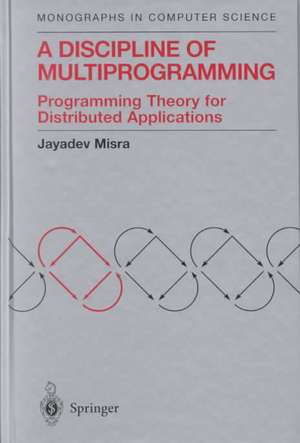
A Discipline of Multiprogramming
Autor Jayadev Misraen Limba Engleză Hardback – 26 iun 2001
Preț: 345.07 lei
Preț vechi: 431.33 lei
-20%
Puncte Express: 518
Carte tipărită la comandă
Livrare economică 27 noiembrie-11 decembrie
Livrare prin curier în România Termenul estimat este afișat lângă disponibilitate.
Transport gratuit de la 400.00 lei Plată online sau ramburs, în funcție de opțiunile comenzii.
Retur gratuit în 14 zile Comandă securizată și suport în română.
Specificații
ISBN-13: 9780387952062
ISBN-10: 0387952063
Pagini: 420
Ilustrații: XVIII, 420 p.
Dimensiuni: 161 x 241 x 26 mm
Greutate: 0.73 kg
Ediția:2001 edition
Editura: Springer
Locul publicării:New York, NY, United States
ISBN-10: 0387952063
Pagini: 420
Ilustrații: XVIII, 420 p.
Dimensiuni: 161 x 241 x 26 mm
Greutate: 0.73 kg
Ediția:2001 edition
Editura: Springer
Locul publicării:New York, NY, United States
V-ar putea interesa
-
 Head First HTML and CSSElisabeth Robson-20%Preț: 297.40 lei371.75 lei
 -
 KanbanDavid J. Anderson-20%Preț: 264.20 lei330.25 lei
 -
 Preț: 295.88 lei
 -
 Professional GitBrent Laster-20%Preț: 256.78 lei320.97 lei
 -
 Pro ASP.NET Web API SecurityBadrinarayanan Lakshmiraghavan-20%Preț: 525.86 lei657.33 lei
 -
 Android CookbookIan F Darwin-20%Preț: 443.80 lei554.76 lei
 -
 Continuous Delivery with Visual Studio ALM 2015Mathias Olausson-20%Preț: 299.70 lei374.63 lei
 -
 The Enterprise Big Data LakeAlex Gorelik-20%Preț: 378.05 lei472.57 lei
 -
 Feature Engineering for Machine LearningAlice Zheng-20%Preț: 342.12 lei427.66 lei
 -
 Mastering ServiceNow - Second EditionMartin Wood-20%Preț: 368.74 lei460.93 lei
 -
 -20%Preț: 636.70 lei795.87 lei
 -
 Logic Based Program Synthesis and TransformationM. Leuschel-20%Preț: 321.94 lei402.43 lei
 -
 Algorithms - ESA 2000Mike Paterson-20%Preț: 330.36 lei412.95 lei
 -
 Generic ProgrammingMehdi Jazayeri-20%Preț: 321.36 lei401.70 lei
 -
 Programs as Data ObjectsOlivier Danvy-20%Preț: 334.80 lei418.50 lei
 -
 Graph-Theoretic Concepts in Computer ScienceAndreas Brandstädt-20%Preț: 324.66 lei405.83 lei
 -
 ECOOP '88 European Conference on Object-Oriented ProgrammingStein Gjessing-20%Preț: 328.49 lei410.62 lei
 -
 Linear Time, Branching Time and Partial Order in Logics and Models for ConcurrencyJacobus W. De Bakker-20%Preț: 671.75 lei839.68 lei
 -
 Computing and CombinatoricsTakao Asano-20%Preț: 346.55 lei433.19 lei
Public țintă
Professional/practitionerCuprins
A Discipline of Multiprogramming.- 1.1 Wide-Area Computing.- 1.2 An Example: Planning a Meeting.- 1.3 Issues in Multiprogram Design.- 1.4 Concluding Remarks.- 1.5 Bibliographic Notes.- 2 Action Systems.- 2.1 An Informal View of Action Systems.- 2.2 Syntax and Semantics of Action Systems.- 2.3 Properties of Action Systems.- 2.4 Examples.- 2.5 Concluding Remarks.- 2.6 Bibliographic Notes.- 3 An Object-Oriented View of Action Systems.- 3.1 Introduction.- 3.2 Seuss Syntax.- 3.3 Seuss Semantics (Operational).- 3.4 Discussion.- 3.5 Concluding Remarks.- 3.6 Bibliographic Notes.- 4 Small Examples.- 4.1 Channels.- 4.2 A Simple Database.- 4.3 Management of Multilevel Memory: Lazy Caching.- 4.4 Real-Time Controller; Discrete-Event Simulation.- 4.5 Example of a Process Network.- 4.6 Broadcast.- 4.7 Barrier Synchronization.- 4.8 Readers and Writers.- 4.9 Semaphore.- 4.10 Multiple Resource Allocation.- 4.11 Concluding Remarks.- 4.12 Bibliographic Notes.- 5 Safety Properties.- 5.1 Introduction.- 5.2 The Meaning of co.- 5.3 Special Cases of co.- 5.4 Derived Rules.- 5.5 Applications.- 5.6 Theoretical Results.- 5.7 Concluding Remarks.- 5.8 Bibliographic Notes.- 5.9 Exercises.- 5.10 Solutions to Exercises.- 6 Progress Properties.- 6.1 Introduction.- 6.2 Fairness.- 6.3 Transient Predicate.- 6.4 ensures, leads-to.- 6.5 Applications.- 6.6 Theoretical Issues.- 6.7 Concluding Remarks.- 6.8 Bibliographic Notes.- 6.9 Exercises.- 6.10 Solutions to Exercises.- 7 Maximality Properties.- 7.1 Introduction.- 7.2 Notion of Maximality.- 7.3 Proving Maximality.- 7.4 Random Assignment.- 7.5 Fair Unordered Channel.- 7.6 Faulty Channel.- 7.7 Concluding Remarks.- 7.8 Bibliographic Notes.- 8 Program Composition.- 8.1 Introduction.- 8.2 Composition by Union.- 8.3 Examples of Program Union.- 8.4 Substitution Axiom under Union.- 8.5 Theoretical Issues.- 8.6 Concluding Remarks.- 8.7 Bibliographic Notes.- 8.8 Exercises.- 8.9 Solutions to Exercises.- 9 Conditional and Closure Properties.- 9.1 Introduction.- 9.2 Conditional Properties.- 9.3 Closure Properties.- 9.4 Combining Closure and Conditional Properties.- 9.5 Concluding Remarks.- 9.6 Bibliographic Notes.- 10 Reduction Theorem.- 10.1 Introduction.- 10.2 A Model of Seuss Programs.- 10.3 Compatibility.- 10.4 Loose Execution.- 10.5 Reduction Theorem and Its Proof.- 10.6 A Variation of the Reduction Theorem.- 10.7 Concluding Remarks.- 10.8 Bibliographic Notes.- 11 Distributed Implementation.- 11.1 Introduction.- 11.2 Outline of the Implementation Strategy.- 11.3 Design of the Scheduler.- 11.4 Proof of Maximality of the Scheduler.- 11.5 Refining the Scheduling Strategy.- 11.6 Designs of the Processors.- 11.7 Optimizations.- 11.8 Concluding Remarks.- 11.9 Bibliographic Notes.- 12 A Logic for Seuss.- 12.1 Introduction.- 12.2 Specifications of Simple Procedures.- 12.3 Specifications of General Procedures.- 12.4 Persistence and Relative Stability.- 12.5 Strong Semaphore.- 12.6 Starvation Freedom in a Resource Allocation Algorithm.- 12.7 Concluding Remarks.- 12.8 Bibliographic Notes.- In Retrospect.- A Elementary Logic and Algebra.- A.1 Propositional Calculus.- A.2 Predicate Calculus.- A.2.1 Quantification.- A.2.2 Textual substitution.- A.2.3 Universal and Existential quantification.- A.3 Proof Format.- A.4 Hoare Logic and Weakest Pre-conditions.- A.4.1 Hoare logic.- A.4.2 Weakest pre-conditions.- A.5 Elementary Relational Calculus.- References.
Recenzii
From the reviews:
"Jayadev Misras ‘Discipline of Multiprogramming – Programming Theory for Distributed Applications’ wants to contribute theories and design principles to enhance productivity in specification, abstraction and modularization. … Most chapters have a large number of examples, contain bibliographic notes and a lot of exercises with solutions. The book concludes with an appendix about elementary logic and algebra, a reference list and an index." (Christoph Meinel, Zentralblatt MATH, Vol. 999, 2002)
"Jayadev Misras ‘Discipline of Multiprogramming – Programming Theory for Distributed Applications’ wants to contribute theories and design principles to enhance productivity in specification, abstraction and modularization. … Most chapters have a large number of examples, contain bibliographic notes and a lot of exercises with solutions. The book concludes with an appendix about elementary logic and algebra, a reference list and an index." (Christoph Meinel, Zentralblatt MATH, Vol. 999, 2002)