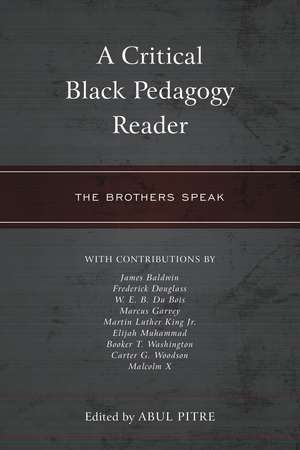
A Critical Black Pedagogy Reader: The Brothers Speak: Critical Black Pedagogy in Education
Editat de Abul Pitreen Limba Engleză Paperback – 15 oct 2019

Preț: 143.73 lei
Preț vechi: 182.69 lei
-21%
Puncte Express: 216
Carte tipărită la comandă
Livrare economică 30 noiembrie-14 decembrie
Livrare prin curier în România Termenul estimat este afișat lângă disponibilitate.
Transport gratuit de la 400.00 lei Plată online sau ramburs, în funcție de opțiunile comenzii.
Retur gratuit în 14 zile Comandă securizată și suport în română.
Specificații
ISBN-13: 9781475848205
ISBN-10: 147584820X
Pagini: 96
Dimensiuni: 148 x 228 x 10 mm
Greutate: 0.18 kg
Editura: Bloomsbury Publishing
Colecția Rowman & Littlefield
Seria Critical Black Pedagogy in Education
Locul publicării:New York, United States
ISBN-10: 147584820X
Pagini: 96
Dimensiuni: 148 x 228 x 10 mm
Greutate: 0.18 kg
Editura: Bloomsbury Publishing
Colecția Rowman & Littlefield
Seria Critical Black Pedagogy in Education
Locul publicării:New York, United States
Cuprins
Series Foreword
Abul Pitre
Foreword
Chance W. Lewis, Ph.D., Collaborative Director, Carol Grotnes Belk Distinguished Professor of Urban Education, Department of Middle, Secondary and K-12 Education, UNC Charlotte
Introduction
Abul Pitre
Chapter 1- What to the Slave Is the Fourth of July?
Frederick Douglass
Chapter 2- The Awakening of the Negro
Booker T. Washington
Chapter 3- The Education of Black Folk
W. E. B. DuBois
Chapter 4- Educate Yourself
Marcus Garvey
Chapter 5- The Seat of the Trouble
Carter G. Woodson
Chapter 6- The Purpose of Education
Martin Luther King Jr.
Chapter 7- A Talk to Teachers
James Baldwin
Chapter 8- History Is a Weapon
Malcolm X
Chapter 9- Get Knowledge to Benefit Self
Elijah Muhammad
About the Editor
About the Writers
Index
Abul Pitre
Foreword
Chance W. Lewis, Ph.D., Collaborative Director, Carol Grotnes Belk Distinguished Professor of Urban Education, Department of Middle, Secondary and K-12 Education, UNC Charlotte
Introduction
Abul Pitre
Chapter 1- What to the Slave Is the Fourth of July?
Frederick Douglass
Chapter 2- The Awakening of the Negro
Booker T. Washington
Chapter 3- The Education of Black Folk
W. E. B. DuBois
Chapter 4- Educate Yourself
Marcus Garvey
Chapter 5- The Seat of the Trouble
Carter G. Woodson
Chapter 6- The Purpose of Education
Martin Luther King Jr.
Chapter 7- A Talk to Teachers
James Baldwin
Chapter 8- History Is a Weapon
Malcolm X
Chapter 9- Get Knowledge to Benefit Self
Elijah Muhammad
About the Editor
About the Writers
Index
Recenzii
A Critical Black Pedagogy Reader: The Brothers Speak, demonstrates the genealogy of critical pedagogy in the history of African Americans from the earliest days. This volume introduces us to the sources of the work of many men and women writing today about the need for a new pedagogy. This is a volume necessary for the current discourse on teaching in urban America.
Pitre has assembled principal essays, which provide, context, clarity, and critical impact related to the Africana experience. Voiced in the context of African American males, this book initiates space to engage, the continuity of disparity exhibited towards African Americans. Overall, this book is a major contribution to the: social sciences, humanities, and professions.
The selection of critical Black pedagogues and their works within this book gives educational leaders a great foundation for understanding the framework of critical Black pedagogy. The selections challenge readers to view these Black leaders in a light that focuses on liberation, equity, and justice for students, particularly those of color.
Critical Black Pedagogy is premised upon the notion that since Africans arrived on the shores of America, men (and women) have elucidated the purpose of education for African Americans, long before the formal construct of Critical Pedagogy was thrust to the forefront of discourse in the 1930s. The point is not to dismiss the outstanding scholarship of critical pedagogues. Rather, the intent is to highlight the fact that the unique experiences of African Americans living in a White Supremacist society require an education that must confront and expose embedded power inequities, historical dehumanization, and distorted knowledge that keeps them economically, intellectually, and socially enslaved approximately 154 years after emancipation. Black students top nearly every negative educational indices. A strong argument can be advanced that by any measure, public education has failed those students.
The recognition that such a reader as this is necessary two decades into the 21st Century speaks to the urgency that is needed to properly educate African American students. This book is a must read for anyone truly concerned with transforming the lives of not just Black students but marginalized students everywhere.
As Abul Pitre posits, the voices of critical Black thinkers in education are routinely erased in educational discourse. Traditional trends in intellectual thought in education demonstrate that historical Black thinkers are rarely taken seriously as canonical voices capable of guiding pedagogy. This volume marks an important contribution to the field of critical Black pedagogy by highlighting the ways in which Black men (the Brothers) dared propose an alternative perspective on education that fundamentally rejected Eurocentric paradigms of thinking. From Frederick Douglass to James Baldwin, much is accomplished by highlighting the tapestry of black men's thoughts on education. The urgency of both Pitre and his ancestral Brothers to define a pedagogy for black folks by black folks emerges from the pages contained herein with palpable baritone profundity.
Pitre has assembled principal essays, which provide, context, clarity, and critical impact related to the Africana experience. Voiced in the context of African American males, this book initiates space to engage, the continuity of disparity exhibited towards African Americans. Overall, this book is a major contribution to the: social sciences, humanities, and professions.
The selection of critical Black pedagogues and their works within this book gives educational leaders a great foundation for understanding the framework of critical Black pedagogy. The selections challenge readers to view these Black leaders in a light that focuses on liberation, equity, and justice for students, particularly those of color.
Critical Black Pedagogy is premised upon the notion that since Africans arrived on the shores of America, men (and women) have elucidated the purpose of education for African Americans, long before the formal construct of Critical Pedagogy was thrust to the forefront of discourse in the 1930s. The point is not to dismiss the outstanding scholarship of critical pedagogues. Rather, the intent is to highlight the fact that the unique experiences of African Americans living in a White Supremacist society require an education that must confront and expose embedded power inequities, historical dehumanization, and distorted knowledge that keeps them economically, intellectually, and socially enslaved approximately 154 years after emancipation. Black students top nearly every negative educational indices. A strong argument can be advanced that by any measure, public education has failed those students.
The recognition that such a reader as this is necessary two decades into the 21st Century speaks to the urgency that is needed to properly educate African American students. This book is a must read for anyone truly concerned with transforming the lives of not just Black students but marginalized students everywhere.
As Abul Pitre posits, the voices of critical Black thinkers in education are routinely erased in educational discourse. Traditional trends in intellectual thought in education demonstrate that historical Black thinkers are rarely taken seriously as canonical voices capable of guiding pedagogy. This volume marks an important contribution to the field of critical Black pedagogy by highlighting the ways in which Black men (the Brothers) dared propose an alternative perspective on education that fundamentally rejected Eurocentric paradigms of thinking. From Frederick Douglass to James Baldwin, much is accomplished by highlighting the tapestry of black men's thoughts on education. The urgency of both Pitre and his ancestral Brothers to define a pedagogy for black folks by black folks emerges from the pages contained herein with palpable baritone profundity.