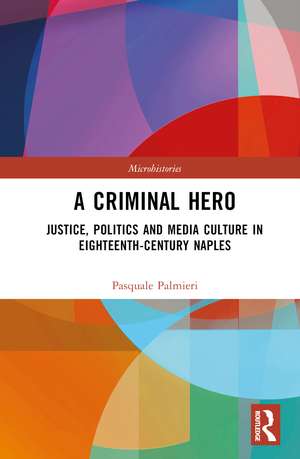
A Criminal Hero: Justice, Politics and Media Culture in Eighteenth-Century Naples: Microhistories
Autor Pasquale Palmierien Limba Engleză Hardback – 19 aug 2024
Focusing on the scandalous affair of the "buried alive", this book shows how the governing authorities in Naples managed the development of news and stories around current events through their systems of courts and bureaucracies. It also aims to demonstrate how, just as importantly, consumers played an increasing in the spread of information, as means to political empowerment. The sources analyzed call for a microhistorical analysis, as well as for an interdisciplinary discussion with media studies at its conceptual core.
A Criminal Hero will appeal to students and scholars alike interested in microhistory, cultural history, media history, history of literature, social and political history, with a focus on the eighteenth century.
Din seria Microhistories
- 18%
 Preț: 1058.46 lei
 - 18%
 Preț: 1113.77 lei
 -
 Preț: 431.98 lei
 -
 Preț: 428.96 lei
 -
 Preț: 429.16 lei
 -
 Preț: 442.18 lei
 -
 Preț: 412.13 lei
 -
 Preț: 415.71 lei
 -
 Preț: 380.12 lei
 -
 Preț: 418.09 lei
 -
 Preț: 411.71 lei
 -
 Preț: 413.20 lei
 -
 Preț: 428.18 lei
 -
 Preț: 433.98 lei
 -
 Preț: 432.39 lei
 -
 Preț: 413.82 lei
 -
 Preț: 435.80 lei
 -
 Preț: 401.22 lei
 - 12%
 Preț: 367.88 lei
 -
 Preț: 464.92 lei
 - 18%
 Preț: 1345.26 lei
 - 18%
 Preț: 1344.48 lei
 - 12%
 Preț: 375.78 lei
Preț: 1112.38 lei
Preț vechi: 1356.55 lei
-18%
Puncte Express: 1669
Carte tipărită la comandă
Livrare economică 01-15 decembrie
Livrare prin curier în România Termenul estimat este afișat lângă disponibilitate.
Transport gratuit pentru acest produs Plată online sau ramburs, în funcție de opțiunile comenzii.
Retur gratuit în 14 zile Comandă securizată și suport în română.
Specificații
ISBN-13: 9781032722252
ISBN-10: 1032722258
Pagini: 158
Dimensiuni: 156 x 234 mm
Greutate: 0.45 kg
Ediția:1
Editura: Taylor & Francis
Colecția Routledge
Seria Microhistories
Locul publicării:Oxford, United Kingdom
ISBN-10: 1032722258
Pagini: 158
Dimensiuni: 156 x 234 mm
Greutate: 0.45 kg
Ediția:1
Editura: Taylor & Francis
Colecția Routledge
Seria Microhistories
Locul publicării:Oxford, United Kingdom
Public țintă
AcademicCuprins
Introduction
Chapter 1: “Buried Alive:” Leopoldo and the Style of the Holy Office (1757–1767)
Chapter 2: Justice, Literature, and Public Space
Chapter 3: A Participatory Tale: Verbal, Visual, and Written Forms of Communication
Chapter 4: Literary Communication and the Building of a Political Culture
Conclusion: A Hidden Identity in the Theater of the World
Chapter 1: “Buried Alive:” Leopoldo and the Style of the Holy Office (1757–1767)
Chapter 2: Justice, Literature, and Public Space
Chapter 3: A Participatory Tale: Verbal, Visual, and Written Forms of Communication
Chapter 4: Literary Communication and the Building of a Political Culture
Conclusion: A Hidden Identity in the Theater of the World
Notă biografică
Pasquale Palmieri is Associate Professor of Early Modern History at the University of Naples “Federico II.” He is Ph.D. in History of European Society (University of Naples Federico II, 2008) and Italian Studies (University of Texas at Austin, 2021). His research interests include early modern media and literary culture, with a particular emphasis on the relationship between politics and religion. His recent publications include Le cento vite di Cagliostro (2023) and The Land of Devotion. Saints, Politics and Media Culture in 18th-Century Italy (2023).
Recenzii
‘Palmieri’s study exposes the tangled web of eighteenth-century Neapolitan media culture, with its intermingling of different genres and power contests. A concise but rich and deeply researched analysis … the study documents the effect that words, written, printed, published, and disseminated, had on people’s understanding of justice and criminality … Although Palmieri’s microhistorical analysis deliberately restricts its geographical and temporal scope by largely focusing on a single individual, the scholar’s transmedial approach is relevant to examinations of the intersection between media culture and power systems, both within Italian studies and beyond. In our current moment, dominated by false news and in which the political landscape bears witness to the increasingly elusive nature of truth, Palmieri’s study feels particularly timely’ - ANNALI D’ITALIANISTICA (Volume 43, 2025).
Descriere
Focusing on the scandalous affair of the “buried alive”, this book shows how the governing authorities in Naples managed the development of news and stories around current events through their systems of courts and bureaucracies.