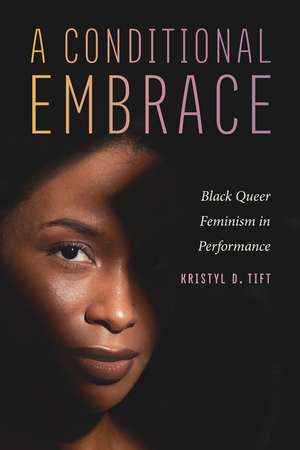
A Conditional Embrace: Black Queer Feminism in Performance: Black Performance and Cultural Criticism
Autor Kristyl D. Tiften Limba Engleză Paperback – 31 iul 2026
Uses an intersectional and intertextual methodology to present a rigorous yet accessible study of Black queer women artists in theater and film.
In A Conditional Embrace, Kristyl D. Tift seeks to understand how Black queer women theater and film artists depict their own survival in heterosexist temporalities and spaces. Using the framework of lovin’ on—a theory inspired by Black feminist thought, performance theory, and queer theory—Tift closely reads the works of a selection of artists to investigate the “conditional embrace” of Black queer art in society. Her intersectional and intertextual methodology considers the text and body as part and parcel of performance work, allowing her to examine the multiple and complex intersections of identity at play in works meant to be read and performed. Tift puts the work of more visible artists such as Dee Rees, Sharon Bridgforth, and Staceyann Chin in direct conversation with lesser-known contributors to Black queer feminist performance such as Shirlene Holmes and Donnetta Lavinia Grays, analyzing not only their plays, installations, and poetry but also interviews, personal essays, performances, and more. Centering the works of artists situated, by birth or migration, in the Southern US and the Caribbean, A Conditional Embrace explores how artists at the margins of art and society represent Black queer women’s survival through processes of self-making, community-building, and homemaking.
In A Conditional Embrace, Kristyl D. Tift seeks to understand how Black queer women theater and film artists depict their own survival in heterosexist temporalities and spaces. Using the framework of lovin’ on—a theory inspired by Black feminist thought, performance theory, and queer theory—Tift closely reads the works of a selection of artists to investigate the “conditional embrace” of Black queer art in society. Her intersectional and intertextual methodology considers the text and body as part and parcel of performance work, allowing her to examine the multiple and complex intersections of identity at play in works meant to be read and performed. Tift puts the work of more visible artists such as Dee Rees, Sharon Bridgforth, and Staceyann Chin in direct conversation with lesser-known contributors to Black queer feminist performance such as Shirlene Holmes and Donnetta Lavinia Grays, analyzing not only their plays, installations, and poetry but also interviews, personal essays, performances, and more. Centering the works of artists situated, by birth or migration, in the Southern US and the Caribbean, A Conditional Embrace explores how artists at the margins of art and society represent Black queer women’s survival through processes of self-making, community-building, and homemaking.















Preț: 287.29 lei
Nou
Puncte Express: 431
Carte tipărită la comandă
Livrare economică 04-10 decembrie
Livrare prin curier în România Termenul estimat este afișat lângă disponibilitate.
Transport gratuit de la 400.00 lei Plată online sau ramburs, în funcție de opțiunile comenzii.
Retur gratuit în 14 zile Comandă securizată și suport în română.
Specificații
ISBN-13: 9780814259900
ISBN-10: 0814259901
Pagini: 150
Ilustrații: 5 b&w images
Dimensiuni: 152 x 229 x 10 mm
Greutate: 0.23 kg
Editura: Ohio State University Press
Colecția Ohio State University Press
Seria Black Performance and Cultural Criticism
ISBN-10: 0814259901
Pagini: 150
Ilustrații: 5 b&w images
Dimensiuni: 152 x 229 x 10 mm
Greutate: 0.23 kg
Editura: Ohio State University Press
Colecția Ohio State University Press
Seria Black Performance and Cultural Criticism
Recenzii
“A Conditional Embrace is a groundbreaking study that illuminates Southern queer Black performance artists, situating their bold feminist work within vital sociohistorical contexts. With the powerful idea of ‘lovin’ on,’ Tift expands the canon and ensures visionary artists receive the recognition they deserve now and into the future.” —Sharrell D. Luckett, editor of African American Arts: Activism, Aesthetics, and Futurity
Notă biografică
Kristyl D. Tift is Assistant Professor of Theatre at Vanderbilt University.
Extras
My approach to reading the past into the present is guided by Diana Taylor’s vision of what an archive can be. Exploring diverse embodied performances of the Southern Hemisphere, Taylor’s The Archive and the Repertoire reassesses “performative artifacts” of the not-so-distant past—performances, which, in their time, and to outsiders looking in, may have seemed inconsequential but are, in fact, embodied social and cultural knowledge deserving of preservation and production. Cookie Woolner’s The Famous Lady Lovers, an interesting historical survey of Black queer women living, loving, and performing in public before the Stonewall Riots, exemplifies how an array of seemingly disparate artifacts, when considered intertextually, can evince an archive that reinstitutes Black queer women performers in the historical record. Situating her study in an era before queer, feminist, and Black Power movements were popular, Woolner proves that the absence of Black queer herstories in theater and performance research presents an opportunity to recover those stories and rediscover their tellers. Woolner recognizes the significance of the theater as a space in which women like Ethel Waters, Gladys Bentley, and Bessie Smith publicly revealed, albeit indirectly, their sexual identities in performance during repressive times. Northern Black queer women are the primary foci of Woolner’s study as Northern spaces have, historically, been more tolerant (and, at times, welcoming) of the presence and performances of Black queer people. The performative artifacts of Black queer women in the more conservative Southern US, however, are often unrecorded, lost, or encoded.
Leaning on archives of old and new, traditional and nontraditional, written and oral, A Conditional Embrace: Black Queer Feminism in Performance attempts to decode the dramatic narratives and visual dramas of Black women theater and performance artists creating in a Black queer feminist aesthetic with a Southern sensibility and love ethic. This book assesses the role of race, gender, and sexuality in Black women’s lives as animated in historical and contemporary performance, broadly defined. My analysis of selected theater, film, and literary works written between the late twentieth and early twenty-first centuries reflects an attempt to fill in some “Black w(h)oles” in Black and queer performance history, theory, and criticism. While the US South and the Caribbean are sites of investigation in this book, it was not my intent to write a book about “Southern” Black queer women playwrights. When I began this research, I sought to unearth Black plays with central or marginal characters who were unapologetically queer in their sexuality and/or gender presentation. Recovering one playwright whose work spoke to this intent led to another which led to another, and as I continued to dig, I found that the artists and their narratives had roots in the US South or the Global South.
While a Southern perspective adds flavor and richness, it also enhances conflict. The regional politics of respectability across lines of race, color, sexuality, and religion often threaten the livelihoods and comfort of Black queer people. In Donnetta Lavinia Grays’s solo play the cowboy is dying, for example, an eight-year-old Donnetta “wrestles” with God in the backyard of her parents’ South Carolina home. It is hurricane season and a storm is coming. The storm may seem unimportant—hurricanes, tornadoes, and tropical storms regularly threaten communities in the Southern United States and the Caribbean—however, it is a metaphor for a storm whirling inside her with respect to her developing sexual identity and the familial and communal resistance she will experience because of it. No matter the extent of their impact, all storms have consequences, the emotional, psychophysical, and material toll of which may vary. And for the survivors, there is a cultural understanding that another storm is always on the horizon.
Leaning on archives of old and new, traditional and nontraditional, written and oral, A Conditional Embrace: Black Queer Feminism in Performance attempts to decode the dramatic narratives and visual dramas of Black women theater and performance artists creating in a Black queer feminist aesthetic with a Southern sensibility and love ethic. This book assesses the role of race, gender, and sexuality in Black women’s lives as animated in historical and contemporary performance, broadly defined. My analysis of selected theater, film, and literary works written between the late twentieth and early twenty-first centuries reflects an attempt to fill in some “Black w(h)oles” in Black and queer performance history, theory, and criticism. While the US South and the Caribbean are sites of investigation in this book, it was not my intent to write a book about “Southern” Black queer women playwrights. When I began this research, I sought to unearth Black plays with central or marginal characters who were unapologetically queer in their sexuality and/or gender presentation. Recovering one playwright whose work spoke to this intent led to another which led to another, and as I continued to dig, I found that the artists and their narratives had roots in the US South or the Global South.
While a Southern perspective adds flavor and richness, it also enhances conflict. The regional politics of respectability across lines of race, color, sexuality, and religion often threaten the livelihoods and comfort of Black queer people. In Donnetta Lavinia Grays’s solo play the cowboy is dying, for example, an eight-year-old Donnetta “wrestles” with God in the backyard of her parents’ South Carolina home. It is hurricane season and a storm is coming. The storm may seem unimportant—hurricanes, tornadoes, and tropical storms regularly threaten communities in the Southern United States and the Caribbean—however, it is a metaphor for a storm whirling inside her with respect to her developing sexual identity and the familial and communal resistance she will experience because of it. No matter the extent of their impact, all storms have consequences, the emotional, psychophysical, and material toll of which may vary. And for the survivors, there is a cultural understanding that another storm is always on the horizon.
Cuprins
Contents
List of Illustrations
Introduction Storms
Chapter 1 Southern Comfort: The Distinction of A Lady and a Woman
Chapter 2 Breaking Form: Orality, Blueswomen, and Theatrical Jazz in the bull-jean stories
Chapter 3 Girls Like Her: Butch Girlhood and the Black Family in the cowboy is dying and Pariah
Chapter 4 Making It Solo: The Radical Crossings of Staceyann Chin
Afterword Recovery Efforts
Acknowledgments
Appendix Musical Notes
Bibliography
Index
List of Illustrations
Introduction Storms
Chapter 1 Southern Comfort: The Distinction of A Lady and a Woman
Chapter 2 Breaking Form: Orality, Blueswomen, and Theatrical Jazz in the bull-jean stories
Chapter 3 Girls Like Her: Butch Girlhood and the Black Family in the cowboy is dying and Pariah
Chapter 4 Making It Solo: The Radical Crossings of Staceyann Chin
Afterword Recovery Efforts
Acknowledgments
Appendix Musical Notes
Bibliography
Index
Descriere
Puts the work of well-known and more obscure artists within Black queer feminist performance in conversation, analyzing their work to investigate society’s “conditional embrace” of Black queer art.