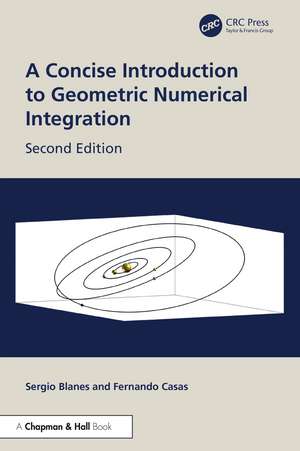
A Concise Introduction to Geometric Numerical Integration
Autor Sergio Blanes, Fernando Casasen Limba Engleză Hardback – 19 noi 2025
—Mathematical Reviews
A Concise Introduction to Geometric Numerical Integration, Second Edition presents the main themes, techniques, and applications of geometric integrators for researchers in mathematics, physics, astronomy, and chemistry who are already familiar with numerical tools for solving differential equations. It also offers a bridge from traditional training in the numerical analysis of differential equations to understanding recent, advanced research literature on numerical geometric integration.
Accessible to researchers and post-graduate students from diverse backgrounds, this introductory book gets readers up to speed on the most significant ideas, methods, and applications. Readers can reproduce the figures and results given in the text using the MATLAB® programs and model files available online.
New to the second edition
· Focus on single-step methods for solving differential equations.
· Full-scale rewrite of Chapter 3,with a new introduction and a more comprehensive treatment of non-autonomous systems and the processing technique.
· New section dedicated to multi-product methods in Chapter 4, and a mention the class of Crouch–Grossman and positivity-preserving integrators.
· A fresh introduction and a more detailed discussion of splitting and composition methods with complex coefficients in Chapter 6.
· A brand-new Chapter 7, showcasing some compelling applications where geometric integrators are now being used.
· Redesigned figures throughout, with improved their clarity and readability. The codes for generating them are provided at the website accompanying the book.
· New exercises, as well as an enhanced list of bibliographic references.
| Toate formatele și edițiile | Preț | Express |
|---|---|---|
| Hardback (2) | 682.71 lei 43-57 zile | |
| CRC Press – 19 noi 2025 | 682.71 lei 43-57 zile | |
| CRC Press – 23 mai 2016 | 1161.87 lei 43-57 zile |
Preț: 682.71 lei
Preț vechi: 853.38 lei
-20% Nou
Puncte Express: 1024
Preț estimativ în valută:
120.87€ • 140.74$ • 104.100£
120.87€ • 140.74$ • 104.100£
Carte tipărită la comandă
Livrare economică 23 februarie-09 martie
Preluare comenzi: 021 569.72.76
Specificații
ISBN-13: 9781032862460
ISBN-10: 1032862467
Pagini: 254
Ilustrații: 52
Dimensiuni: 156 x 234 mm
Greutate: 0.63 kg
Ediția:2. Auflage
Editura: CRC Press
Colecția Chapman and Hall/CRC
ISBN-10: 1032862467
Pagini: 254
Ilustrații: 52
Dimensiuni: 156 x 234 mm
Greutate: 0.63 kg
Ediția:2. Auflage
Editura: CRC Press
Colecția Chapman and Hall/CRC
V-ar putea interesa
-
 p-Adic Methods and Their ApplicationsAndrew J. Baker-27%Preț: 499.57 lei685.89 lei
 -
 Multiplicative Number TheoryHarold Davenport-15%Preț: 453.24 lei533.22 lei
 -
 Topics in the Theory of NumbersJanos Suranyi-15%Preț: 485.59 lei571.28 lei
 -
 A Classical Introduction to Modern Number TheoryKenneth Ireland-15%Preț: 545.74 lei642.05 lei
 -
 The Book of NumbersRichard GuyPreț: 325.67 lei
 -
 Advanced Topics in Computational Number TheoryHenri Cohen-15%Preț: 580.14 lei682.52 lei
 -
 Elementary Methods in Number TheoryMelvyn B. Nathanson-15%Preț: 522.44 lei614.64 lei
 -
 Pi and the AgmJonathan M Borwein-9%Preț: 1112.99 lei1223.06 lei
 -
 Essays on the Theory of NumbersRichard DedekindPreț: 51.29 lei
 -
 -25%Preț: 137.07 lei183.46 lei
 -
 Problem-Solving and Selected Topics in Number TheoryMichael Th Rassias-15%Preț: 515.03 lei605.92 lei
 -
 A Classical Introduction to Modern Number TheoryKenneth Ireland-15%Preț: 512.71 lei603.19 lei
 -
 Fermat's Last TheoremSimon SinghPreț: 75.78 lei
 -
 Intersections of Hirzebruch–Zagier Divisors and CM CyclesBenjamin HowardPreț: 333.50 lei
Public țintă
Postgraduate and Undergraduate AdvancedCuprins
Preface to the First Edition. Preface to the Second Edition. 1 What is geometric numerical integration?. 2 Classical integrators and preservation of properties. 3 Splitting and composition methods. 4 Other types of geometric numerical integrators. 5 Long-time behavior of geometric integrators. 6 Time-splitting methods for PDEs of evolution. 7 Geometric integrators in action: other relevant applications. A Additional mathematical results. Bibliography. Index.
Notă biografică
Sergio Blanes is a Professor of Applied Mathematics at Universitat Politècnica de València, Spain. He earned his PhD in Theoretical Physics from the Universitat de València in 1998. Following this, he held postdoctoral research positions at the University of Cambridge, the University of Bath, and the University of California, San Diego. In 2002, he was awarded a Ramón y Cajal Research Fellowship. He was also a visiting researcher at the Isaac Newton Institute in 2019. His research interests include geometric numerical integration and computational mathematics and physics.
Fernando Casas is a Professor of Applied Mathematics at Universitat Jaume I in Castellón, Spain. He has served as a Visiting Research Associate at the University of Maryland, College Park, and as a Temporary Assistant Research Scientist at Texas A&M University at Qatar. In 2018, he held the Lebesgue Chair (Senior Position) at the Centre Henri Lebesgue, Université de Rennes. His primary research interests lie in the numerical analysis of differential equations and geometric numerical integration.
Fernando Casas is a Professor of Applied Mathematics at Universitat Jaume I in Castellón, Spain. He has served as a Visiting Research Associate at the University of Maryland, College Park, and as a Temporary Assistant Research Scientist at Texas A&M University at Qatar. In 2018, he held the Lebesgue Chair (Senior Position) at the Centre Henri Lebesgue, Université de Rennes. His primary research interests lie in the numerical analysis of differential equations and geometric numerical integration.
Descriere
This book presents the main themes, techniques, and applications of geometric integrators for researchers in mathematics, physics, astronomy, and chemistry and offers a bridge from traditional training in the numerical analysis of differential equations to understanding recent, advanced research literature on numerical geometric integration.
Recenzii
"[A Concise Introduction to Geometric Numerical Integration] is highly recommended for graduate students, postgraduate researchers, and researchers interested in beginning study in the field of geometric numerical integration."
— David Cohen, Mathematical Reviews, November 2017
— David Cohen, Mathematical Reviews, November 2017