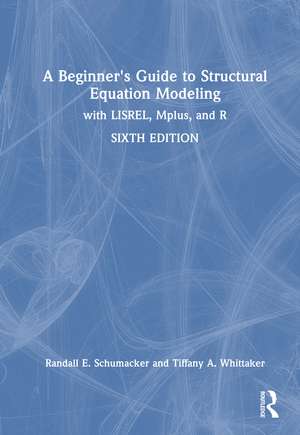
A Beginner's Guide to Structural Equation Modeling: with LISREL, Mplus, and R
Autor Randall E. Schumacker, Tiffany A. Whittakeren Limba Engleză Hardback – 6 sep 2026
This new update includes thorough insights on theory testing, data analysis, and results interpretation; a focus on using LISREL, Mplus, and R programs; and an increased focus on SEM terminology, output, model types, and analyses. It also includes two new chapters on reproducing results in SEM journal articles and conducting a Monte Carlo analysis. Examples with real data make theory easier to understand and allow SEM beginners to conduct, interpret, and write up analyses for observed variable path models to full structural models. Exercises at the end of each chapter strengthen the utility of the book for beginners.
This book is intended for beginners in SEM and designed for introductory graduate courses in SEM taught in psychology, education, business, and the social and health care sciences. It also appeals to researchers and faculty in various disciplines. Prerequisites include correlation and regression methods.
Preț: 1077.65 lei
Preț vechi: 1314.21 lei
-18% Nou
Puncte Express: 1616
Carte tipărită la comandă
Livrare economică 28 noiembrie-12 decembrie
Livrare prin curier în România Termenul estimat este afișat lângă disponibilitate.
Transport gratuit pentru acest produs Plată online sau ramburs, în funcție de opțiunile comenzii.
Retur gratuit în 14 zile Comandă securizată și suport în română.
Specificații
ISBN-13: 9781041073796
ISBN-10: 1041073798
Pagini: 466
Ilustrații: 142
Dimensiuni: 178 x 254 mm
Greutate: 1.02 kg
Ediția:6
Editura: Taylor & Francis
Colecția Routledge
Locul publicării:Oxford, United Kingdom
ISBN-10: 1041073798
Pagini: 466
Ilustrații: 142
Dimensiuni: 178 x 254 mm
Greutate: 1.02 kg
Ediția:6
Editura: Taylor & Francis
Colecția Routledge
Locul publicării:Oxford, United Kingdom
Public țintă
Postgraduate and Undergraduate AdvancedCuprins
Table of Contents. About the Authors. Preface. Support Material for the Book. Learning SEM. Book Approach. New to the 6th Edition. Acknowledgements. Chapter 1 – Introduction. What Is Structural Equation Modeling?. History of Structural Equation Modeling. Why Conduct Structural Equation Modeling?. Structural Equation Modeling Software. SEM in Statistical Packages. AMOS (SPSS). PROC CALIS (SAS). SEM (STATA). SEPATH (Statistica). SEM stand-alone Software. EQS. JMP – SAS Interface. Mplus. SEM Free Software. OpenMX – R interface. R. Latent GOLD. Software Considerations. Exercises. References. Chapter 2 - SEM Modeling Steps. SEM Modeling Steps Explained. Model Specification. Model Identification. Model Estimation. Model Testing. Table of Model Fit Indices. Parameter Statistical Significance. Model Comparison. Information Criteria for Non-nested Models. Model Modification. Modification Indices. Expected Parameter Change. MIs and EPCs in LISREL, Mplus, and R. Summary. Chapter Footnote. Exercises. References. Chapter 3 - Data Complexity. Data Access. Sample Size and Power. semPower R code to calculate sample size. Measurement Scale. Restriction of Range. Skewness. Missing Data. Outliers. Non-normality. Summary. Exercises. References. PDF Article References*. Chapter 4 - Correlation and Regression. Types of Correlation Coefficients. Factors Affecting Correlation Coefficients. Nonlinearity. Missing Data. Level of Measurement and Restriction of Range. Non-Normality. Outliers. Multiple Regression and Correlation. Bivariate, Part, and Partial Correlations. Multicollinearity and Suppressor Variables. Covariance and Correlation Matrix Conversion. Cov2Cor and Cor2Cov Functions In R. Correlation Matrix or Covariance Matrix Usage. Standardized or Unstandardized Results. Correction for Attenuation. Multiple Regression Model. Model specification. Model Identification. Model Estimation. Model Testing. Hypothesis Testing. Model Modification. Mplus Program. Multiple Regression Limitations. Model Specification. Measurement Error. Additive Equation. Chapter Footnote. Regression Model with Intercept Term. Exercises. References. Chapter 5 - Path Models. Path Model. Diagram Conventions. LISREL-SIMPLIS Achievement Path Model Program. Mplus Achievement Path Model Program. R Program for Achievement Path Model. R Achievement Path Model Program. Indirect Effects. Understanding Direct and Indirect Effects. Reproducing the Correlation Matrix. Total Effects and Correlation. Correlation Reproduction Standardized Example. Decomposition using an Unstandardized Example. Path Model Example. Model Specification. LISREL SIMPLIS Program. Mplus Program. R Program. Model Identification. Model Estimation. Model Testing. Residual Matrix Output. Testing Indirect Effects. Bootstrapping Standard Errors of Indirect Effects. R Bootstrap Example. Reporting Path Model Results. Path Model Assumptions and Limitations. Summary. Exercises. References. Chapter 6 – Measurement Models Part 1. Exploratory Factor Analysis. Sample Size. Number of Factors. Rotation Methods. Factor Scores. EFA vs PCA. LISREL-SIMPLIS EFA Example. Mplus EFA Program. EFA Program in R with the Psych Package. Pattern and Structure Matrices. Confirmatory Factor Analysis. CFA Example. Model specification. Model identification. Model Estimation. LISREL-SIMPLIS Program. Model Testing. Model Modification. Mplus Program. R Software Program. Lavaan Computer Output. CFA with Missing Continuous Data. LISREL-SIMPLIS CFA Model with Missing Data. Mplus Program-CFA Model with Missing Data. CFA with Mean Structure. LISREL-SIMPLIS Modified Program. CFA Caveats. CFA with Missing Ordinal Indicators. LISREL-SIMPLIS Program with Missing Ordinal Indicators. Mplus Program with Missing Ordinal Indicators. lavaan Program with Missing Ordinal Indicators. Model Comparisons. Summary. Exercise. References. Chapter 7 – Measurement Models Part 2. Second-Order Factor Model. Model Specification. Model Identification. Model Estimation. Model Testing. Model Modification. Model Interpretation. Bifactor Model. Model Specification. Model Identification. Model Estimation. Model Testing. Model Modification. Model Interpretation. Model Comparisons Between the Second-Order and Bifactor Models. R Program - Second-Order Factor Model. R Second-Order Factor Model Output. R Program Bifactor Model. R Bifactor Program Output. Summary. Exercise. References. Chapter 8 - Multiple Group Models. Brief Summary of Multiple Group Modeling. Multiple Group Path Analysis Model. Model Identification in Separate Groups. Model Estimation in Separate Groups. Model Testing in Separate Groups. Model Identification (Baseline multiple group model – no equality constraints). LISREL-SIMPLIS Program. Mplus Program. R lavaan Program. Model Testing Baseline Multiple Group Model – no equality constraints. Model Identification Multiple Group Model – with equality constraints. Model Estimation Multiple Group Model – with equality constraints. LISREL-SIMPLIS Program. Mplus Program. R lavaan Program. Model Testing Multiple Group Model – with equality constraints. Model Modification. LISREL-SIMPLIS Modified Program. Mplus Modified program. R lavaan Modified Program. Model Modification – Partial Invariance Model. Multiple Group Model Interpretation. Multiple Group CFA Measurement Model. Measurement Invariance. Multiple Group CFA Example. Model Identification in Separate Groups. LISREL SIMPLIS Model Estimation in Separate Groups. Mplus Model Estimation in Separate Groups. R lavaan Model Estimation in Separate Groups. Model Testing in Separate Groups. Model Identification - Configural CFA model – no equality constraints. Model Estimation - Configural CFA model – no equality constraints. Model Testing - Configural CFA model – no equality constraints. Model Identification - Metric Multiple Group CFA Model. Model Estimation - Metric Multiple Group CFA Model. Model Testing Metric Multiple Group CFA Model. Model Modification Metric Multiple Group CFA Model. Model Identification – Scalar (strong invariance) Multiple Group CFA Model. Model Estimation - Scalar (strong invariance) Multiple Group CFA Model. Model Testing - Scalar (strong invariance) Multiple Group CFA Model. Final Model Interpretation. Structural Model Group Differences. Multiple Group Models with Ordinal Indicators. Invariance Testing Cautions. Summary. Exercise. References. Chapter 9 – Structural Equation Models Part 1. Structural Equation Models. Structural Equation Model Example. Model Specification – SEM Educational Achievement. Model Identification – SEM Educational Achievement. Model Estimation – SEM Educational Achievement. Model Testing – SEM Educational Achievement. LISREL - SIMPLIS SEM PROGRAM. Model Modification – SEM Educational Achievement. LISREL - SIMPLIS Modified Program. Mplus Modified Program. R Modified Program. Structural Equation Model with Covariate Variables (MIMIC Model). R lavaan Program. SEM Model Interpretation. SEM Longitudinal Model – Exercise Behavior. Model Identification – SEM Longitudinal Model. Model Estimation – SEM Longitudinal Model. LISREL-SIMPLIS SEM Measurement Model. Mplus SEM Measurement Model. R lavaan SEM Measurement Model. Model Testing – SEM Measurement Model. Summary. Exercises. References. Chapter 10 – Structural Equation Models Part 2. Hypothesis Testing. Parameter Significance Test. Power and Sample Size - RMSEA. Power (RMSEA) - R code. Sample Size (RMSEA) – R code. Model Fit Chi-Square. Two-Step Versus Four-Step SEM Model Approach. Best Practices in SEM. Checklist for Structural Equation Modeling. Model Specification. Model Identification. Data Preparation. Model Estimation. Model Testing. Model Modification. Summary. Exercise. References. Chapter 11 – Reproducing SEM Article Results. First SEM Journal Article Example. First LISREL_SIMPLIS Program. First SEM Article Results. First Article Interpretation. Second SEM Journal Article Example. Second LISREL- SIMPLIS Program. Second Article Interpretation. Third SEM Journal Article Example. Third LISREL-SIMPLIS Program. Modified Second-Order Factor Model. Third Article Interpretation. Summary. Exercise. References. Chapter 12 – SEM Monte Carlo Methods. Method 1 – Generate Population Data from Random Numbers. LISREL SIMPLIS Program - Covariance Matrix. R Program Method 1. Method 2 – Generate Population Data from Covariance Matrix. Cholesky Decomposition Approach. Program 1 – Create Population Matrix. Program 2 – Generate Multivariate Normal Variables. Program 3 – Use Population Covariance Matrix in Model. Pattern Matrix Approach. R Program Method 2. Mplus Program Method 2. Method 3 - Generate Covariance Matrix from Population Model. R Program to Compute Population Covariance Matrix. R Program Method 3. Mplus Method 3. Summary. Exercise. References. Basic Matrices in SEM. Greek Symbols in SEM. Name Index. Subject Index.
Notă biografică
Randall E. Schumacker is Professor of Educational Research at the University of Alabama, USA, where he teaches courses in multiple regression, multivariate statistics, and structural equation modeling.
Tiffany A. Whittaker is Department Chair in the Department of Educational Psychology at the University of Texas at Austin, USA, where she teaches courses in structural equation modeling, statistical analysis for experimental data, and advanced statistical modeling.
Tiffany A. Whittaker is Department Chair in the Department of Educational Psychology at the University of Texas at Austin, USA, where she teaches courses in structural equation modeling, statistical analysis for experimental data, and advanced statistical modeling.
Descriere
The sixth edition of A Beginner’s Guide to Structural Equation Modeling has been redesigned to consider the medium-term needs of a beginner in structural equation modeling (SEM) to guide them through their research.