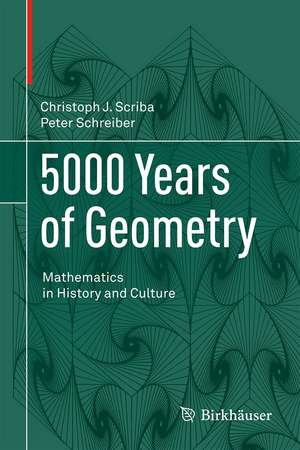
5000 Years of Geometry
Autor Christoph J. Scriba, Peter Schreiber Traducere de Jana Schreiberen Limba Engleză Hardback – 5 mai 2015
Găsim în lucrarea 5000 Years of Geometry o abordare interdisciplinară rară, care depășește granițele rigide ale matematicii pure pentru a explora modul în care percepțiile geometrice s-au împletit, de-a lungul mileniilor, cu arhitectura, artele vizuale, filozofia și ingineria. Suntem de părere că această a treia ediție, tradusă din limba germană, reușește să transforme istoria unei discipline tehnice într-o cronică a civilizației umane, de la primele calcule din Mesopotamia până la sistemele de axiome și geometria computațională a secolului XX. Cartea completează perspectiva oferită de Geometry in History de S. G. Dani, adăugând o dimensiune vizuală și culturală mult mai bogată prin utilizarea planșelor color și a tabelelor cronologice care ancorează evoluția matematică în contextul istoric global. Lucrarea se poziționează ca un proiect de sinteză în cadrul operei lui Christoph J. Scriba, care și-a dedicat cariera istoriografiei matematice, așa cum am văzut în Writing the History of Mathematics: Its Historical Development. Dacă acea lucrare se concentra pe evoluția socială a disciplinei, volumul de față este mult mai aplicat, integrând exemple concrete de probleme geometrice din diferite epoci. Structura este riguros cronologică: primele capitole analizează antichitatea greacă și orientală, urmate de evoluțiile din Evul Mediu și Renaștere, culminând cu ramurile moderne precum geometria proiectivă și analitică din secolele XVII-XVIII. Fiecare secțiune este precedată de un tabel de date istorice, facilitând o progresie clară a ideilor. Această ediție Springer din 2015 se distinge nu doar prin rigoarea academică, ci și prin calitatea grafică excepțională, oferind cititorului acces la o selecție de texte originale care permit contactul direct cu sursele istorice ale geometriei.
Preț: 1135.52 lei
Preț vechi: 1384.78 lei
-18%
Carte tipărită la comandă
Livrare economică 12-26 noiembrie
Specificații
ISBN-10: 3034808976
Pagini: 640
Ilustrații: XII, 626 p. 313 illus., 156 illus. in color.
Dimensiuni: 160 x 241 x 40 mm
Greutate: 1.07 kg
Ediția:2015
Editura: birkhäuser
Locul publicării:Basel, Switzerland
V-ar putea interesa
-
 Geometry with TrigonometryPatrick D Barry-30%Preț: 394.76 lei564.53 lei
 -
 Hyperbolic ManifoldsAlbert Marden-11%Preț: 560.09 lei629.31 lei
 -
 An Illustrated Introduction to Topology and HomotopySasho Kalajdzievski-18%Preț: 942.39 lei1149.26 lei
 -
 The Interesting Golden RatioVincent SiuPreț: 103.31 lei
 -
 Distance GeometryAntonio Mucherino-15%Preț: 651.06 lei765.96 lei
 -
 Discrete and Computational GeometryJin AkiyamaPreț: 391.23 lei
 -
 Preț: 387.27 lei
 -
 Computational GeometryMark de BergPreț: 442.32 lei
 -
 Mathematische LinguistikMaurice GrossPreț: 495.85 lei
 -
 Meditation mit KindernPeter SchreiberPreț: 144.02 lei
 -
 Einführung in die Fraktale GeometrieJesse StellmachPreț: 242.91 lei
 -
 Lehrbuch Der Dynamik Fester Korper: MagdeburgJulius PetersenPreț: 435.08 lei
 -
 Die HENNE-KASERNE in Erfurt 1950-1990Peter SchreiberPreț: 123.00 lei
 -
 Die BLUMENTHAL-KASERNE in Erfurt 1956-1990Peter SchreiberPreț: 122.93 lei
 -
 -15%Preț: 622.28 lei732.09 lei
 -
 BENOIT MANDELBROTFrame Michael-18%Preț: 1184.18 lei1444.12 lei
 -
 Plain Plane GeometryAmol SasanePreț: 344.52 lei
Public țintă
Lower undergraduateDe ce să citești această carte
Recomandăm această carte studenților și pasionaților de istoria ideilor care doresc să înțeleagă geometria nu ca pe un set de formule abstracte, ci ca pe un motor al culturii umane. Cititorul câștigă o viziune panoramică asupra modului în care spațiul a fost conceptualizat de-a lungul a 5000 de ani, beneficiind de un aparat critic solid, ilustrații de înaltă calitate și rezumate structurate care facilitează învățarea.
Cuprins
Recenzii
“It is a very good book indeed, and an important and valuable addition to the literature on the subject. … the book is interesting and well-written, and filled with excellent figures … . The topic coverage throughout is excellent, and readers should learn a great deal from this book. … this is an important and valuable book. If you like either geometry or the history of mathematics, take a look at it.” (Mark Hunacek, MAA Reviews, June, 2015)
Textul de pe ultima copertă
Geometry originated in the ancient cultures along the Indus and Nile Rivers and in Mesopotamia, experiencing its first “Golden Age” in Ancient Greece. Inspired by the Greek mathematics, a new germ of geometry blossomed in the Islamic civilizations. Through the Oriental influence on Spain, this knowledge later spread to Western Europe. Here, as part of the medieval Quadrivium, the understanding of geometry was deepened, leading to a revival during the Renaissance. Together with parallel achievements in India, China, Japan and the ancient American cultures, the European approaches formed the ideas and branches of geometry we know in the modern age: coordinate methods, analytical geometry, descriptive and projective geometry in the 17th an 18th centuries, axiom systems, geometry as a theory with multiple structures, and geometry in computer sciences in the 19th and 20th centuries.
Each chapter of the book starts with a table of key historical and cultural dates and ends with a summary of essential contents of geome
try in the respective era. Compelling examples invite the reader to further explore the problems of geometry in ancient and modern times. The book will appeal to mathematicians interested in Geometry, and to all readers with an interest in cultural history.
From letters to the authors for the German language edition
I hope it gets a translation, as there is no comparable work.
Prof. J. Grattan-Guinness (Middlesex University London)
"Five Thousand Years of Geometry" - I think it is the most handsome book I have ever seen from Springer, and the inclusion of so many color plates really improves its appearance dramatically!
Prof. J.W. Dauben (City University of New York)
An excellent book in every respect. The authors have successfully combined the history of geometry with the general development of culture and history. …
The graphic design is also excellent.
Prof. Z. Nádenik (Czech Technical University in Prague)
Caracteristici
Provides useful tables that reflect major historical and cultural developments and parallel advances in geometry
Includes interesting exercises with a historical background
Presents colorful illustrations and original texts from different eras of cultural history