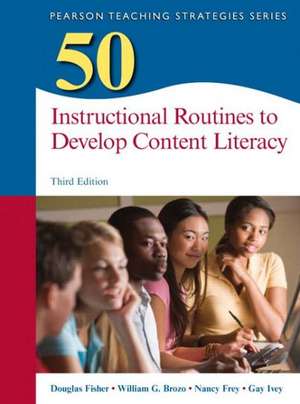
50 Instructional Routines to Develop Content Literacy
Autor Douglas Fisher, William G. Brozo, Nancy Frey, Gay Iveyen Limba Engleză Paperback – 9 oct 2024
The routines are:
- Selected to ensure that all students engage in reading, writing, speaking, listening, and viewing as part of the literacy process.
- Taken from real classrooms, real students, and real results.
- Organized for easy and quick referencing.
- Applicable to English learners and struggling readers.
Preț: 378.31 lei
Puncte Express: 567
Carte tipărită la comandă
Livrare economică 30 noiembrie-14 decembrie
Livrare prin curier în România Termenul estimat este afișat lângă disponibilitate.
Transport gratuit de la 400.00 lei Plată online sau ramburs, în funcție de opțiunile comenzii.
Retur gratuit în 14 zile Comandă securizată și suport în română.
Specificații
ISBN-13: 9780133347968
ISBN-10: 0133347966
Pagini: 160
Dimensiuni: 216 x 276 x 9 mm
Greutate: 0.3 kg
Ediția:3. Auflage
Editura: Pearson
ISBN-10: 0133347966
Pagini: 160
Dimensiuni: 216 x 276 x 9 mm
Greutate: 0.3 kg
Ediția:3. Auflage
Editura: Pearson
V-ar putea interesa
-
 Notice & NoteRobert E ProbstPreț: 360.68 lei
 -
 Preț: 470.09 lei
 -
 Preț: 441.13 lei
 -
 Rigorous ReadingNancy FreyPreț: 276.09 lei
 -
 Preț: 276.29 lei
 -
 Visible Learning for Literacy, Grades K-12Douglas FisherPreț: 206.90 lei
 -
 Preț: 36.42 lei
Textul de pe ultima copertă
Some of the best-known authors in the field come together to provide teachers with fifty step-by-step procedures for implementing content area instructional routines to improve students literacy skills. "50 Instructional Routines to Develop Content Literacy, 3/e" helps adolescents to become more successful readers. Middle and high school teachers can immediately put to use its practical information and real classroom examples from science, social studies, English, math, the visual and performing arts, and core electives to improve students reading, writing, and oral language development. Going above and beyond basic classroom strategies, the instructional routines recommend simple changes to teachers everyday procedures that foster student comprehension, such as thinking aloud, using question-answer relationships, and teaching with word walls. The routines are:
- Selected to ensure that all students engage in reading, writing, speaking, listening, and viewing as part of the literacy process.
- Taken from real classrooms, real students, and real results.
- Organized for easy and quick referencing.
- Applicable to English learners and struggling readers.
- NEW!More detailed classroom scenarios.
- NEW! New routines that address the Common Core State Standards.
- NEW! Up-to-date research reviews and references.
- NEW! A focus on additional content areas.
Cuprins
Table of Contents
1) Adjunct Displays
2) Annotation
3) Anticipation Guides
4) Close Reading
5) Collaborative Conversations
6) Conversation Roundtable
7) Debate
8) Directed Reading-Thinking Activity
9) Exit Slips
10) Fishbowl Discussions
11) Found Poems
12) Generative Reading
13) Guest Speakers
14) Independent Reading
15) Interest Surveys, Questionnaires, and Interviews
16) Jigsaw
17) KWL
18) Language Experience Approach
19) Mnemonics
20) Modeling Comprehension
21) Numbered Heads Together
22) Opinionnaire
23) Popcorn Review
24) Questioning the Author
25) Question-Answer Relationship
26) RAFT Writing
27) Read-Alouds
28) Readers' Theatre
29) Read-Write-Pair-Share
30) Reciprocal Teaching
31) ReQuest
32) Response Writing
33) Shades of Meaning
34) Shared Reading
35) Socratic Seminar
36) Split-Page Notetaking
37) Student Booktalks
38) Student Questions for Purposeful Learning
39) Text Impressions
40) Text Structures
41) Text-Dependent Questions
42) Think-Alouds
43) Tossed Terms
44) Vocabulary Cards
45) Vocabulary Self-Awareness
46) Word Grids/Semantic Feature Analysis
47) Word Scavenger Hunts
48) Word Sorts
49) Word Walls
50) Writing Frames and Templates
1) Adjunct Displays
2) Annotation
3) Anticipation Guides
4) Close Reading
5) Collaborative Conversations
6) Conversation Roundtable
7) Debate
8) Directed Reading-Thinking Activity
9) Exit Slips
10) Fishbowl Discussions
11) Found Poems
12) Generative Reading
13) Guest Speakers
14) Independent Reading
15) Interest Surveys, Questionnaires, and Interviews
16) Jigsaw
17) KWL
18) Language Experience Approach
19) Mnemonics
20) Modeling Comprehension
21) Numbered Heads Together
22) Opinionnaire
23) Popcorn Review
24) Questioning the Author
25) Question-Answer Relationship
26) RAFT Writing
27) Read-Alouds
28) Readers' Theatre
29) Read-Write-Pair-Share
30) Reciprocal Teaching
31) ReQuest
32) Response Writing
33) Shades of Meaning
34) Shared Reading
35) Socratic Seminar
36) Split-Page Notetaking
37) Student Booktalks
38) Student Questions for Purposeful Learning
39) Text Impressions
40) Text Structures
41) Text-Dependent Questions
42) Think-Alouds
43) Tossed Terms
44) Vocabulary Cards
45) Vocabulary Self-Awareness
46) Word Grids/Semantic Feature Analysis
47) Word Scavenger Hunts
48) Word Sorts
49) Word Walls
50) Writing Frames and Templates
Notă biografică
About our authorsDouglas Fisher, Ph.D., is Professor of Educational Leadership at San Diego State University and a teacher leader at Health Sciences High and Middle College having been an early intervention teacher and elementary school educator. He is the recipient of an International Reading Association Celebrate Literacy Award, the Farmer award for excellence in writing from the National Council of Teachers of English, as well as a Christa McAuliffe award for excellence in teacher education. He has published numerous articles on reading and literacy, differentiated instruction and curriculum design as well as books, such as Better Learning Through Structured Teaching, Rigorous Reading and Text Complexity: Raising Rigor in Reading.Nancy Frey, Ph.D., is a Professor of Literacy in the Department of Educational Leadership at San Diego State University. She is the recipient of the 2008 Early Career Achievement Award from the National Reading Conference. Nancy has published in The Reading Teacher, Journal of Adolescent and Adult Literacy, English Journal, Voices in the Middle, Middle School Journal, Remedial and Special Education, TESOL Journal, Journal of Learning Disabilities, Early Childhood Education Journal and Educational Leadership. She has co-authored (with Doug Fisher) books on formative assessment (Checking for Understanding and Formative Assessment Action Plan), instructional design (Better Learning for Structured Teaching), data-driven instruction (Using Data to Focus Instructional Improvement) and brain-based learning (In a Reading State of Mind.) Nancy is a credentialed special educator, reading specialist and administrator in California, and has taught at the elementary, middle and high school levels for 2 decades. She is a teacher leader at Health Sciences High and Middle College, where she learns from her colleagues and students every day.