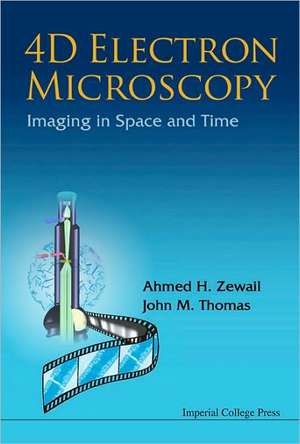
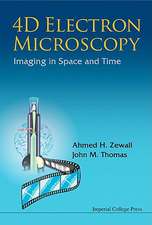
4D Electron Microscopy
Autor Ahmed H Zewailen Limba Engleză Paperback – 31 dec 2009
Structura acestui volum, publicat sub egida Imperial College Press, este concepută ca un expozeu aprofundat al conceptelor de paradigmă care permit explorarea materiei în patru dimensiuni: cele trei spațiale și timpul. Metodologia propusă de Ahmed H Zewail nu se rezumă la o simplă descriere tehnică, ci reconstruiește cadrul teoretic al microscopiei electronice (EM) pentru a integra domeniul temporal prin impulsuri de electroni de ordinul femtosecundelor. Recomandăm această lucrare nu ca pe un manual de utilizare, ci ca pe o fundamentare științifică a modului în care vizualizarea dinamicii moleculare poate fi realizată cu o rezoluție temporală fără precedent.
Remarcăm efortul autorului de a ancora noile dezvoltări tehnologice în principiile fundamentale ale difracției, facilitând astfel tranziția de la metodele statice, convenționale, la cele dinamice. Volumul extinde cadrul propus de 4D VISUALIZATION OF MATTER cu date noi despre pachetele coerente de electroni unici, oferind o perspectivă tehnică mai detaliată asupra instrumentelor necesare pentru a observa etapele embrionare ale cristalizării sau topirii. În comparație cu Coherent Electron Microscopy: Designing Faster and Brighter Electron Sources, care se concentrează pe designul surselor de electroni, lucrarea de față pune accent pe aplicabilitatea acestor surse în capturarea fenomenelor fizice și biologice ultrarapide.
Stilul este unul academic riguros, specific literaturii de specialitate din domeniul fizicii materiei condensate. Textul reușește să sintetizeze progresele revoluționare din ultimii ani, oferind o analiză comparativă între undele de electroni și radiația de sincrotron, devenind astfel o resursă esențială pentru cercetătorii care doresc să înțeleagă viitorul microscopiei la scară nanometrică.
Preț: 354.13 lei
Carte tipărită la comandă
Livrare economică 24 noiembrie-08 decembrie
Specificații
ISBN-10: 1848164009
Pagini: 341
Dimensiuni: 163 x 244 x 18 mm
Greutate: 0.68 kg
Editura: Imperial College Press
Locul publicării:United Kingdom
V-ar putea interesa
-
 -35%Preț: 870.51 lei1343.44 lei
 -
 High-Resolution Electron MicroscopyJohn C. H. Spence-31%Preț: 1003.53 lei1458.33 lei
 -
 -8%Preț: 414.90 lei450.97 lei
 -
 -9%Preț: 1048.76 lei1152.48 lei
 -
 Liquid Cell Electron MicroscopyFrances M. Ross-33%Preț: 1067.02 lei1591.31 lei
 -
 Preț: 453.37 lei
 -
 -18%Preț: 751.83 lei916.86 lei
 -
 Scientific Researches in Atomic Force MicroscopyKate Wright-18%Preț: 640.36 lei780.93 lei
 -
 4D Electron MicroscopyAhmed H. Zewail-18%Preț: 741.34 lei904.06 lei
 -
 -18%Preț: 979.31 lei1194.28 lei
 -
 Optically Induced NanostructuresAndreas Ostendorf-23%Preț: 1429.19 lei1856.10 lei
De ce să citești această carte
Această lucrare semnată de Ahmed H Zewail este indispensabilă cercetătorilor din fizică, chimie și biologie structurală care doresc să depășească limitele imagisticii statice. Cititorul câștigă o înțelegere profundă a microscopiei electronice 4D, învățând cum să vizualizeze procese dinamice la nivel atomic cu o viteză de neegalat. Este fundamentul teoretic necesar pentru a lucra cu cele mai avansate tehnici de investigare a materiei disponibile astăzi.