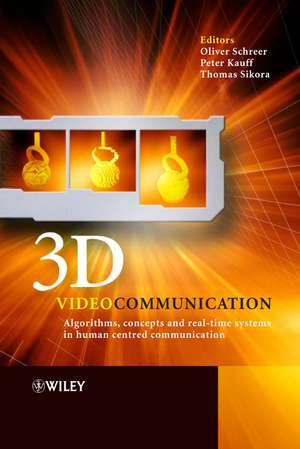
3D Videocommunication
Editat de Oliver Schreer, Peter Kauff, Thomas Sikoraen Limba Engleză Hardback – sep 2005
Preț: 709.32 lei
Preț vechi: 1017.08 lei
-30%
Puncte Express: 1064
Carte indisponibilă temporar
Doresc să fiu notificat când acest titlu va fi disponibil:
Se trimite...
Specificații
ISBN-13: 9780470022719
ISBN-10: 047002271X
Pagini: 368
Dimensiuni: 175 x 254 x 27 mm
Greutate: 0.83 kg
Ediția:New.
Editura: Wiley
Locul publicării:Chichester, United Kingdom
ISBN-10: 047002271X
Pagini: 368
Dimensiuni: 175 x 254 x 27 mm
Greutate: 0.83 kg
Ediția:New.
Editura: Wiley
Locul publicării:Chichester, United Kingdom
Public țintă
- Industry and research community: design, visualisation and software engineers, researchers and developers.
- Experienced telecommunication researchers and network planners.
- Multimedia coding, image and video processing are now growing aspects of many undergraduate and postgraduate curricula in electronic engineering and computer science, this book would be beneficial to these students and tutors.
Cuprins
List of Contributors xiii
Symbols xix
Abbreviations xxi
Introduction 1
Oliver Schreer, Peter Kauff and Thomas Sikora
Section I Applications of 3D Videocommunication 5
1 History of Telepresence 7
Wijnand A. IJsselsteijn
1.1 Introduction 7
1.2 The Art of Immersion: Barker's Panoramas 10
1.3 Cinerama and Sensorama 11
1.4 Virtual Environments 14
1.5 Teleoperation and Telerobotics 16
1.6 Telecommunications 18
1.7 Conclusion 19
2 3D TV Broadcasting 23
Christoph Fehn
2.1 Introduction 23
2.2 History of 3D TV Research 24
2.3 A Modern Approach to 3D TV 26
2.4 Stereoscopic View Synthesis 29
2.5 Coding of 3D Imagery 34
2.6 Conclusions 36
3 3D in Content Creation and Post-production 39
Oliver Grau
3.1 Introduction 39
3.2 Current Techniques for Integrating Real and Virtual Scene Content 41
3.3 Generation of 3D Models of Dynamic Scenes 44
3.4 Implementation of a Bidirectional Interface Between Real and Virtual Scenes 46
3.5 Conclusions 52
4 Free Viewpoint Systems 55
Masayuki Tanimoto
4.1 General Overview of Free Viewpoint Systems 55
4.2 Image Domain System 57
4.3 Ray-space System 59
4.4 Surface Light Field System 64
4.5 Model-based System 65
4.6 Integral Photography System 68
4.7 Summary 70
5 Immersive Videoconferencing 75
Peter Kauff and Oliver Schreer
5.1 Introduction 75
5.2 The Meaning of Telepresence in Videoconferencing 76
5.3 Multi-party Communication Using the Shared Table Concept 79
5.4 Experimental Systems for Immersive Videoconferencing 83
5.5 Perspective and Trends 87
Section II 3D Data Representation and Processing 91
6 Fundamentals of Multiple-view Geometry 93
Spela Ivekovic, Andrea Fusiello and Emanuele Trucco
6.1 Introduction 93
6.2 Pinhole Camera Geometry 94
6.3 Two-view Geometry 96
6.4 N-view Geometry 106
6.5 Summary 112
7 Stereo Analysis 115
Nicole Atzpadin and Jane Mulligan
7.1 Stereo Analysis Using Two Cameras 115
7.2 Disparity From Three or More Cameras 125
7.3 Conclusion 130
8 Reconstruction of Volumetric 3D Models 133
Peter Eisert
8.1 Introduction 133
8.2 Shape-from-Silhouette 135
8.3 Space-carving 140
8.4 Epipolar Image Analysis 143
8.5 Conclusions 148
9 View Synthesis and Rendering Methods 151
Reinhard Koch and Jan-Friso Evers-Senne
9.1 The Plenoptic Function 152
9.2 Categorization of Image-based View Synthesis Methods 154
9.3 Rendering Without Geometry 158
9.4 Rendering with Geometry Compensation 165
9.5 Rendering from Approximate Geometry 169
9.6 Recent Trends in Dynamic IBR 170
10 3D Audio Capture and Analysis 175
Markus Schwab and Peter Noll
10.1 Introduction 175
10.2 Acoustic Echo Control 176
10.3 Sensor Placement 181
10.4 Acoustic Source Localization 182
10.5 Speech Enhancement 185
10.6 Conclusions 190
11 Coding and Standardization 193
Aljoscha Smolic and Thomas Sikora
11.1 Introduction 193
11.2 Basic Strategies for Coding Images and Video 194
11.3 Coding Standards 202
11.4 MPEG-4 - an Overview 204
11.5 The MPEG 3DAV Activity 210
11.6 Conclusion 214
Section III 3D Reproduction 217
12 Human Factors of 3D Displays 219
Wijnand A. IJsselsteijn, Pieter J.H. Seuntiëns and Lydia M.J. Meesters
12.1 Introduction 219
12.2 Human Depth Perception 220
12.3 Principles of Stereoscopic Image Production and Display 225
12.4 Sources of Visual Discomfort in Viewing Stereoscopic Displays 226
12.5 Understanding Stereoscopic Image Quality 230
13 3D Displays 235
Siegmund Pastoor
13.1 Introduction 235
13.2 Spatial Vision 236
13.3 Taxonomy of 3D Displays 237
13.4 Aided-viewing 3D Display Technologies 238
13.5 Free-viewing 3D Display Technologies 242
13.6 Conclusions 258
14 Mixed Reality Displays 261
Siegmund Pastoor and Christos Conomis
14.1 Introduction 261
14.2 Challenges for MR Technologies 263
14.3 Human Spatial Vision and MR Displays 264
14.4 Visual Integration of Natural and Synthetic Worlds 265
14.5 Examples of Desktop and Hand-held MR Systems 273
14.6 Conclusions 278
15 Spatialized Audio and 3D Audio Rendering 281
Thomas Sporer and Sandra Brix
15.1 Introduction 281
15.2 Basics of Spatial Audio Perception 281
15.3 Spatial Sound Reproduction 284
15.4 Audiovisual Coherence 291
15.5 Applications 293
15.6 Summary and Outlook 293
Section IV 3D Data Sensors 297
16 Sensor-based Depth Capturing 299
João G.M. Gonçalves and Vítor Sequeira
16.1 Introduction 299
16.2 Triangulation-based Sensors 301
16.3 Time-of-flight-based Sensors 303
16.4 Focal Plane Arrays 308
16.5 Other Methods 309
16.6 Application Examples 309
16.7 The Way Ahead 311
16.8 Summary 311
17 Tracking and User Interface for Mixed Reality 315
Yousri Abdeljaoued, David Marimon i Sanjuan, and Touradj Ebrahimi
17.1 Introduction 315
17.2 Tracking 316
17.3 User Interface 324
17.4 Applications 328
17.5 Conclusions 331
References 331
Index 335
Notă biografică
Dr Oliver Schreer, Heinrich-Hertz-Institute, & TU Berlin, Germany
Oliver Schreer is Adjunct Professor at the Faculty of Electrical Engineering and Computer Science, Technical University Berlin. He lectures on Image Processing in Videocommunications and is a regular guest editor for the IEEE Transactions on Circuits, Systems and Video Technology.
Dr Peter Kauff, Heinrich-Hertz-Institute, Berlin, Germany
Peter Kauff is the head of the "Immersive Media & 3D Video" Group at Heinrich-Hertz-Institute (HHI), Fraunhofer Gesellschaft, Berlin. He has been involved in numerous German and European projects related to digital HDTV signal processing and coding, interactive MPEG-4-based services, and advanced 3D video processing for immersive tele-presence and immersive media.
Professor Dr Thomas Sikora, Head of the Communication Systems Group, Technical University of Berlin, Berlin
As the chairman of the ISO-MPEG video group (Moving Picture Experts Group), Dr Sikora was responsible for the development and standardization of the MPEG video coding algorithms. He frequently works as an industry consultant on issues related to interactive digital video. He is an appointed member of the Supervisory board of a number of German companies and international research organizations. He is an Associate Editor for IEEE Signal Processing Magazine and the EURASIP Signal Processing: Image Communication journal and currently serves as the Editor-in-Chief of the IEEE Transactions on Circuits and Systems for Video Technology.
Descriere
The migration of immersive media towards telecommunication applications is advancing rapidly. Impressive progress in the field of media compression, media representation, and the larger and ever increasing bandwidth available to the customer, will foster the introduction of these services in the future.