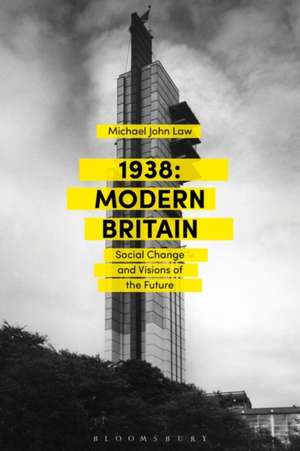
1938: Modern Britain: Social Change and Visions of the Future
Autor Dr. Michael John Lawen Limba Engleză Paperback – 14 dec 2017
By considering topics as diverse as the opening of a new type of pub, the launch of several new magazines, the emergence of push-button radios and large screen televisions sets, and the building of a huge office block, he reveals a Britain, both modern and intrigued by its own modernity, that was stopped in its tracks by war and the austerity that followed. For some, life in Britain was as consumerist, secular, Americanized and modern as it would become for many in the late 1950s and early 1960s.
Presenting a fresh perspective on an important year in British social history, illuminated by six engaging case studies, this is a key study for students and scholars of 20th-century Britain.
Preț: 177.80 lei
Preț vechi: 240.20 lei
-26%
Puncte Express: 267
Carte tipărită la comandă
Livrare economică 19 noiembrie-03 decembrie
Livrare prin curier în România Termenul estimat este afișat lângă disponibilitate.
Transport gratuit de la 400.00 lei Plată online sau ramburs, în funcție de opțiunile comenzii.
Retur gratuit în 14 zile Comandă securizată și suport în română.
Specificații
ISBN-13: 9781474285018
ISBN-10: 1474285015
Pagini: 200
Ilustrații: 21 b/w illustrations
Dimensiuni: 156 x 232 x 16 mm
Greutate: 0.32 kg
Editura: Bloomsbury Publishing
Colecția Bloomsbury Academic
Locul publicării:London, United Kingdom
ISBN-10: 1474285015
Pagini: 200
Ilustrații: 21 b/w illustrations
Dimensiuni: 156 x 232 x 16 mm
Greutate: 0.32 kg
Editura: Bloomsbury Publishing
Colecția Bloomsbury Academic
Locul publicării:London, United Kingdom
V-ar putea interesa
-
 -27%Preț: 67.37 lei92.04 lei
 -
 Life in the Victorian Country HousePamela Horn-30%Preț: 81.62 lei115.92 lei
 -
 Holiday CampsKathryn Ferry-33%Preț: 45.84 lei68.17 lei
 -
 The District NurseSusan Cohen-36%Preț: 37.46 lei58.59 lei
 -
 Bloody British HistoryGEOFF HOLDERPreț: 72.32 lei
 -
 Autumn of TerrorFrogg MoodyPreț: 71.22 lei
 -
 -27%Preț: 66.78 lei91.51 lei
 -
 Witchcraft And Society in England and America, 1550-1750Dr Marion Gibson-21%Preț: 411.64 lei523.60 lei
 -
 Food and Identity in England, 1540-1640: Eating to ImpressDr Paul S. Lloyd-25%Preț: 278.27 lei369.66 lei
 -
 How to Survive the Titanic or The Sinking of J. Bruce IsmayFrances WilsonPreț: 68.27 lei
 -
 -28%Preț: 87.46 lei120.68 lei
 -
 Our Island StoryH.E. Marshall-26%Preț: 79.17 lei107.06 lei
 -
 WRNS: The Women’s Royal Naval ServiceNeil R. Storey-28%Preț: 44.27 lei61.42 lei
 -
 Canals in BritainTony Conder-26%Preț: 47.94 lei64.95 lei
 -
 DuchessesJane Dismore-15%Preț: 126.16 lei149.05 lei
 -
 The Girl with the Widow's PeakUrsula D'AboPreț: 103.44 lei
Cuprins
List of Figures
List of Tables
List of Maps
Acknowledgements
Chapter 1. Partial History
Chapter 2. Representations of Modern Life in 1938
Chapter 3. Glasgow's Empire Exhibition
Chapter 4. Big Screen Televisions and Push-button Radios
Chapter 5. The Adelphi Building
Chapter 6. Picture Post - The Modernity of Everyday Life
Chapter 7. Cars, Coaches and Charabancs at the Prospect Inn
Chapter 8. Britain's New Airports
Chapter 9. Conclusion
Notes
Bibliography
Index
List of Tables
List of Maps
Acknowledgements
Chapter 1. Partial History
Chapter 2. Representations of Modern Life in 1938
Chapter 3. Glasgow's Empire Exhibition
Chapter 4. Big Screen Televisions and Push-button Radios
Chapter 5. The Adelphi Building
Chapter 6. Picture Post - The Modernity of Everyday Life
Chapter 7. Cars, Coaches and Charabancs at the Prospect Inn
Chapter 8. Britain's New Airports
Chapter 9. Conclusion
Notes
Bibliography
Index
Recenzii
John Law's engaging and richly textured 1938 challenges us to consider what the future used to look like - and, in doing so, opens up new ways of thinking about 1930s Britain. Drawing this remarkable year out of the lengthening shadows of war, Law reveals a world absorbed by the wonders of entertainment technologies and cutting edge architecture, the glamour of international travel and everyday novelties of Picture Post magazine. Insightful and surprising, 1938 is a compelling account of a modern world that has often disappeared from view.
From television sets to office blocks to forgotten municipal airports, 1938 reveals a Britain enthralled by the wonders of modern life. With great lucidity and an eye for curious detail, Law charts a growing social optimism about technology that would reach fruition in the consumer culture of the 1950s.
This brief, rather breezy book argues convincingly that Britain in 1938 was much more "modern" than one might have thought; the developments associated with postwar Britain were well on their way in that year, only to be delayed by war the following year and the recovery period after the war. Summing Up: Recommended. All public and academic levels/libraries.
From television sets to office blocks to forgotten municipal airports, 1938 reveals a Britain enthralled by the wonders of modern life. With great lucidity and an eye for curious detail, Law charts a growing social optimism about technology that would reach fruition in the consumer culture of the 1950s.
This brief, rather breezy book argues convincingly that Britain in 1938 was much more "modern" than one might have thought; the developments associated with postwar Britain were well on their way in that year, only to be delayed by war the following year and the recovery period after the war. Summing Up: Recommended. All public and academic levels/libraries.