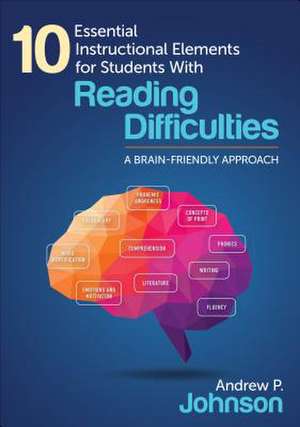
10 Essential Instructional Elements for Students With Reading Difficulties: A Brain-Friendly Approach
Autor Andrew P. Johnsonen Limba Engleză Paperback – 15 dec 2015
În volumul 10 Essential Instructional Elements for Students With Reading Difficulties, Andrew P. Johnson propune o schimbare de paradigmă în intervenția pedagogică pentru elevii care întâmpină dificultăți la lectură. Lucrarea se distinge prin fundamentarea pedagogiei în neuroștiințe, oferind un model de predare „brain-friendly” care prioritizează extragerea sensului din text. Considerăm că valoarea adăugată a acestei ediții constă în structura sa riguroasă, care ghidează cadrul didactic de la înțelegerea mișcărilor oculare și a căilor neurale, până la implementarea unor lecții de tip SRE (Scaffolded Reading Experience) sau lectură ghidată.
Cartea extinde cadrul propus de How the Brain Learns to Read de David A. Sousa prin integrarea datelor recente despre fluxul bidirecțional al informației în procesul cognitiv. În timp ce Sousa pune bazele neuroștiințifice generale, Johnson livrează o strategie concretă în zece puncte care acoperă vocabularul, fluența și înțelegerea, insistând pe utilizarea indiciilor semantice și sintactice. De asemenea, lucrarea completează viziunea din Designing Meaning-Based Interventions for Struggling Readers, o altă operă a autorului, oferind de data aceasta o perspectivă mai tehnică asupra modelului neurocognitiv al procesării informației.
Structura este organizată logic pentru a sprijini progresia educatorului: prima secțiune clarifică distincția dintre creier și minte în contextul lecturii, a doua secțiune oferă instrumente practice pentru diagnostic și documentarea progresului prin pasaje de lectură gradate, iar ultima parte detaliază cele zece elemente instrucționale esențiale. Reținem abordarea echilibrată a autorului, care, deși recunoaște importanța codului fonetic, pledează pentru o pedagogie unde semnificația rămâne obiectivul central, ancorând astfel practica educațională în realitatea modului în care creierul uman procesează limbajul scris.
Preț: 296.23 lei
Carte tipărită la comandă
Livrare economică 30 noiembrie-14 decembrie
Specificații
ISBN-10: 1483373770
Pagini: 256
Dimensiuni: 178 x 254 x 20 mm
Greutate: 0.53 kg
Ediția:1
Editura: SAGE Publications
Colecția Corwin
Locul publicării:Thousand Oaks, United States
V-ar putea interesa
-
 The Gift of LearningRonald D. DavisPreț: 153.31 lei
 -
 Neuropsych Perspectives RTIElaine Fletcher-Janzen-8%Preț: 422.89 lei459.66 lei
 -
 Making Connections in Elementary and Middle School Social StudiesAndrew P. Johnson-27%Preț: 927.18 lei1270.11 lei
 -
 -8%Preț: 440.70 lei479.02 lei
 -
 Designing Meaning-Based Interventions for Struggling ReadersAndrew P. Johnson-19%Preț: 512.22 lei632.37 lei
 -
 Academic Writing: Process and ProductAndrew P. Johnson-24%Preț: 253.93 lei333.22 lei
 -
 -24%Preț: 225.37 lei297.80 lei
 -
 -21%Preț: 367.32 lei462.07 lei
 -
 -25%Preț: 177.38 lei237.77 lei
 -
 -25%Preț: 212.30 lei284.66 lei
 -
 Adventures in SticklandAndrew P. JohnsonPreț: 57.54 lei
 -
 Breaking the Speech BarrierMary Ann RomskiPreț: 204.94 lei
 -
 -28%Preț: 363.43 lei507.95 lei
 -
 -24%Preț: 187.92 lei247.85 lei
 -
 Preț: 143.69 lei
 -
 -20%Preț: 122.89 lei153.91 lei
 -
 -21%Preț: 150.04 lei189.43 lei
 -
 -20%Preț: 154.47 lei192.95 lei
 -
 -20%Preț: 162.39 lei201.95 lei
 -
 Fragile X Syndrome: A Guide for TeachersSuzanne SaundersPreț: 441.88 lei
 -
 Multisensory EnvironmentsPaul PaglianoPreț: 443.26 lei
 -
 Preț: 352.48 lei
 -
 Preț: 379.83 lei
 -
 Preț: 88.93 lei
 -
 Preț: 187.02 lei
 -
 Building IndependenceChristine E ReevePreț: 233.04 lei
 -
 Perioperative Pain Control: Tools for SurgeonsPeter F. Svider-5%Preț: 704.66 lei741.75 lei
De ce să citești această carte
Recomandăm această carte educatorilor și terapeuților care caută o metodologie bazată pe dovezi neurocognitive pentru a sprijini elevii cu dificultăți de citire. Cititorul câștigă un set clar de zece strategii aplicabile imediat, trecând de la simpla decodare la o înțelegere profundă a textului. Este o resursă esențială pentru a transforma procesul de predare într-unul adaptat funcționării naturale a creierului.
Descriere scurtă
Recenzii
His arguments are clear and his writing is easy to read. His suggestions for instruction are research-based and cover early literacy development quite completely. Primary grade teachers, especially, will love this book, and rightfully so.
"As an educator with 30 years’ experience as a reading specialist and learning disabilities teacher, I recommend this book as a resource that pulls together divergent ideas about reading, and weaves them together in a way that makes sense."
"It has become fashionable in recent years to view the teaching of reading as being as simple as getting children to sound out words. This is understandable. When we look at a page we see words made of out of letters, so it's easy to think that that's all there is to it. And for legislators and publishers this is an attractive proposition. The fundamental job of teaching children to read becomes something simple, logical, easy to measure, and of course easy to explain to parents. However, a closer look at what really goes on when we read soon tells us that the story is deeper, more beautiful, and more complex. Those words refuse to play ball (try “give” and “hive”) and when we read we don't actually look at every letter in every word--far from it. Professor Johnson tells the story of reading in a logical and clear manner with a book that is excellently researched, immaculately referenced, and full of practical tips for the practitioner."
"This book for teachers who want to help their struggling students learn to read and write includes classroom-tested reading and writing strategies and activities that students will enjoy and practice. Creating the conditions for student success is all spelled out in this book."
"This is the text I wish I had when I began to teach. Dr. Johnson clearly illustrates the process our brain uses to create meaning from text. He suggests reading teachers need to de-emphasize phonics and use activities that ask the student to also use semantic and syntactical cues. The text includes ten chapters of instructional elements with tons of activities to increase motivation, phonic awareness, and fluency."
Cuprins
Context
Code First or Meaning First
Tools in Your Teaching Toolbox
Audience
Section I. Understanding the Reading Process
Chapter 1. Creating Meaning With Print: The Neurocognitive Model
Understanding Reading
Reading: A Neurological Perspective
The Neurocognitive Process
Last Word
Chapter 2. Eye Movement and Neural Pathways
Eye Movement During Reading
Understanding Our Learning Organ
Last Word
Chapter 3. Understanding Reading From a Cognitive Perspective
The Difference Between Brain and Mind
The Information Processing Model
The Two-Way Flow of Information
Last Word
Section II. Diagnosing Reading Problems, Documenting Progress, and Planning Instruction
Chapter 4. Diagnosis and Documentation
Diagnosing the Problem
Graded Word Lists
Graded Reading Passages
Assessing Comprehension
Putting It Together
Last Word
Chapter 5. Reading Lessons
SRE Lesson
Guided Reading Lesson
Shared Reading Lesson
Last Word
Section III. 10 Instructional Elements
Chapter 6. 10 Elements of Reading Instruction
No Magical Programs
Comprehensive Reading Instruction
Teaching Reading With the Brain in Mind
Last Word
Chapter 7. Emergent Literacy: Concepts of Print and Phonemic Awareness
Approaches to Early Literacy Instruction
Creating the Conditions for Early Literacy Learning
Concepts of Print
Phonemic-Phonics Hybrid Activities
Last Word
Chapter 8. Emotions and Motivation
Emotions
The Value-Expectancy Theory of Motivation
Some Basic Strategies
Last Word
Chapter 9. Literature and Instructional Approaches
Strategies for Promoting Voluntary Reading
Instructional Approaches
Last Word
Chapter 10. Phonics
Fawnix
14 Strategies
Last Word
Appendix: Phonics Checklist
Chapter 11. Strategies for Developing Word Identification Skills
Terms and Concepts Related to Word Identification
Context Clues: The Semantic Cueing System
Word Order and Grammar: The Syntactic-Cueing System
Word Parts
Morphemic Analysis
Sight Words
Last Word
Chapter 12. Fluency
Reading Fluency
Neural Pathways and Networks
Strategies for Enhancing Reading Fluency
Avoid Round-Robin Reading
Last Word
Chapter 13. Comprehension of Narrative Text
Comprehension Basics
Teaching Tips
Activities Organized by Cognitive Process
Last Word
Chapter 14. Comprehension of Expository Text
Expository Text
Teacher Pre-Reading Strategies
Study-Skill Strategies
Pedagogical Strategies to Develop Cognitive Processes Related to Comprehension
Last Word
Chapter 15. Vocabulary
Attending to Vocabulary
General Principles for Developing Students’ Vocabulary
Strategies for Developing Students’ Vocabulary
Visual Displays and Graphic Organizers
Last Word About Words
Chapter 16. Writing
The Why and How of Writing
Specific Strategies
Last Word
Epilogue