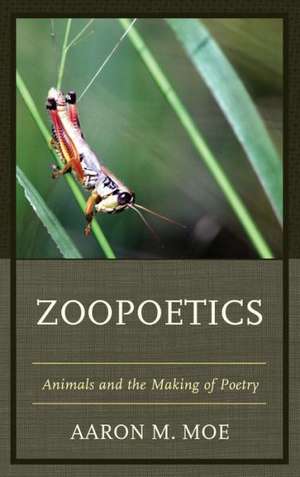
Zoopoetics
Autor Aaron M Moeen Limba Engleză Hardback – 19 dec 2013
Gestures are paramount to zoopoetics. Through the interplay of gestures, the human/animal/textual spheres merge making it possible to recognize how actual, biological animals impact the material makings of poetry. Moreover, as many species are makers, zoopoetics expands the poetic tradition to include nonhuman poiesis.
Preț: 722.53 lei
Preț vechi: 938.35 lei
-23%
Puncte Express: 1084
Carte tipărită la comandă
Livrare economică 27 august-10 septembrie
Livrare prin curier în România Termenul estimat este afișat lângă disponibilitate.
Transport gratuit pentru acest produs Plată online sau ramburs, în funcție de opțiunile comenzii.
Retur gratuit în 14 zile Comandă securizată și suport în română.
Specificații
ISBN-13: 9780739186626
ISBN-10: 0739186620
Pagini: 170
Ilustrații: 9 b/w photos;
Dimensiuni: 157 x 235 x 14 mm
Greutate: 0.41 kg
Ediția:New.
Editura: Bloomsbury Publishing
Locul publicării:New York, United States
ISBN-10: 0739186620
Pagini: 170
Ilustrații: 9 b/w photos;
Dimensiuni: 157 x 235 x 14 mm
Greutate: 0.41 kg
Ediția:New.
Editura: Bloomsbury Publishing
Locul publicării:New York, United States
V-ar putea interesa
-
 Literary Theory: A Very Short IntroductionJonathan Culler-20%Preț: 56.07 lei70.34 lei
 -
 Digressions in European LiteratureAlexis GrohmannPreț: 385.03 lei
 -
 Literature, Ethics, and AestheticsSabrina AchillesPreț: 385.10 lei
 -
 Toward a Sociobiological HermeneuticMichael WainwrightPreț: 388.54 lei
 -
 Globalectics – Theory and the Politics of KnowingNgugi Wa Thiong′o-23%Preț: 503.67 lei654.12 lei
 -
 Literature and PhilosophyAlan SingerPreț: 272.18 lei
 -
 What Ever Happened to Modernism?Gabriel JosipoviciPreț: 241.71 lei
 -
 Studying Literature: The Essential CompanionDr Paul Goring-23%Preț: 242.42 lei313.56 lei
 -
 The Literary Theory HandbookGregory CastlePreț: 346.39 lei
 -
 Preț: 213.65 lei
 -
 Preț: 220.17 lei
 -
 Great AcceleratorPaul VirilioPreț: 121.39 lei
 -
 The Paul de Man NotebooksPaul De Man-25%Preț: 631.71 lei838.22 lei
 -
 Dictionary of Cultural and CriMichael PaynePreț: 423.35 lei
 -
 Readings of Trauma, Madness, and the BodySarah AndersonPreț: 389.02 lei
 -
 A Companion to Ayn RandAllan Gotthelf-9%Preț: 1225.17 lei1346.34 lei
 -
 The Household Tips of the Great WritersMark CrickPreț: 97.45 lei
 -
 Introducing SemioticsPaul CobleyPreț: 63.45 lei
Cuprins
Contents
Abbreviations
Preface
Part 1: Foundations
Prelude: The Coat of a Horse
1 Zoopoetics: An Introduction
Interlude: Mimic Octopi
2 Walt Whitman & the Origin of Poetry
Interlude: Cats
3 "Whose poem is this?": E. E. Cummings' Zoopoetics
Part 2: Implications
Interlude: Beluga Whales
4 "learning my steps": Zoopoetics and Mass
Extinction in W. S. Merwin's Poetry
Interlude: Elephants
5 The Zoopoetics of a Multispecies Polis: Brenda
Hillman's Practical Water
Postlude: Owls
Bibliography
Index
About the Author
Abbreviations
Preface
Part 1: Foundations
Prelude: The Coat of a Horse
1 Zoopoetics: An Introduction
Interlude: Mimic Octopi
2 Walt Whitman & the Origin of Poetry
Interlude: Cats
3 "Whose poem is this?": E. E. Cummings' Zoopoetics
Part 2: Implications
Interlude: Beluga Whales
4 "learning my steps": Zoopoetics and Mass
Extinction in W. S. Merwin's Poetry
Interlude: Elephants
5 The Zoopoetics of a Multispecies Polis: Brenda
Hillman's Practical Water
Postlude: Owls
Bibliography
Index
About the Author
Recenzii
The critical study of ecopoetics demands innovative methodological approaches to reading and thinking about the relationship between poetry, form, and ecology. Moe's book models precisely this type of approach, by bringing critical animal studies to the study of poetry and poetics in a rigorous and sustained way. In this sense, Zoopoetics is an important and timely contribution to a developing field.
The virtuosity and knowingness of this reading does justice to persistent demands within ecocriticism for rejuvenated critical attention to the natural world. . . .Moe's . . . wide-ranging interest in animal behavior is showcased in the interludes between chapters, brief vignettes that recount engaged encounters between humans and other animals. Ultimately, if there's a critical imperative hidden in Zoopoetics, it's the insistence that we allow poetry and animal bodies to overlay one another in translucent palimpsests of meaning-we can't read poems without reading animals first. . . .[This] book will best suit those interested in the pleasures and possibilities of reading poetry.
[This is a] wonderfully instructive and challenging book. . . .Moe is an erudite and adept scholar of poetry and the poetic tradition. . . .Zoopoetics ought to attract the interest of literary scholars, poets, and avid readers of poetry alike. . . .Moe's extraordinarily exquisite attentiveness to the textual dynamics of the poetry of Whitman, Cummings, Merwin, and Hillman-and, by imaginative implication, the extra-human world, particularly the lives of animals-is exemplary and timely.
Zoopoetics is an original, lucid examination of how animals shape the human art of poetry. Drawing upon the foundational work of such scholars as Paul Shepard, Donna Haraway, and David Abram, Aaron Moe uses the Derridian concept of 'zoopoetics' to deepen our understanding of language and our understanding of what animals mean to humans. Without other species, we might be essentially voiceless. This is a significant study of 'animality,' one of the central paradigms in the field of ecocriticism.
Aaron Moe's Zoopoetics lucidly demonstrates that poetry is a shared space in which human and other animals may 'stretch toward' each other, a space in which many of our best poets in English attend to nonhuman poiesis. This is a timely and important contribution to ecocriticism and animal studies.
The virtuosity and knowingness of this reading does justice to persistent demands within ecocriticism for rejuvenated critical attention to the natural world. . . .Moe's . . . wide-ranging interest in animal behavior is showcased in the interludes between chapters, brief vignettes that recount engaged encounters between humans and other animals. Ultimately, if there's a critical imperative hidden in Zoopoetics, it's the insistence that we allow poetry and animal bodies to overlay one another in translucent palimpsests of meaning-we can't read poems without reading animals first. . . .[This] book will best suit those interested in the pleasures and possibilities of reading poetry.
[This is a] wonderfully instructive and challenging book. . . .Moe is an erudite and adept scholar of poetry and the poetic tradition. . . .Zoopoetics ought to attract the interest of literary scholars, poets, and avid readers of poetry alike. . . .Moe's extraordinarily exquisite attentiveness to the textual dynamics of the poetry of Whitman, Cummings, Merwin, and Hillman-and, by imaginative implication, the extra-human world, particularly the lives of animals-is exemplary and timely.
Zoopoetics is an original, lucid examination of how animals shape the human art of poetry. Drawing upon the foundational work of such scholars as Paul Shepard, Donna Haraway, and David Abram, Aaron Moe uses the Derridian concept of 'zoopoetics' to deepen our understanding of language and our understanding of what animals mean to humans. Without other species, we might be essentially voiceless. This is a significant study of 'animality,' one of the central paradigms in the field of ecocriticism.
Aaron Moe's Zoopoetics lucidly demonstrates that poetry is a shared space in which human and other animals may 'stretch toward' each other, a space in which many of our best poets in English attend to nonhuman poiesis. This is a timely and important contribution to ecocriticism and animal studies.