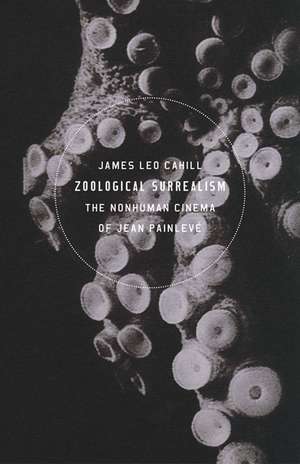
Zoological Surrealism: The Nonhuman Cinema of Jean Painlevé
Autor James Leo Cahillen Limba Engleză Paperback – 19 feb 2019
Provenind dintr-o arhivă vastă și minuțios explorată a pionierului francez Jean Painlevé, Zoological Surrealism ne propune o incursiune fascinantă în intersecția dintre știință și avangardă. Remarcăm modul în care autorul James Leo Cahill reușește să transforme analiza unor filme documentare despre lumea subacvatică într-o meditație profundă asupra condiției non-umane. Subliniem calitatea senzorială a descrierilor: de la mișcările onirice ale caracatițelor la erotismul bizar al căluților de mare, volumul surprinde acea privire suprarealistă care a precedat mult mai faimoasele explorări ale lui Jacques-Yves Cousteau.
Structura lucrării este organizată tematic, debutând cu „vocația copernicană” a camerei de filmat — capacitatea acesteia de a disloca perspectiva antropocentrică. Capitolele avansează de la drame neozoologice și metamorfozele crustaceelor către analize politice și etice mai complexe, precum cele din „The Blood of the Beasts”. Complementar volumului Animal Life and the Moving Image de Michael Lawrence, care oferă o privire de ansamblu asupra relației dintre ecrane și animale, Zoological Surrealism se concentrează pe o nișă istorică specifică, oferind o rigoare arhivistică ce lipsește adesea studiilor generaliste.
În contextul operei autorului, această carte extinde preocupările din Cinema of Exploration, unde James Leo Cahill investiga cinematograful ca aparat de percepție senzorială. Aici, el rafinează această teorie prin prisma suprarealismului francez interbelic, demonstrând cum estetica „brută” a naturii a servit drept critică socială și politică. Rezultatul este o experiență de lectură densă, dar vibrantă, care ne invită să privim ecologia prin lentila unei camere ce refuză să vadă omul ca centru al universului.
Preț: 203.52 lei
Carte disponibilă
Livrare economică 05-19 noiembrie
Livrare express 22-28 octombrie pentru 35.26 lei
Specificații
ISBN-10: 1517902169
Pagini: 384
Ilustrații: 72
Dimensiuni: 140 x 216 x 30 mm
Greutate: 0.57 kg
Editura: University of Minnesota Press
Colecția Univ Of Minnesota Press
V-ar putea interesa
-
 Amphibious SoulCriag FosterPreț: 101.37 lei
 -
 Alfred Hitchcock & the Making of PsychoStephen RebelloPreț: 68.30 lei
 -
 -31%Preț: 639.66 lei933.40 lei
 -
 The Book of Sea Monsters: Leviathans of LiteratureDr Prema Arasu, BA (Hons), MLitt (PhD)-27%Preț: 143.23 lei196.97 lei
 -
 Cinema I: The Movement-ImageGilles Deleuze-20%Preț: 168.26 lei210.15 lei
 -
 Drawn to Nature: American Animation in the Age of ScienceColin WilliamsonPreț: 190.23 lei
 -
 Preț: 181.04 lei
 -
 50 Film Ideas You Really Need to KnowHelen O’Hara-28%Preț: 50.70 lei70.25 lei
 -
 Preț: 109.75 leiRecomandat
 -
 The Worlds of Hayao MiyazakiNicolas Rapold-20%Preț: 160.26 lei200.73 lei
 -
 Bernard Palissy and the Arts of the EarthFrançois QuivigerPreț: 129.23 lei
 -
 Butterfly: Exploring the World of Lepidoptera (2025)David . G JamesPreț: 355.09 lei
 -
 Riddles of the SphinxKimberly Lamm-32%Preț: 66.84 lei98.96 lei
 -
 The Future of TruthWerner HerzogPreț: 106.62 lei
 -
 Animals in FilmJonathan BurtPreț: 126.44 lei
 -
 AnimaliaAndrew Brown-18%Preț: 76.30 lei93.51 lei
 -
 -18%Preț: 136.84 lei166.83 lei
 -
 A Cinematic Mode of Existence: Perspectival Analytic of the ImageHalbe Hessel Kuipers-32%Preț: 628.64 lei926.98 lei
 -
 -26%Preț: 214.11 lei289.88 lei
De ce să citești această carte
Recomandăm această carte cercetătorilor și pasionaților de istoria filmului care doresc să descopere rădăcinile suprarealiste ale documentarului științific. Cititorul câștigă o înțelegere profundă a modului în care filmul poate media relația noastră cu lumea non-umană, oferind un context istoric esențial pentru dezbaterile contemporane despre ecologie și Anthropocen. Este o resursă academică rară ce combină estetica vizuală cu analiza politică riguroasă.
Despre autor
James Leo Cahill este un cercetător specializat în istoria și teoria cinematografului, cunoscut pentru abordările sale interdisciplinare care unesc studiile media cu filosofia și istoria științei. În activitatea sa academică, acesta explorează modul în care tehnologiile vizuale transformă percepția umană asupra mediului înconjurător. Pe lângă volumul de față, el a coordonat Cinema of Exploration, o lucrare colectivă ce analizează cinematograful ca instrument de descoperire, de la expedițiile coloniale la avangarda senzorială. Expertiza sa în arhivele franceze îi permite să aducă la lumină perspective inedite asupra suprarealismului și a ecologiei media.
Descriere scurtă
Before Jacques-Yves Cousteau, there was Jean Painlevé, a pioneering French scientific and nature filmmaker with a Surrealist’s eye. Creator of more than two hundred films, his studies of strange animal worlds doubled as critical reimaginations of humanity. With an unerring eye for the uncanny and unexpected, Painlevé and his assistant Geneviève Hamon captured oneiric octopuses, metamorphic crustaceans, erotic seahorses, mythic vampire bats, and insatiable predatory insects.
Zoological Surrealism draws from Painlevé’s early oeuvre to rethink the entangled histories of cinema, Surrealism, and scientific research in interwar France. Delving deeply into Painlevé’s archive, James Leo Cahill develops an account of “cinema’s Copernican vocation”—how it was used to forge new scientific discoveries while also displacing and critiquing anthropocentric viewpoints.
From Painlevé’s engagements with Sergei Eisenstein, Georges Franju, and competing Surrealists to the historiographical dimensions of Jean Vigo’s concept of social cinema, Zoological Surrealism taps never-before-examined sources to offer a completely original perspective on a cutting-edge filmmaker. The first extensive English-language study of Painlevé’s early films and their contexts, it adds important new insight to our understanding of film while also contributing to contemporary investigations of the increasingly surreal landscapes of climate change and ecological emergency.
Notă biografică
Cuprins
Introduction: Cinema’s Copernican Vocation
1. Neozoological Dramas: Comparative Anatomy by Other Means
2. Metamorphoses: Crustaceans, the Coming of Sound, and Plasmatic Anthropomorphism
3. Amour Flou: The Seahorse and the Blur of Sex
4. Substitutes, Vectors, and the Circulatory Systems of Modernity: Dr. Normet’s Serum: Experimental Treatment of a Hemorrhage in a Dog and The Vampire
5. Carnivorous Cinema: Freshwater Assassins and The Blood of the Beasts
Conclusion: Unfinished Revolutions, Untimely Nature
Acknowledgments
Notes
Index
Recenzii
"A remarkable study of Jean Painlevé’s cinematic attention to the marvels of animal life, James Leo Cahill’s study elegantly resolves the contradictions between intellectual biography and non-anthropocentric modes of inquiry. At once a focused critical biography and a wide-ranging study of organic systems thinking, Zoological Surrealism is alive with the intellectual ferment of the French 1930s. It is an essential text for any reader invested in the development of systems thinking, as well as in the history of experimental film, art, science, and thought."—Jonathan P. Eburne, author of Outsider Theory: Intellectual Histories of Unorthodox Ideas
"The bridge thus established between comparative anatomy, Surrealism, and cinema is the subject of this intriguing study that James Leo Cahill, its author, an expert in cinema studies and French cultural history, presents with clarity and depth. It is a study that scientists, poets, artists, and their allies will benefit from, especially in charting the differences between anthropomorphic and anthropocentric perspectives that modern ecology and environmental science also use to effect."—Leonardo Reviews
"Zoological Surrealism’s approach encourages a salutary provincializing of cinema studies, prompting further investigation into how cinema, science, and the avant-garde intersect."—Film Quarterly
"This book should expand the ranks of the convinced by leaps and bounds. Zoological Surrealism is a major work."—H-France Reviews
"His new study of the filmmaker’s work from writer James Leo Cahill is a dense, thought provoking work that attempts to re-contextualize Painleve’s work within the larger conversations surrounding non-fiction."—Criterioncast
"This book is a formidable piece of research and a strong contribution to an ecological turn in film scholarship and practice."—Cinephiliacs
"An emotionally challenging, theoretically stimulating, and historically rigorous read, this book ultimately offers timely new perspectives on an important historical figure and the legacy of his works, and it challenges us to develop new and creative approaches to de-anthropocentric praxis, with the overarching urge for increased care and attention to nonhuman animal life."—Synoptique
"Cahill’s prose is, once again, as playful and evocative as his subject matter, dipping frequently into metaphor and association."—Cultural Critique
“As we—the human and the animal—hurtle towards an unsure future on a less and less hospitable planet, Cahill’s book encourages the reader to take Painlevé’s zoological surrealism as a mode of reinvention and survival.” —SubStance Journal