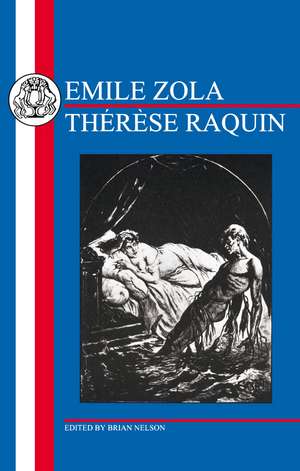
Zola: Thérèse Raquin: French Texts
Autor Emile Zola Brian Nelsonen Limba Engleză Paperback – 1998
pornography on its publication in 1867. "Putrid literature" was how
Louis Ulbach described the novel in a contemporary review. Zola
defended himself against these attacks in his preface to the second
edition, in which he outlined his aim to produce a new, "scientific"
form of realism. The novel marks a crucial step in Zola's development
and is a major early work of Naturalism.
In his introduction to
Thérèse Raquin, Brian Nelson places the novel in its cultural,
intellectual and artistic contexts, and compares Zola's scientific aims
with his actual practice in this work. The scientific status of
Naturalist fiction remains problematic; in the final analysis it is
influenced by literary models and conventions. Zola's powerful
mythopoeic imagination does much to counteract the mechanistic view of
humanity the novel was intended to embody. The myth of the fall is,
indeed, fundamental to Zola's Naturalistic vision.
Din seria French Texts
- 17%
 Preț: 162.48 lei
 - 21%
 Preț: 161.22 lei
 - 22%
 Preț: 121.79 lei
 - 20%
 Preț: 158.15 lei
 - 15%
 Preț: 173.00 lei
 - 17%
 Preț: 162.58 lei
 - 16%
 Preț: 168.36 lei
 - 17%
 Preț: 162.91 lei
 - 17%
 Preț: 163.38 lei
 - 17%
 Preț: 162.02 lei
 - 17%
 Preț: 162.70 lei
 - 20%
 Preț: 163.45 lei
 - 20%
 Preț: 164.01 lei
 - 5%
 Preț: 162.07 lei
 - 17%
 Preț: 163.77 lei
 - 16%
 Preț: 164.74 lei
 - 17%
 Preț: 162.37 lei
 - 22%
 Preț: 160.95 lei
 - 16%
 Preț: 166.21 lei
 - 17%
 Preț: 162.07 lei
 - 16%
 Preț: 165.03 lei
 - 21%
 Preț: 163.34 lei
 - 17%
 Preț: 163.34 lei
 - 17%
 Preț: 162.02 lei
 - 17%
 Preț: 162.70 lei
 - 17%
 Preț: 162.70 lei
 - 17%
 Preț: 163.71 lei
 -
 Preț: 162.70 lei
 - 21%
 Preț: 154.49 lei
Preț: 163.34 lei
Preț vechi: 196.37 lei
-17%
Puncte Express: 245
Carte tipărită la comandă
Livrare economică 28 noiembrie-12 decembrie
Livrare prin curier în România Termenul estimat este afișat lângă disponibilitate.
Transport gratuit de la 400.00 lei Plată online sau ramburs, în funcție de opțiunile comenzii.
Retur gratuit în 14 zile Comandă securizată și suport în română.
Specificații
ISBN-13: 9781853992872
ISBN-10: 1853992879
Pagini: 190
Dimensiuni: 136 x 214 x 14 mm
Greutate: 0.25 kg
Editura: Bloomsbury Publishing
Colecția Bristol Classical Press
Seria French Texts
Locul publicării:London, United Kingdom
ISBN-10: 1853992879
Pagini: 190
Dimensiuni: 136 x 214 x 14 mm
Greutate: 0.25 kg
Editura: Bloomsbury Publishing
Colecția Bristol Classical Press
Seria French Texts
Locul publicării:London, United Kingdom
Recenzii
Novel by Emile Zola, first published serially as Un Mariage d'Amour in 1867 and published in book form with the present title in the same year. Believing that an author must simply establish his characters in their particular environment and then observe and record their actions as if conducting an experiment, Zola nonetheless adopted a highly moral, unscientific tone in this grisly novel, the first to put his "analytical method" into practice. The sensual Therese and her lover Laurent murder her weak husband Camille. After marrying, they are haunted by Camille's ghost, and their passion for each other turns to hatred. They eventually kill themselves. Conservative readers accused Zola of prurience; the novel, however, illustrates the author's belief that sexual pleasure leads only to brutality and destruction.
Notă biografică
Emile Zola (1840-1902) is best known for his series of novels telling the history of the Rougon-Macquart family. 'Nana' (1880) and 'Germinal' (1885) are among the most powerful of the novels.