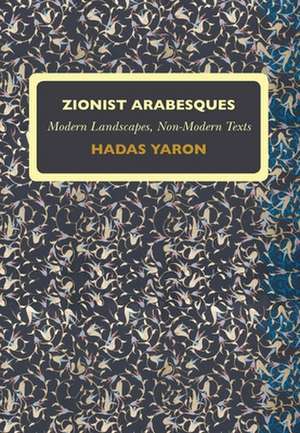
Zionist Arabesques: Modern Landscapes, Non-Modern Texts
Autor Hadas Yaronen Limba Engleză Hardback – aug 2010
Preț: 539.22 lei
Preț vechi: 729.39 lei
-26%
Puncte Express: 809
Carte disponibilă
Livrare economică 02-16 noiembrie
Livrare prin curier în România Termenul estimat este afișat lângă disponibilitate.
Transport gratuit pentru acest produs Plată online sau ramburs, în funcție de opțiunile comenzii.
Retur gratuit în 14 zile Comandă securizată și suport în română.
Specificații
ISBN-13: 9781934843789
ISBN-10: 1934843784
Pagini: 250
Dimensiuni: 156 x 234 x 17 mm
Greutate: 0.48 kg
Ediția:New.
Editura: Academic Studies Press
Colecția Academic Studies Press
Locul publicării:Boston, MA, United States
ISBN-10: 1934843784
Pagini: 250
Dimensiuni: 156 x 234 x 17 mm
Greutate: 0.48 kg
Ediția:New.
Editura: Academic Studies Press
Colecția Academic Studies Press
Locul publicării:Boston, MA, United States
V-ar putea interesa
-
 -18%Preț: 77.10 lei94.29 lei
 -
 BaghdadJustin Marozzi-19%Preț: 98.48 lei121.43 lei
 -
 Becoming Ottomans: Sephardi Jews and Imperial Citizenship in the Modern EraJulia Phillips Cohen-18%Preț: 277.50 lei337.05 lei
 -
 Black FlagsJoby Warrick-18%Preț: 78.03 lei94.69 lei
 -
 The Ottoman EndgameSean McMeekin-18%Preț: 101.28 lei123.57 lei
 -
 Preț: 215.32 lei
 -
 -17%Preț: 108.35 lei131.29 lei
 -
 -26%Preț: 540.20 lei730.87 lei
 -
 -22%Preț: 171.91 lei220.50 lei
 -
 Writing Palestine 1933-1950: Dorothy Kahn Bar-AdonDorothy Kahn Bar-Adon-25%Preț: 504.00 lei672.44 lei
 -
 -19%Preț: 188.23 lei232.41 lei
 -
 -23%Preț: 805.59 lei1046.23 lei
 -
 Eros and Tragedy: Jewish Male Fantasies and the Masculine Revolution of ZionismOfer Nordheimer Nur-26%Preț: 551.14 lei740.90 lei
Cuprins
Introduction: The Field, the Ethnography and the Anthropologist. Chapter One: Conventional and Environmental Agriculture: The Modern, Anti-Modern and Non Modern Landscapes. Chapter Two: From Europe to the Middle East: Blossoming the Desert, Cultivating the Land of Israel. Chapter Three: The State as a Plot: Who Owns the Land, Who Plans the Landscape. Conclusions: Writing the Ethnographic Text: The Power of Words. Notes. Works Cited. Index.
Recenzii
“… a compelling, original and well written piece of scholarship, and also a work of real passion and subtlety. Zionist Arabesques focus(es) on the material, experienced reality of Zionism, its phenomenology in the Israeli/Palestinian landscape. Evil or bad intentions lose meaning and instead we focus on grids and trees, cows, borders, documents, narratives. In this way, the impact of Zionism gains a new meaning: a specific form of interaction of the modern and the non-modern (in the contradictory aspirations and worldviews of Zionist settlers between spatial geometry, markets and romanticism), meeting yet another form of interaction of the modern and non-modern (in the experience of the Palestine/Israeli landscape). As such, Zionist Arabesques should be of interest to a wide audience, including not only anthropologists but also historians, critical theorists and the general public interested in the fates of Zionism – or of modernism.”
"A most subtle and penetrating ethnographic study of transformations in land, nature, and agriculture in Israel in light of the expropriation of Palestinian villages. A crucial, imaginatively researched contribution."
"A most subtle and penetrating ethnographic study of transformations in land, nature, and agriculture in Israel in light of the expropriation of Palestinian villages. A crucial, imaginatively researched contribution."